Porsche 911 Carrera GTS review – why Porsche's T-Hybrid is also one of the best
A new turbo-charged hybrid engine and chassis upgrades have injected personality and huge capability into the 992.2 GTS – it’s one of our favourite modern 911s
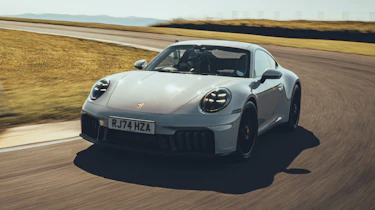
The age of the hybrid Porsche 911 is upon us, and it’s been in the making for some time. The seeds were sown for an electrified 911 when the 992 was originally conceived – capacity to carry a battery was baked into its platform from the outset – but Porsche waited until its Gen 2 update to capitalise on this, first with the 911 GTS T-Hybrid.
It follows the same recipe as the old GTS in being firmer and sharper than a standard Carrera, but its powertrain is radically different, centred around a brand new 534bhp hybrid engine. Ever-stricter emissions regulations meant that electrification was inevitable to keep the 911 alive into the future, but no matter how much cleaner and more powerful the new GTS is, the idea of a 992 with more weight and complexity – and no option of a manual gearbox – sounds like a purist's nightmare.
> How a 48-hour test reveals that our Porsche 911 Carrera GTS is a Diet Coke GT3
The reality is different. Within a few miles of driving the new GTS, you come to the realisation that it’s brilliantly resolved, and one of the cleverest electrified performance cars around. It still has all the nuance and precision a 911 should, and the electric element doesn’t intrude on the purity of the experience at all – rather it amplifies the intensity, and crucially, doesn’t lumber the GTS with too much extra weight. In the GTS T-Hybrid, the 992 has come of age as one of the very best variants there’s been. It might be the ultimate all-rounder of the current lineup, as we’ve discovered across numerous tests on road and track. Now, we’ve put it against the stopwatch around the Anglesey Coastal Circuit.
Engine, gearbox and technical highlights
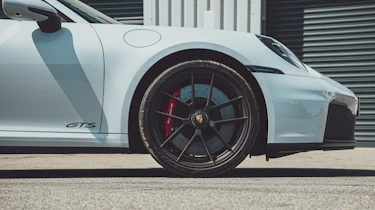
- Brand new 3.6-litre engine with a single electric turbo
- Electric motor integrated into the gearbox boosts power to 534bhp
- Hybrid system means no three-pedal option
More reviews
In-depth reviews
- Porsche 911 Carrera GTS review – why Porsche's T-Hybrid is also one of the best
- Porsche 911 Targa review – the opposite of a purists 911, but still superb
Long term tests
Reviews
- Porsche 911 Turbo (930, 1974 - 1989) review – when Germany took on Italy’s icons
- Porsche 911 Challenge review – this £200k racer might be the most fun 911
- Gunther Werks Turbo review – part Porsche 911 Turbo, part hypercar
- Porsche 911 GT3 S/C review – does a convertible GT3 really make sense?
- Porsche 911 (992.2) GT3 Manthey Kit review – a road-legal race car with a warranty
- Porsche 911 GT3 RS Manthey kit review – the ultimate Nürburgring toy tested to the limit
A huge amount of engineering has gone into achieving this. The GTS gets an all-new engine – up from 3-litres in other Carreras to 3.6 – and uses a new single turbocharger that’s reminiscent of the unit seen hanging from the underbelly of a 935 racer, but is more flexible than the old twin-turbo set-up. And as is the modern way, it also has a battery and an electric motor with the latter incorporated into the eight-speed PDK transmission. What there isn’t is any propulsion under electricity alone. Some might see this as an opportunity missed. After all, even Lamborghini’s new V8 twin-turbocharged hybrid that runs to 10,000rpm will offer a few miles of electric range.
Not the new 911. Its hybrid system is purely about delivering more performance more efficiently, using fewer components and future-proofing the flat-six engine for as many generations to come as possible. Hence that capacity increase (the 3-litre motor is still available in the base Carrera, which now uses the turbos from the outgoing GTS, albeit detuned by 84bhp to 394bhp) and that new turbocharger. The latter is a crucial part of the T‑Hybrid system and employs an integrated electric motor positioned between the compressor and turbine wheel, allowing for the removal of the wastegate and the ability to build up boost pressure immediately, eliminating any noticeable form of lag.
The turbos fitted to the old GTS engine took over three seconds to reach maximum boost; in the 3.6 that time is reduced to 0.8 seconds. At 27kg it weighs the same as the old twin-turbo arrangement, and it also generates 15bhp of electric power to feed back to the 1.9kWh battery that’s positioned in the front of the car, where the traditional battery once lived (this is now re-homed behind the rear seat). On its own the GTS’s new flat-six generates 478bhp and 420lb ft of torque. The e-motor, meanwhile, is capable of 56bhp and 111lb ft. When the two work together, the combined peak figures are 534bhp and 450lb ft.
All in the GTS weighs 1595kg (or 1645kg for the 4 GTS), so it’s not a flyweight, but still usefully lighter and more powerful than its nearest rival – the 1895kg, 469bhp Mercedes-AMG GT55. The T‑Hybrid GTS the quickest-accelerating Carrera ever, reaching 62mph in 3sec in both two- and four-wheel drive forms. Just 2.5sec after a full-throttle standing start – without using launch control – it will have covered 21.5 metres, some seven metres further than its predecessor.
Chassis-wise the changes are measured, with a thorough overhaul and reconfiguration of the adaptive dampers (PASM) and the standard fitment of rear-axle steering. The latter isn’t a simple carry-over part, however. It’s all new for the T-Hybrid with the components adapted to suit the 50kg weight increase over the previous PDK-equipped GTS (the majority of the weight gain being over the rear of the car), the 1mm narrower rear track and the wider, 315/30 x 21 rear tyres that sit on 11.5in-wide wheels. The geometry is carried over from the outgoing GTS, but the spring rates have been adapted to suit.
In terms of the dampers, their Normal and Sport settings have been recalibrated and when paired with Porsche’s Dynamic Chassis Control hardware, Sport mode reduces body roll further still.
Driver’s note
‘It doesn’t feel sanitised as a result of going hybrid. The flat-six fires immediately (it’s started by the hybrid motor) and sounds really rather savage. It’s loud. Fast, too. This is a truly quick car.’ – James Taylor, evo Deputy Editor, who tested the Porsche 911 Carrera GTS T-Hybrid on track
Performance, ride and handling
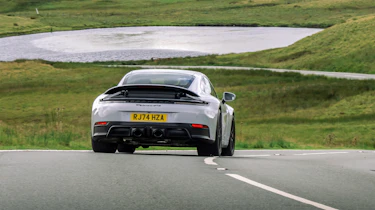
- Ferocious and angry-sounding flat-six
- Hybrid system augments the engine rather than intruding
- Connected, precise and biddable handling
At a steady cruise in eighth gear the motor is calm but gives the impression of a big capacity, torque rich engine, but find a decent road, drop down the ratios and the GTS really begins to flex. Short bursts of acceleration deliver the kind of instant responses expected from a healthy-lunged naturally aspirated engine. Your throttle inputs start an immediate chain reaction of increased revs and forward propulsion. There’s no gradual build-up as the boost increases and the turbo spools, the powertrain is simply primed and ready – even in Normal mode. And there’s no awkward lag between an initial hit of e-motor response and the engine waking up – the powertrain operates as a cohesive whole.
Switching to Sport Plus injects this second-generation 992 with a pure hit of adrenaline. There’s a sweetness and crispness to how it revs as the engine changes character as it climbs through its power band, eradicating the somewhat monotone delivery of its 3-litre predecessor. It’s an encapsulating tone, the crescendo building with a vigour and infectious nature that’s been missing since the Carrera models gained their turbos. At idle it chunters and grumbles like an older flat-six, too, and though the way the engine cuts in and out in low speed traffic can deliver an awkward shunt through the drivetrain, this almost adds to the mechanical feel, Nissan GT-R-style.
Porsche claims the GTS T‑Hybrid has the pace and performance of the 991-generation GT3, and while some might scoff, owners of said GT3 perhaps, the rate of engine development means it’s hard not to agree with those who work at Weissach. In auto mode the drop in ratios when you pin the throttle isn’t as quick as a GT car’s PDK, but the speed with which the GTS builds momentum is hard to ignore. The algorithm that monitors the engine speed and selects the gear ratio feels well set, with upshifts coming as the engine reaches peak speed, dropping it back into its meaty mid-range ready to go again. Which it relishes doing, time and again, mile after mile.
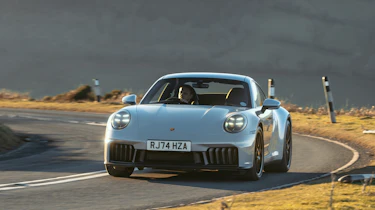
Select manual for the shifts and the new GTS comes to you even more, the immediacy upped further still, the engagement levels further heightened. That rapid boost-pressure build provides such an improvement in throttle adjustability that the 992.2 starts to feel more than a facelifted model. You feel more in tune and connected with the car, a more integral component in the processes being played out. It’s not that the 992.1 felt aloof and distant – the previous manual GTS was a supremely capable, involving sports car – but this new model takes those intangible elements that often left us cold and adds context and detail that was missing before.
The GTS always feels connected, but you need to work it hard to stress the chassis and reap the biggest rewards. When you do, the motor is once again an intrinsic part of everything this 911 does. On tighter routes its eager responses allow you to balance the car just-so through and out of a corner, meaning you can lean on the chassis harder and ask more from it, and all the time the GTS becomes more alive beneath you. In tight uphill turns you can balance the car on the throttle with greater precision, with a much cleaner exit as you roll off the lock and dial in the throttle. Wind the stability systems back and you can apply as much or as little corrective lock as desired, the car far more comfortable being adjusted on the throttle and riding out any slide, as there’s no longer a rush of boost to unsettle the process.
The four-wheel drive Carrera 4 GTS still has a wide window of adjustability, and is something of a revelation on track. Compared to an AMG GT, it offers more feedback, gives you more confidence and moulds to your driving in a way that can almost feel uncanny. Be neat and precise and it has huge traction and precision to draw from, but with more aggression the four-wheel drive system feels heavily rear-biased with a sense of easy, natural throttle adjustability. It readily rotates under power but feels stable and assured, finding strong forward drive as it straightens up through the exit. The fact it offers this kind of bandwidth without an array of BMW M4-style four-wheel drive modes makes it even more impressive.
On the road, the GTS’s ride is firm and it picks up surface imperfections – more so than a base Carrera, and even in the softest damper mode – but the platform's fundamental qualities still shine through, and you can carry immense speed. The chassis settles very quickly and follows your steering inputs with real accuracy, although this does mean that there’s less opportunity to enjoy the sensation of it gradually loading up into a corner.
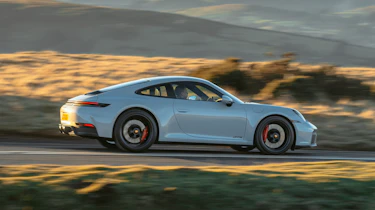
Rear-axle steering is a key contributing factor to the GTS’s agility on the road. Through tighter hairpins the nose turns in quicker, with the rear reacting accordingly to position its mass where required. As with the previous generation it’s a piece of hardware that enlivens the 911. Coupled to the more responsive and explosive engine it makes for an intoxicating package.
A manual gearbox would be the icing on the cake, but the GTS’s hybrid hardware means it’s not possible to fit one, denying some of the interaction of the previous three-pedal GTS. The latest Carrera and Carrera S are also PDK only, making the Carrera T the only manual 992.2 you can buy this side of a GT3.
The PDK in the GTS offers snappily quick upshifts, but the downshifts aren't as quick. As you’re perhaps expecting, you have to pre-empt your requirements and get the command in sooner. Ultimately, it lacks the instantaneous crispness of a GT model’s PDK, but it’s certainly not a deal breaker.
The rest of the package remains on point. The brakes, for example, which are the optional carbon-ceramics on our car, continue to improve with each iteration and almost have a feel of cast-iron stoppers, so impressive is the modulation and feedback during hard stops. Under soft applications the pedal feels a little too light in its initial travel which may be a side effect of the GTS’s regenerative braking.
Driver’s note
‘As with the old, pre-hybrid 992 GTS, the Porsche’s strength is its communication. You’re very much in touch with what’s going on: hit a wet patch and feel the front slip a little, come off the throttle and feel the tail begin to rotate. It always keeps you in the loop – and feels more natural than an AMG GT.’ – James Taylor, evo Deputy Editor, who tested the Porsche 911 Carrera GTS T-Hybrid on track
On track
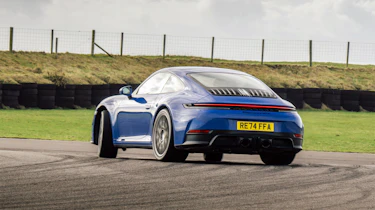
- Communicative and adjustable, without the need for a dizzying array of drive modes
- Four-wheel drive system seamlessly adapts to your driving
- More approachable than an AMG GT
Around Anglesey circuit the Carrera 4 GTS is formidably quick (as you'd expect), but the driving experience is absorbing and uncorrupted – despite its hybrid and four-wheel drive hardware.
We’ve also put the £139,400 2WD model to the test against the stopwatch. The car included options like deleted rear seats to save weight and was driven to the circuit and back again on the same Goodyear Eagle F1s it set its lap times on (albeit with adjusted pressures for the hot weather).
On track, this is a searingly rapid car, ripping through its twin-clutched ratios with seemingly no let-up in acceleration. Boost-build and torque delivery are near instantaneous, which lends shock and awe to the GTS’s acceleration but makes it hard to tame wheelspin. I’m torn between leaving the traction control in partway-off PSM Sport and fully disabling it. Experience from lapping other cars at Anglesey suggests the latter is ultimately quicker, so off it goes.
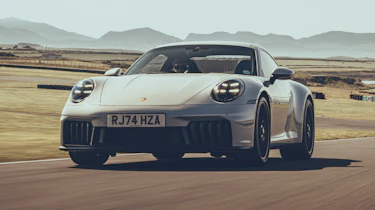
Happily, the GTS communicates just as clearly as other 911s and gives you plenty of confidence, even when the rear axle makes a bid to take the lead from the front.
It’s a very easy car to control in a slide. If rear grip and traction are limited on this baking-hot day, front-end grip is a different matter. It’s remarkable how positively this generation of 911 turns in, even without the GT3’s double-wishbone front axle.
The GTS records a best of 1:15.3, 1.9 seconds behind the 991.2 GT3 with PDK transmission we timed in 2017. Bearing in mind the sun-baked circuit’s lack of traction, and given that hot air would have curbed power a little, Porsche’s performance parity claims with the 991 GT3 have real credibility. And of all the cars we’ve timed at the Anglesey this year, the GTS was the most adept at covering the hundreds of miles there and back.
Anglesey Coastal Circuit – Porsche 911 times
| Car | Time |
|---|---|
| 992.1 GT3 RS | 1:12.0 |
| 992.1 GT3 (PDK) | 1:12.8 |
| 991.2 GT3 (PDK) | 1:13.4 |
| 991.1 GT3 RS | 1:13.6 |
| 991.1 Turbo S | 1:13.6 |
| 992.2 GTS | 1:15.3 |
Design, interior and tech
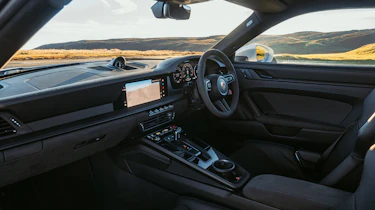
- New active aero elements and bumpers to distinguish from lesser Carreras
- Grippy Race-Tex interior trim
- Rear seats are a no-cost option
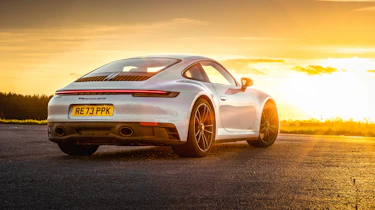
Visually the GTS makeover is less extensive than the powertrain’s workover. At the front there’s a new front bumper with active aero elements in its lower section to aid cooling (the black ‘gills’ increase airflow through the car by 25 per cent) and new LED headlights that now incorporate the indicators, and when the GTS fills your mirrors the sharp creases in the bonnet give it a pseudo GT-car appearance. At the rear there’s a new full-width light bar that fully illuminates, while the GTS is all about its centre-exit sports exhaust. As an overall design the 992 still looks like a big car on the road, although it feels less so from behind its steering wheel and the new TFT digital dash and central screen.
You can settle yourself touring-car low in the driver’s seat, the tops of those front wings visible through the screen, and where both the 991 and 992 have previously felt a bit too clinical and functional, there’s something about this latest car that generates a sense of being in something special again. Granted, an Alcantara steering wheel always helps with a sports car interior and the adaptive sports seats trimmed in Porsche’s simple Race-Tex material and with leather side bolsters provide good support and a functional finish. Although given the forces this car can generate, those with a habit of taking their Carrera on track will want the benefit of the more extreme bucket seats (£4622).
Living with it
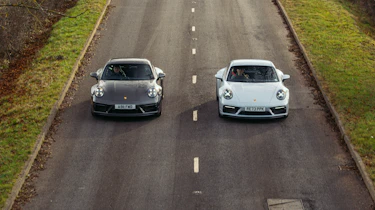
The lighter, Ice Grey car pictured here is evo’s long-term 911 Carrera GTS: rear-wheel drive, manual gearbox, optional lightweight pack (carbon-shell bucket seats, no rear seats, reduced sound deadening, rear-wheel steering). The darker Agate Grey car is a 911 Carrera 4 GTS: all-wheel drive, dual-clutch PDK transmission (though you can spec it with a manual ’box), four-way electric-adjust seats.
Aside from the extra driven axle, these two are specced quite differently. This C4 is in relatively luxurious guise: electric sunroof, demure interior trim and a slightly higher ride height, compared to ‘our’ cafe-racer GTS with its buckets and carpet trim over the space the +2 pews would normally occupy. Just how much difference does all that make? A back-to-back test over 48 hours is revealing. And surprising.
Settling into the C4’s cabin, there’s more leather, more soft-touch surfaces. That plusher feeling is reflected in the way it drives, too. Ride quality is much smoother and comfier than our uncompromisingly firm long-termer. The Fast Fleet C2 has the PASM Sport suspension that’s fitted as standard to GTS models and drops the ride height by 10mm versus standard. This particular C4 is fitted with the regular PASM set-up instead, which is a no-cost option. With exactly the same wheels, tyres and brakes, meaning unsprung mass is presumably the same, extra pair of driveshafts up front notwithstanding, this C4’s ride quality is far more pliant.
I wonder if that’s also a function of the standard, more plumply cushioned seats, too, transmitting less of the road surface directly to my body than the carbon shells in our car do.
Another difference is that our car features rear-wheel steering, which is relatively subtle in its operation but nonetheless has a minor role to play in the suspension’s action as well as the car’s agility at low speeds and stability at high speeds. This C4 doesn’t have rear-steer but does have Power Steering Plus, which reduces the steering’s weight at low speeds and adds heft at higher speeds. In general, the C4’s steering is a little weightier than our C2’s, smoother and oilier in its motion where our car is lighter, dartier in feel. Maybe it’s the effect of the driven front wheels in the C4, too.
The eight-speed PDK transmission’s shorter ratios in the C4 contribute to pulverising acceleration. All the more if you press the little button in the centre of the drive mode switch, which sets engine and transmission to a give-it-everything map for 20 seconds. Handy for overtaking or a quick shot of shock-and-awe. This really is a very fast car. With AWD and PDK, the C4 can get to 62mph in 3.3 seconds to our C2’s 4.1; not that I’ve ever wished our car felt faster. The longer ratios in the seven-speed manual gearbox accentuate just how mighty the 473bhp GTS engine feels at its top end, if you let it rev all the way out in one gear. Which you can also do in manual mode in a PDK car, of course, but you somehow feel all the more connected to the drivetrain if you’re selecting its gear via a lever you move yourself.
The C4 doesn’t pivot into oversteer in quite the same way as our 2WD car, which gives you the option of being neat and tidy or allowing the car to move around a little more mid-corner and on exit. Equally, however, the C4’s variable front-to-rear torque split has a rear-biased feeling much of the time, and its balance is far from inert. In the conditions of this test – newly salted roads with zero degrees showing on the temperature gauge – its surefootedness means you cover ground quickly and easily with a lower mental workload than in our C2, which requires you to work a bit harder.
The C4 features an electronically controlled rear differential rather than the mechanical limited-slip diff in the C2 GTS, which perhaps contributes partly to the extra degree of communication our long-termer possesses at the limit, but the C4 is still a nimble, agile machine.
When you simply want to get somewhere, in any weather, on any set of roads, the C4 is a multi-tool for the job. In long-distance comfort, it’s a vast step up from our long-termer. (It still chucks out a fair bit of tyre noise – a trait of most current 911s – but far less than our C2.)
Aside from demonstrating the 992-generation 911’s bandwidth, these two ostensibly near-identical cars show just what a difference spec can make to the character of a model. (Incidentally, the 2WD Carrera GTS starts at £122k, the C4 GTS at £128k. These optioned-up test cars weigh in at £139,333 and £123,024 respectively.) Our long-termer feels raw and involving, a bit like a Diet Coke GT3, the C4 a plush, all-weather missile with the manners of a grand tourer.
The first time I drove a Porsche 992 it was a 2WD Carrera S, and although it was a seriously impressive car, I came away slightly disappointed. To me it felt more remote than the previous 991 Carrera S; more like a luxury coupe than an involving sports car. The dark grey car tested here reminds me very much of that first 992 experience – brilliant, but not a car I fell in love with. There’s something in the alchemy of this C2 GTS’s spec that makes it the most involving 992 I’ve driven short of a GT3. Both these cars are superb but I’d take our Fast Fleet Carrera just the way it is. – James Taylor, evo issue 322
Price and rivals
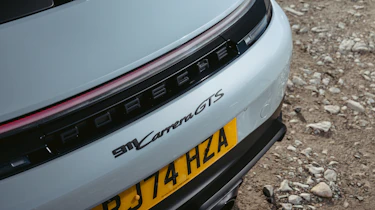
At £139,400 the Carrera GTS T-Hybrid has crept into the big money purchase sector, and into BMW M4 CS territory. The M4 is less connected and can be more wayward, especially on Cup 2 tyres in the wet, but it’s bruising character is a thrill of its own – and it’s more useable than the 911.
A more direct comparison is Mercedes-AMG’s GT55, which starts from £142,200 and has a similar form factor – but with a non-hybrid twin-turbo V8. It’s a less immersive car to drive than the Porsche and not on the same level in performance terms, but as an everyday sports coupe the latest GT is compelling and more rounded than ever.
If you have more to spend, the £165,000 Aston Martin’s Vantage is a big step up from the Porsche in terms of price and performance, and far more bespoke in terms of its design and cabin. Hugely exciting too, wieldy and endlessly adjustable but probably lacking the all-weather pace of a 4 GTS.
Perhaps the new GTS’s biggest challenge, as is often the case with 911s, comes from within Porsche’s own staple, with plenty of used, low mileage 992 911 Turbos available for similar or less money than new hybrid model. The latest manual Carrera T also makes a compelling case as the most raw, interactive 911 this side of a GT3, for over £20k less than the GTS.