Porsche 911 Challenge review – this £200k racer might be the most fun 911
The 911 Challenge replaces the Cayman GT4 Clubsport as Porsche’s entry-level racer. It’s not as fast as a Cup car, but even more fun to drive

The Porsche 911 GT3 is often described as a race car for the road. In some ways it’s an apt description, because there’s genuine motorsport DNA in the way it responds, sounds and how focused it feels. But it isn’t actually a race car. It has road car amenities, treaded tyres, a fully kitted interior and suspension designed to cope with potholes and speed bumps.
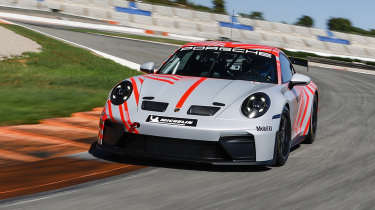
Step forward the 911 Challenge, which is what happens when you strip a GT3 back to its bare essentials and fully optimise it for the track, with no regard for road use. It’s Porsche’s new entry-level race car to replace the Cayman GT4 Clubsport (given the Cayman is no longer in production), and it’ll race in the one-make Porsche Carwow Sprint Challenge, a support series for the BTCC. The price? £171,052, plus VAT.

911-based race cars already exist, of course, such as the Cup, GT3 R and recently launched GT4 R, but the Challenge stays closest to its road car roots to be as affordable to buy and run as possible. Where a Cup car has wider bodywork, extensive aero and a thoroughly reworked race-spec cabin, the Challenge looks pretty much identical to a standard GT3. The only notable changes are a tweaked (and adjustable) rear wing, go-faster stickers and 18-inch wheels wearing Michelin slicks. Behind those you’ll spot a Brembo braking system derived from the GT4 R.
More reviews
In-depth reviews
- Porsche 911 Carrera GTS review – why Porsche's T-Hybrid is also one of the best
- Porsche 911 Targa review – the opposite of a purists 911, but still superb
Long term tests
Reviews
- Gunther Werks Turbo review – part Porsche 911 Turbo, part hypercar
- Porsche 911 Turbo (1974 - 1989) review – why the 930 was the original 911 wild child
- Porsche 911 GT3 S/C review – does a convertible GT3 really make sense?
- Porsche 911 (992.2) GT3 Manthey Kit review – a road-legal race car with a warranty
- Porsche 911 GT3 RS Manthey kit review – the ultimate Nürburgring toy tested to the limit
Most of the interior is familiar too, the dashboard, dial pack and steering wheel borrowed from the road car (the latter using the four rotary controllers you’ll find in the GT3 RS, and a flattened centre boss with no airbag). Beyond that it’s full race spec, with a full roll cage, safety nets and a Sabelt bucket seat. There’s nowhere for a passenger to sit, and all unnecessary trim and sound deadening has been stripped out in pursuit of lightness, exposing the bare bodyshell.
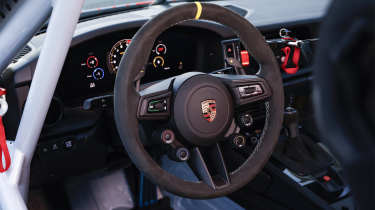
Fold yourself through the cage and you drop down very low in the seat, the dashboard nearly up to eye-level. It’s a little intimidating but if you’ve driven a 911 road car, you’ll feel at home. All the major controls are the same, even down to the starter button to the left of the wheel. Fire it up and there’s a familiar GT3 chunter, but with extra volume and intensity. The engine is borrowed from the road car, a 4-litre naturally-aspirated flat-six with 508bhp (up from 503bhp) and 347lb ft (up from 332lb ft), and a modified rear silencer and lack of an exhaust particulate filter gives it a grittier voice. The noise resonates through the chassis more strongly, sending pulses and vibrations through the seat.
Pulling away in a race car normally requires careful balancing of a sharp throttle and grabby racing clutch, but the 911 Challenge uses the same seven-speed PDK transmission as the road car, so it’s just a case of slotting the shift lever into drive and pulling away (the automatic mode remains too, should you want to make things even easier). Sitting against the pit limiter at Circuit Ricardo Tormo in Valencia the Challenge buzzes with the energy of a proper racer. Release the limiter using the button on the right hand spoke of the wheel and it comes to life, sweeping through the first two gears as I filter into the long left hander of turn one.
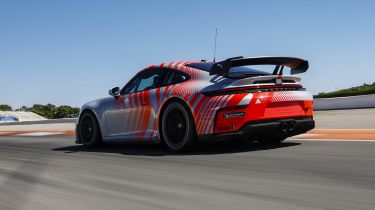
What’s immediately reassuring is that the Challenge is more feelsome than any other GT racer I’ve driven, which tend to have light steering efforts to allow quick inputs and corrections. It takes just a single corner to feel at home, the steering loading up beautifully and communicating more clearly than a road-going GT3 as you lean into the grip of the Michelin slicks.
Adding to your confidence is the fact that the Challenge retains the road car’s safety electronics, with stability control, ABS and traction control. Their calibrations have been adapted to suit the slick tyres and the suspension, which borrows components from the 911 Cup, with the TC and ABS adjustable through eight positions using dials on the steering wheel. As in a GT3 RS you can also tweak settings for the PTV+ (Porsche Torque Vectoring) differential under power and coast.
Even with a helmet on, the first run to the redline is a pure delight, the hardened soundtrack bouncing around the bare cabin and vibrations tickling your back as you approach the 9000rpm cut-off. It’s quick but not eye-wideningly rapid in a straight line, despite the extra power over a GT3 and the fact the Challenge is 29kg lighter at 1450kg, but the sounds and sensations are addictive. This characterises the Challenge as a whole. It may be a race car but it doesn’t chase performance and lap times at the expense of involvement. Above all it’s simply huge fun to drive.
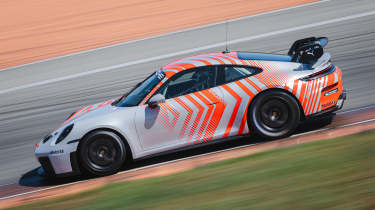
You need to really hustle the Challenge to get performance from it, much like an old 911, which comes as a surprise given it’s a slick-shod racer. It feels alive and minutely adjustable all the way through a corner, and it’s not unyieldingly stiff in its setup so you can use weight transfer to easily manipulate the car. That often means using the rearward weight balance to rotate the car on the brakes, stabilising the rear with a slight bit of throttle mid corner, then controlling a gentle slide all the way to the exit. It’s more playful yet grippier and far better controlled than a road-going GT3, and more expressive than you’d expect of a race car.
Braking performance is superb, with a solid pedal that allows you to modulate around the ABS, although there isn’t the otherworldly stability and stopping power of a high downforce car. Neither is there the unbreakable high speed grip – it’s not a car that feels totally nailed to the tarmac, testing your commitment to carry more speed. Instead the Challenge is mobile and active, keeping you busy with subtle corrections but offering plenty of forewarning of when grip falls away.
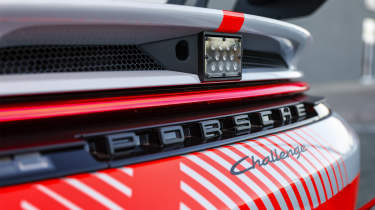
It’s a totally addictive blend of race car precision and classic 911 dynamics, and the fact there aren't stacks of power and torque means you’re constantly at maximum attack, high up in the revs, chasing the throttle, wringing its neck. The road car powertrain largely works a treat, but the PDK gearbox is missing the instantaneous snap of a proper pneumatic racing gearbox. The shifts are rapid and smooth by any measure but slightly soft edged in the context of a race car.
By and large, the Challenge is an utter joy when stringing laps together – probably the most richly rewarding race car I’ve driven. It’s fast and capable, yes, but also easy to read, playful and fantastically engaging. After a session it leaves you recapping every braking point, turn-in and apex, itching to get back out to hone your technique and enjoy the strangely analogue thrill it delivers over and over again. It’s a pretty powerful way of catching the racing bug.