Best track day cars 2026 – our favourite circuit thrillers from Caterham to Valkyrie
Some of the world's most visceral, engaging track cars have emerged in recent times – these are our favourites

If you think track cars need to be intimidating and uncompromising, you’d be wrong. At least, you’d be wrong about the very best track cars, which are more nuanced than that. The best examples welcome their drivers, offering astonishing performance for those with experience, and a clear path for progression and development for those with plenty to learn. They also need to be accommodating enough that you don’t want to get out after two laps because you’re sweating, your back’s in tatters and your body aches…
Track day stalwarts from Caterham and Ariel make the cut, but also extreme, single-minded supercars from the likes of Porsche and Aston Martin. So in no particular order, here are the best track day cars you can buy now that’ll make every turn-in, apex and straight a pleasure.
Best track day cars 2026
- Alpine A110 R Ultime
- Praga Bohema
- Dallara EXP
- Caterham Seven
- Ariel Atom 4RR
- McLaren Artura Trophy Evo
- Manthey Racing Porsche 911 GT3 RS
- Honda Civic Type R
- Radical SR3 XXR
- Ford Mustang GTD
- Spartan
- Revolution 500 Evo
- Aston Martin Valkyrie
Alpine A110 R Ultime
- Pros – The ultimate A110
- Cons – Eyewatering price
- evo rating: 5 stars
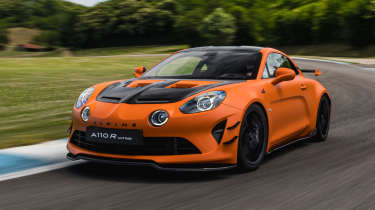
With its broad scope of chassis adjustability, the Alpine A110 R can be tuned to be a delightful road car or a focused track car. Life 110’s upgrade package took it further still… then Alpine itself, seemingly in a fit of emotional lunacy, conceived the ultra limited, ultra extreme A110 R Ultime as a goodbye to its beloved sports car.
The significantly revised aero adds 160kg of downforce by comparison to the A110 R but it’s what’s going on underneath that defies belief. The Ultime sports effectively a new transmission, still a dual-clutch but with six forward gears instead of seven, omission of the last gear allowing the other six to be beefed up. This is in order to transmit the Ultime’s increased power (up to 340bhp on 103 octane fuel) to the rear wheels. It also gets a 10mm wider track, Michelin Cup 2 tyres, AP Racing brakes and 20-way adjustable Ohlins dampers. The result is an A110 at its extreme best.
‘An R will let you back off and still have a good time, whereas the Ultime never relaxes and always seems to be asking for more commitment. It is unashamedly extreme, and we could understand if plenty of people drove both the R (or even the standard A110) and the Ultime and preferred the former. However, it is also absolutely wonderful that it exists.’ – Henry Catchpole, evo contributor.
Praga Bohema
- Pros – A cut-price Aston Martin Valkyrie
- Cons – That price is still seven figures…
- evo rating: 4.5 stars
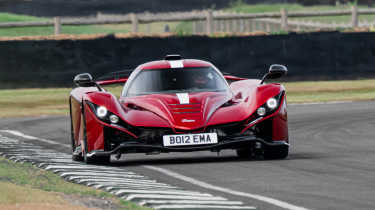
If you know Praga, you’re probably imagining what is effectively a race car, not unlike a Radical or a Revolution. The Czech company’s latest work however has been closer to the rarified road-going hypercar space, albeit with a retained focus on track performance. This almost insectoid device is the £1.5million Praga Bohema, with disparate sheets of windtunnel-honed carbonfibre coachwork clothing a carbonfibre monocoque chassis and in the middle, a development of the 3.8-litre twin-turbo V6 you might be familiar with from Nissan’s GT-R, upgraded by Litchfield to 700bhp.
With cars of this nature there’s always a chance that the extraordinary collection of parts won’t make a cohesive whole. Not so here. The Bohema is an approachable, balanced track car. Its limits are enormously high but once you’re dancing around them, it doesn’t bite your head off. It’s extraordinarily fast, of course, but once you have your eye in, the intimidation factor dissipates. Some hypercars, bizarrely, are better suited to the temperature-controlled lockups their owners stow them away in, to accrue value like a blue-chip stock, than track work. Not so the Bohema.
‘The most similar machine in character I’ve driven on track is an LMP3 car: there’s the same sense of glued-down stability, and an endless well of engine muscle to draw from. Goodwood is a fast enough place to feel the aero surfaces painting the Bohema into the road. This both gives you confidence and a sense of trepidation in approaching the Bohema’s handling limits, given that they’re so high. But when you do, its balance is approachable. It’s safe, stable; unruffled, even. But still engaging and rewarding.’ – James Taylor, evo Deputy Editor
Dallara EXP

- Pros – Enormous track performance that's predictable and usable
- Cons – £80k price hike over the Stradale
- evo rating: 5 stars
Hugely important in a track car is trusting what you’re buying. This is a car you’re going to be travelling in at high speed and placing a lot of faith in its componentry to perform as advertised, hold together and let you enjoy a circuit safely. Big names matter in this arena, which is why this car is off to a great start before you’ve even seen it: Dallara. The company has produced single-seater racing car chassis, and supplies platforms for Cadillac, BMW and McLaren in the Hypercar class at Le Mans.
The Dallara EXP is the roofless track-prepared development of the Stradale, its first home-grown car in its multi-decade history. The EXP weighs just 890kg, can produce up to 1240kg of downforce at 180mph and as a result of both of these stats, doesn’t need ceramic brakes to be able to stop on a penny, even with the speeds it can get to with nearly 500bhp. The balance is forgiving, with controllable flurries of over and understeer if provoked.
‘The EXP has the character of a race car – the stability, the ability to mash the brakes like a leg-press – but it’s a car built for enjoyment rather than to be a tool for a job. Its limits are high, and it takes confidence and commitment to approach them, but it’s predictable and on your side when you do. It wants to support you; it wants you to have a good time.’ – James Taylor, evo Deputy Editor.
Caterham Seven
- Pros – Ultimate, no-compromises driver focus
- Cons – Not the last word in usability…
- evo rating: 5 stars
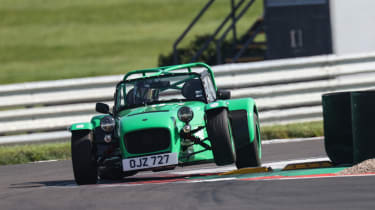
With every distraction and every ounce of fat carved away, the Caterham Seven distils driving into its core components. The formula has remained fundamentally the same since the Caterham's spiritual predecessor – the Lotus Seven – arrived in the late ’50s, but gradual evolution has seen the Seven become a physical, raw and formidable track car.
With a range that spans from the dainty, vintage-style Super Seven series and all the way to the crazed, supercharged 620R, speccing the ultimate Seven is somewhat of a minefield, but fear not – evo has done all the work for you. To coincide with the magazine's 25th anniversary and Caterham's 50th, we partnered with the British car maker to produce the Seven evo25 Edition; a unique spec of Caterham that combines our favourite elements from existing models. With a 210bhp Ford Duratec motor, adjustable 420 Cup-derived Bilstein dampers and a selection of track-oriented options, the evo25 is glorious to drive on track but at home on the road too – covering distance in the snug, cosy cockpit with the dampers softened off is no hardship (provided you’re wearing earplugs). Unsurprisingly, neither is belting around your favourite circuit.
‘The way the Caterham smears its way through fast corners is hugely satisfying, largely because of the raw speed, but also because of the confidence it gives you and how it communicates its limits. There’s tons of grip, but it’s always malleable, so you can l-e-a-n into the increasing lateral load until the front, rear or, as is more likely, both ends slowly relinquish their hold.’ – Richard Meaden, evo co-founder and Editor-at-Large.
Ariel Atom 4RR
- Pros – Extraordinary performance and involvement
- Cons – Extraordinary price
- evo rating: 5 stars
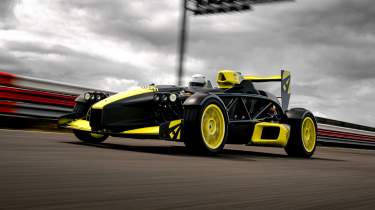
The Ariel Atom represents the pinnacle of track day thrills. At the top of the range is the wild, all-encompassing Atom 4RR – it's hard to think of another car that's so exquisitely technical yet primal and raw in character. Its Civic Type R-derived turbocharged engine kicks out 525bhp and it weighs less than 700kg, making it rabidly quick (62mph comes up in just 2.4sec), but that’s only part of the story. Compared to the already extreme Atom 4R there’s reworked suspension and brakes, aerodynamics and a stronger bronze-welded chassis, to name but a few changes.
The result is an overwhelming combination of speed, grip and intensity, with some approachability dialled in. Variable traction control, ABS and a superbly balanced chassis mean you have confidence to exploit the 4RR’s performance without feeling like you’re just hanging on for the ride.
‘Nosing out onto the track, everything feels good. Really good. It’s a rare sensation, but in a few cars, almost from the moment the wheels start rolling, you can sense their settled, confident nature, and this Atom is one of them. Its steering is weighty but direct and precise, and even though this is a smooth racetrack, I already have the feeling that the damping is going to be just-so.’ – John Barker, evo co-founder and Editor-at-Large.
McLaren Artura Trophy Evo
- Pros – The full race car experience made accessible
- Cons – Full race car means you’ll need a tow rig
- evo rating: 5 stars
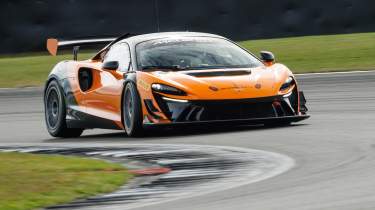
You probably won’t climb out of a McLaren Artura wishing it had more performance, but with the track-only Trophy Evo version, McLaren has ramped up the capability of its ‘baby’ mid-engined supercar to a stunning degree. With a dry-sumped 3-litre twin turbo V6, no hybrid system, a full aero package and slick tyres, it’s massively exciting yet accessible to drive – and a gateway into McLaren’s Trophy race series.
> McLaren Artura Trophy Evo review
With 612bhp at your disposal the Evo feels massively quick, but it’s the cornering performance that leaves the biggest impression. Make the most of its high-speed grip and neutral handling and it’ll lap close to GT3 pace. If you’re a (very) wealthy racing fan, there aren’t many better ways to spend a quarter of a million pounds.
‘It’s a truly entertaining, fulfilling car to drive and – given its remit is for customers to enjoy themselves, as well as potentially progressing further up the GT racing ladder – it nails the dynamic side of its brief comprehensively.’ – James Taylor, evo Deputy Editor.
Porsche 911 GT3 RS Manthey Racing
- Pros – The ultimate track-focused 911
- Cons – A big cost (£100,000) for an upgrade kit
- evo rating: 5 stars
The Porsche 911 GT3 RS is all the track car most could ever need. This entry is as much an endorsement of the eCoty 2023 winner as it is a mention that, if you want the ultimate road-legal track car, the Manthey Racing GT3 RS takes it a step further still.
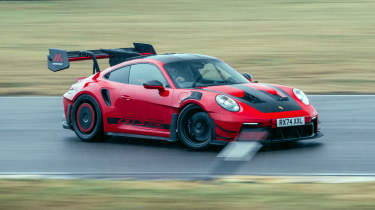
If the standard GT3 RS feels like a 911 Cup car with number plates, the Manthey Racing GT3 RS is something altogether more extreme. Worth noting, it manages an increase to 1000kg of downforce without adding any drag. The aero balance is slightly further forward, which improves the balance at speed – perfect for track work. While the 518bhp 4-litre flat-six is unchanged, the suspension has been comprehensively reworked for more precise control, and to cope with the downforce.
Spring rates are up by 30 and 15 per cent at the front and rear, respectively. Crucially, however, the Manthey RS is still configurable in terms of its damping and diff settings. A custom semi-active damper setup has been developed for the car, which can make adjustments in real time, with the system using chassis acceleration, steering angle, braking pressure, throttle position, gear selection and vehicle speed data.
Complex, comprehensive – it certainly explains the extensive testing on the Nürburgring prior to the car’s reveal. But the result is a car that’s usefully more capable on track – possibly the ultimate road-legal track car – without compromising its road ability too much. Pricing is sturdy, with the conversion alone costing £99,999.
‘It might look (and go!) even more like a racing car, but it doesn’t sacrifice any more practicality or usability compared with the base car. If you can accept the sharper ride, don’t blanch at the Marvel looks, and buy-in wholeheartedly to Manthey’s approach and status, this RS is a truly extraordinary car. One capable of things no road-legal 911 has ever done before.’ – Richard Meaden, evo co-founder and Editor-at-Large
Honda Civic Type R

- Pros – Astonishing capability, engagement and quality
- Cons – Could sound better
- evo rating: 5 stars
The FL5 Honda Civic Type R is an example of a manufacturer listening to feedback and delivering in brilliant fashion. We loved the previous FK8-generation car, its communicative, tenacious chassis and engaging powertrain, but there were two snags in the otherwise world-beating formula: its divisive styling and the restrictive drive mode presets that left the Type R with untapped potential. The FL5 model rectified both of these and brought a host of engineering enhancements in one hit, resulting in the best hot hatch of the modern era.
In an age of DCT-equipped four-wheel drive mega hatches, the Type R feels almost touring car-like in the surgical, sometimes frantic way it delivers performance. The Honda's communicative controls and instinctive manual gearshift draw you into exploiting all of its potential on track, where even full-blooded sports cars would have a very hard time clinging to its rear wing. Sadly the FL5 went off sale this year, but if you can pick up a nearly new example, you’ll own a superb, usable performance car that feels at home pretty much anywhere.
‘The FL5 is astonishingly good. We'd go so far as to say that it sits right up in the pantheon of all-time hot hatchback greats, with an unmatched level of polish and poise.’ – Richard Meaden, evo co-founder and Editor-at-Large.
Radical SR3 XXR
- Pros – Impossibly friendly to drive for such an extreme car
- Cons – Not as configurable as more sophisticated machinery
- evo rating: 4.5 stars
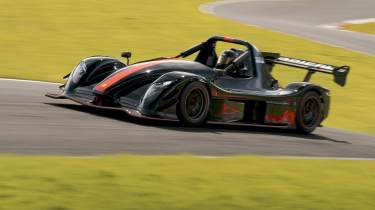
The Radical SR3 has been around since 2002, but don't let that fool you. In XXR form it's a cutting-edge downforce demon that scrambles your mind with its sheer precision, intensity and cornering ability. You sit reclined in the chassis, LMP-style, with the centre of gravity skimming the ground and a 1500cc RPE racing engine revving to the stratosphere. Despite weighing just 699kg (full of fuel) and putting out 232bhp, it's not the straight line speed that gets you – rather the enormous cornering and braking potential the SR3 manages to generate.
> Radical SR3 XXR v Revolution 500 Evo
In the dry you can lean hard on the Hankook slick tyres, braking impossibly deep and carrying massive speed through every apex. There's real finesse to the driving experience too, and it's possible to place the Radical with pinpoint accuracy and trim your lines to what feels like the nearest millimetre. It's one of the most intensely pure track driving experiences out there.
‘You live in the stratosphere in the SR3: up in the rarefied air of high revs and higher corner speeds. The precision you can operate it with, the sheer stability and confidence it gives you, is quite something.’ – James Taylor, evo Deputy Editor.
Ford Mustang GTD
- Pros – Wild and indulgent, a Mustang like no other
- Cons – Dull interior
- evo rating: 5 stars
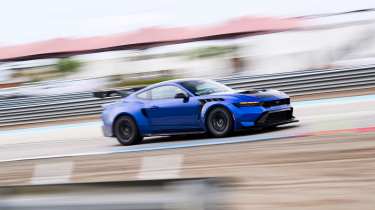
A Ford Mustang to take on Porsche’s 911 GT3 RS. Surely it can’t be done? On the contrary, the GTD proves that with extensive re-engineering courtesy of Multimatic, a Mustang can be a superbly capable and highly entertaining track car capable of mixing it with Europe’s very best. The small matter of 815bhp from a supercharged 5.2-litre V8 helps this, of course…
It takes one look at the GTD to know that it’s every bit as serious as a GT3 RS, and as close as you’ll get to a Mustang GT3 car with number plates. Swollen bodywork with wider tracks, an extensive aero package and enormous Michelin Pilot Sport Cup 2R tyres are the most obvious changes, and under the skin there’s bespoke chassis hardware with Multimatic spool valve dampers. These allow a 40mm ride height drop in Track Mode, which takes the GTD from charismatic, approachable road car to seriously focused circuit machine.
On track the GTD doesn’t have the otherworldly tenacity and grip of a GT3 RS, but it’s in a different realm to most supercars. It’s nowhere near as intimidating as you’d expect a rear-drive 800bhp+ muscle car to be, with huge stability, great traction and surprising directness for a 1989kg lump. You never fully escape the sense of mass, but there’s great satisfaction to be had in hustling the Mustang along, and it’s a more physical and theatrical experience than a GT3 RS.
‘The GTD’s trick is that, as well as the usual sensory rewards you get in a normal Mustang, it can be hustled with a more attacking style, at which point it enters a new realm altogether. Switch to Sport, open the exhaust valves, back off the ESC and it’s a wild thrill. It keeps giving back the harder you drive it, never running out of control and delivering flashes of excitement for corner after corner.’ – Yousuf Ashraf, evo Senior Staff Writer
Spartan
- Pros – Impossibly capable, yet thrilling and involving
- Cons – Industrial engine note, overwhelming at times
- evo rating: 4.5 stars
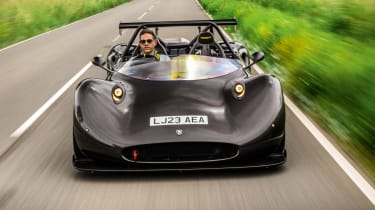
The name says it all; the Australian-built Spartan is just about as angry and unhinged as track cars come. Inspired by 1960s Can-Am cars, its flowing carbonfibre body helps keep weight down to just 745kg (full of fuel), and its supercharged 460bhp Honda engine has the goods to thrill, excite and downright terrify its driver (in the best way possible).
Thankfully, the Spartan combines this furious performance with directness and communication on a circuit. This gives you confidence to really lean on it through corners, at which point you'll find that the balance is neutral and approachable with reassuring high speed stability.
‘The Spartan is genuinely mind-altering. After three flat-out timed laps, I feel like I’ve just survived some kind of explosion. It’s a heart-pounding, head-spinning thrill. One laced with the immense satisfaction of knowing you have been responsible for every command and input. I can’t think of another road-legal car that places so much in the hands of the driver and delivers such an intense and unfiltered reward.’ – Richard Meaden, evo co-founder and Editor-at-Large.
Revolution R500 evo
- Pros – Astonishing performance, mind-blowing downforce
- Cons – Feels ‘big fish little pond’ on smaller circuits
- evo rating: 5 stars
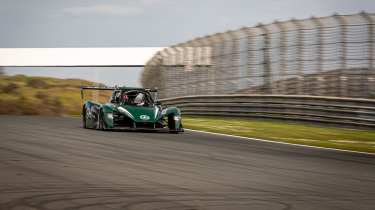
What better track car than just an outright racer? That’s what the Revolution R500 evo is – a blistering carbon-tubbed, 500bhp prototype in the image of the very fastest top-flight endurance racers, good for 800kg of downforce at 130mph and with a power-to-weight ratio of 608bhp/ton.
It has a 3.5-litre supercharged V6 to thank for its 500bhp, 410lb ft of potency, making it capable of 0-62mph in the region of 2.5sec, on the way to a 185mph top speed. But straight-line figures are a formality in a car like this. It’s how it rounds a circuit that boggles the mind. That’s not to say this is a car that welds itself to a track’s surface. You still need to manage the throttle, feel the chassis balance, but you still get the sense that the laws of physics bend around the Revolution, like light around a gravity well.
‘Once you’ve had a lap or two to adapt, you’re having too much fun to be frightened. As well as being devastatingly fast, the 500 evo is also an entertainer. There’s big grip of course, but it’s anything but an on-rails racing machine. You’re correcting slides, working with the car, making a difference. You’re totally engaged.’ – James Taylor, evo deputy editor.
Aston Martin Valkyrie
- Pros – Breathtaking design, unmatched occasion, 11,100rpm V12
- Cons – Steep learning curve, horrendous cockpit noise
- evo rating: 4 stars
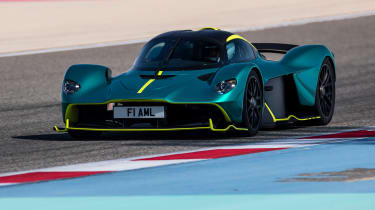
If you want to recalibrate your expectations as to what a road car is capable of, look no further than the Aston Martin Valkyrie. It should come as no surprise that the 1139bhp, Adrian Newey-designed machine is the most technically impressive, physically demanding hypercar of them all, but with a shrink-wrapped body generating a sustained 600kg of downforce at speed, it opens up an entirely new realm of performance.
> Aston Martin Valkyrie review
The Valkyrie takes time, skill and enormous commitment to get near its potential, but when everything comes together, there's no road car quite like it.
'At first everything feels like it's happening too fast, but the trick is to look further and further ahead. It feels unnatural, but it’s all part of the recalibration process. One that you gradually get on top of lap-by-lap, but with less time to relax on the straights and so much compressed into each braking effort, the Valkyrie is a ruthless and relentless test of your focus and mental stamina.' – Richard Meaden, evo co-founder and Editor-at-Large.