Audi RS5 Review - the fast estate that takes the fight to BMW’s M3
Hybrid power provides Audi’s new super estate with a class leading 630bhp, but it comes at a price. Well two actually
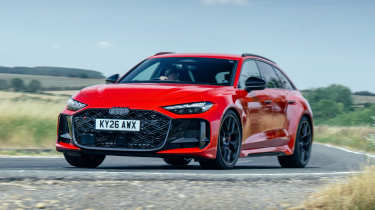
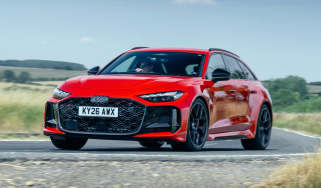
Until the RS6’s replacement arrives in 2027 your desire for a fast Audi estate needs to be directed towards the £91,300 B10 RS5 Avant. It’s Audi Sport’s first plug-in hybrid model, one of its most powerful ever and tipping our scales at nearly 2.5 tons, one of the heaviest, too.
In a world of BMW M3 Tourings that rely solely on six-cylinders a couple of turbochargers and a C63 that’s slowly creeping off-sale with its four-cylinder hybrid engine Audi’s fast estate representative has an opportunity to claim a top of podium spot for the do-everything family performance car.
Equipped with seemingly every piece of chassis trickery Audi Sport has at its disposal, the RS5 wants for nothing in the tech department, including a bespoke motor to power the car’s electric mechanical-torque vectoring. Through its pre-set drive modes and configurable ‘RS’ mode it will go from sleeper GT-esque family car to an unhinged and rabid destroyer of tyres. Its six-cylinder, turbocharged petrol engine is supplemented by a hybrid system that’s integrated into the gearbox and drives through the car’s quattro all-wheel-drive system.
Ride and handling
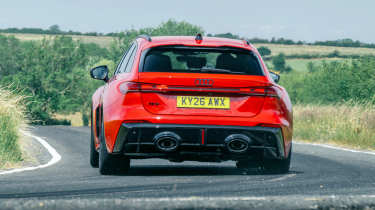
- Configurable drive modes and electromechanical rear diff add unexpected dynamic polish
- Ride comfort ups its daily driving capability
- Could be more exuberant in regular drive modes
More reviews
In-depth reviews
- Audi RS5 Review - the fast estate that takes the fight to BMW’s M3
- Audi RS5 (2017 - 2024) review – deceptively docile with ballistic performance
Reviews
- Audi RS5 Sportback (2019 - 2024) review – the sensible BMW M3 alternative
- Audi RS5 review – finally an M4 beater?
- 2017 Audi RS5 review - Audi's most entertaining coupe yet?
- Audi RS5 Cabriolet (2014 - 2015) review – the first and last of its kind
- Audi RS5 (2011 - 2015) review – stylish, less dynamic BMW M3 alternative
- Audi RS5 Review
Just as the circle of white smoke is completed and any view of the Marrakech street circuit obscured, there is a sudden, scolding sound from the new £92,300 Audi RS5, a tell-tale tack-tack-tack-tack. I can feel it, too, not just the percussive beat in the arch but the slightly lopsided change in balance. The right rear (optional) Pirelli P Zero R has delaminated, spectacularly. I doubt the standard-fit Bridgestone Potenza Sport would have survived so long.
Yes, rear. The RS5 was mid-oversteer, not understeer, when rubber began flaying the arch-liner. Not a stance that an Audi RS Avant has really been associated with in the last 30 years. But the latest B10 RS5 has a new trick up its back axle. A world-first no less. An electromechanical torque-vectoring rear differential with its own 10bhp, 30lb ft electric motor that can shift torque powerfully between the rear wheels in either direction, regardless of throttle or brake input. Where the old Sport Differential could only deploy torque differences of up to 1200Nm, this can manage 2000Nm and it can do so in just 15 milliseconds.
> BMW M5 CS v Audi RS6 GT – the greatest supersaloon v the ultimate fast-estate
The result is that you can pick Torque Rear from the Drive Select menu, turn the steering wheel, bury the throttle and, as long as you trust the algorithms to do their job, hold the RS5 in a big, long drift. It’s fun, albeit a very four-wheel-drive sort of slide, in that you need to keep the throttle pinned and use the steering to adjust the angle and direction of the oversteer. Feather your right foot as you would in a purely rear-drive car and the rear axle will think it’s time to turn on the house lights, roll the credits and end the show.
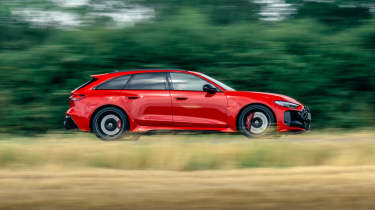
To that extent, maintaining a drift or donut is quite brutal on the tyres, as I found out after just a handful of circumnavigations of the cones. The fact that the Audi engineers didn’t seem in the least surprised or concerned suggests I wasn’t demonstrating an unexpected level of heavy-handedness either. The swiftness with which a new set of Pirellis was bolted onto the rear end also indicated they had come to Morocco prepared.

Donuts and indeed the Torque Rear setting are, of course, the extreme expression of what the system can do. A few more regular laps of the dusty, bumpy, scruffy Marrakech street circuit in the RS Sport setting reveal a car that is well balanced and easy to adjust both on- and off-throttle. The central (passive) Torsen differential, capable of shifting up to 70 per cent of torque to the front or 85 per cent to the rear, now has permanent preload, making it quicker to respond – and it feels it. There is real precision, and thankfully it’s not all about big, blunt inputs and lurid outputs.
Through a long, medium-speed left-hander, between unforgiving concrete barriers, with a jolting dip in the middle just for good measure, the big RS5 Avant is easy to play with. It feels very natural to hold right on the edge and you can calmly let small slides play out without any sense that they must be gathered up immediately for fear of momentum building into something monstrous. The steering ratio is quick at 13:1 and although it isn’t brimming with fluctuating weight and granular texture, you get a really nice feeling of connection to the car through both hands and backside. Turn into a corner and you can quickly sense how the sidewalls are loaded, making the RS5 feel both smaller and lighter than it really is.
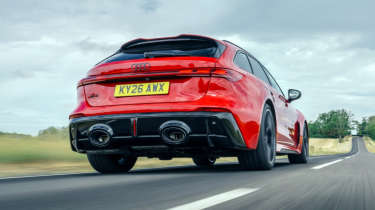
Some of the same sensations that were in the surprising RS6 GT are present in the RS5, particularly that connection to a back axle that feels alert and ready as soon as you turn into a corner, willing to be adjusted with more or less throttle as necessary. I wouldn’t say the big Audi feels delicately fleet of foot, but rather as the Revuelto cleverly doesn’t feel heavier than the Aventador, so the B10 with its new tech doesn’t give you the sense that it’s carrying around 30 per cent more weight than the B9.
The braking is impressive too. All the launch cars were fitted with the optional carbon-ceramics, which measure a mighty 440mm in diameter at the front but also save 7.5kg in unsprung mass per corner. The system is brake-by-wire, but you’d never know and, perhaps aided by the new rear diff, it inspires real confidence. Audi actually claims that, despite the RS5’s extra mass, its stopping distance from 62mph is 11 per cent shorter than the B9’s – 34.4m reduced to 30.4m.
It’s testament to the steering’s precision that you feel confident and relatively calm threading the RS5’s big arches through gaps between buildings and oncoming traffic. The five-link suspension has twin-valve dampers that independently adjust compression and rebound, and despite running the optional 21-inch wheels wrapped in 30-profile rubber, the result feels a world away from the monastic mattress ride of old RS models. The fact that I’d driven 800 miles in an air-suspended Range Rover Sport before driving the Audi I never found myself diving for the Audi’s suspension settings to soften things off speaks volumes.
Engine, gearbox and performance
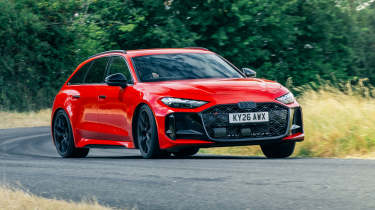
- V6 engine lacks character…
- Hybrid powertrain delivers a mighty punch
- You can’t get away from its weight
Unfortunately what doesn’t speak volumes is the exhaust system through which the RS5’s twin-turbo V6 breathes. It’s an increasingly common refrain these days as legislation seeks to strangle any sense of soundtrack joy, and despite the most prominent ovals since the US President’s office, there really isn’t a great deal of aural interest in the new RS5. There is just enough aggression in the noise under hard acceleration to make you know you’re in something performance-orientated, but it’s not musical or inspiring, which is a shame.

The RS5 is a hefty beast because of its burden of batteries beneath the boot that feed the electric motor that augments the V6. Yes, the weight is distributed very evenly, 49:51 front:back, but there is no sugar-coating the 2419kg our scales displayed when you weighed our long term test cars. The decision was taken early on in the RS5’s development that it would be a plug-in hybrid, heralding a new era for Audi Sport, and that there should be a decent EV range and not just something token, as is the case with so many hybrid supercars – and the C63 AMG.
So the new RS5 comes with a 25.9kWh battery and a radial flux motor mounted between the engine and gearbox. The battery can be fully recharged at home on an 11kW charger in 2.5 hours, or replenished on the go with the V6. All in, it’s good for a range of a claimed 54 miles of pure EV driving, so its hybrid capabilities do feel genuinely useful and something that might actually sway consumers.
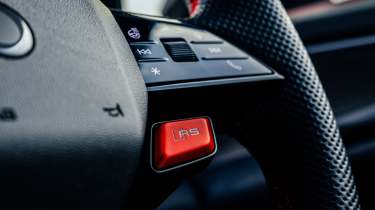
However, just adding EV capability and over 600kg to the old RS4 recipe would have felt like tipping the scales too much towards the practical and away from the performance. Yes, there is an uplift in the power and torque figures, the 2.9-litre, twin-turbo V6 gaining 59bhp on its own and the addition of the electric motor boosting the overall numbers to 630bhp and 603lb ft from the B9 RS4’s 444bhp and 442lb ft. But it could be argued that these increases really only serve to mitigate the uptick in weight. In terms of power-to-weight the B10 has 265bhp at its disposal, the B9 RS4 259bhp. That’s progress for you…
Audi would argue that the 0-62mph time has dropped by 0.3sec from 3.9 to 3.6. It also claims that in the first 2.5sec of a launch, the new RS5 travels 22.6m compared with the old RS4’s 14.7m, which is impressive. However, I would still argue that’s not a big enough benefit to mitigate the mass. The addition of that Dynamic Torque Control rear axle, though? That just might be, and Audi says it wouldn’t have been possible without the 400V architecture that came with being a PHEV.
The eight-speed torque-converter doesn’t leave much of an impression either. It’s not obstructive, but neither the demeanour of the shifts nor the action of the small paddles screams RS. I asked about the decision not to go for a DCT and it sounds as though the engineers were faced with choosing between what was already available and what would fit with the integration of the e-motor.
Interior, tech and efficiency
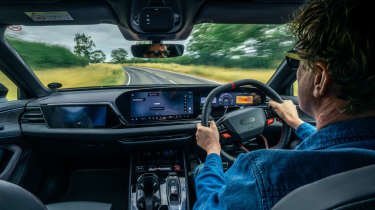
- The RS5’s cabin isn’t as special os some super-execs and the battery robs boot space
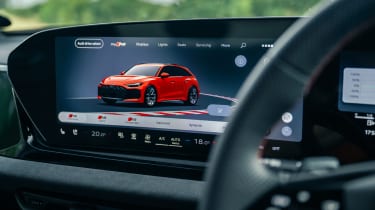
- It’s reasonable quality and the HMI, while still housing the HVAC controls, is intuitive
- Plug the RS5 in regularly to enjoy the ability to cruise silently and cheaply on electric power
Heading out into the maelstrom of Marrakech traffic and the mixed surfaces that sometimes do a good impression of the UK’s own cratered highways, the RS5 is a very relaxed place to be. The screens and the graphics therein are large enough not to feel fiddly and they’re augmented with a few sensibly chosen physical buttons for things like the drive modes, ADAS and hi-fi controls.It would be nice if the HVAC controls weren’t on the touchscreen, but there is at least a little lip to rest your hand on while fiddling with the fan or tweaking the temperature.

Between the engine and battery combined you’re looking at a maximum 350-mile range, the volts provide 50 of those. Be warned, the fuel tank is a thimble-like 48 litres and the battery pack and motors consume a large area of the rear load space.
Putting the new EV range to good use with a bit over half the battery charged, I easily covered almost 30 miles without troubling the twin-turbo V6. It wasn’t thrilling, but it made the RS5 feel very much the modern all-rounder. It added another facet to that blend of space and pace, practicality and performance that has always made a fast Audi (especially in Avant form) so appealing.
I’ve driven 7,000 miles in the new Audi RS5 in the UK. This is what I think
Let’s get the humdrum stuff out of the way first. The RS5 Avant isn’t very practical if you’re coming from a previous-gen RS4 or current-gen BMW M3. The boot space has been invaded by the battery and motor of the hybrid system. Reducing load space requires the retractable load cover to be removed if you need to turn your holiday luggage on its side to fit.
The electric powertrain hardware also compromises the RS5’s role as a fast estate to cover big miles in one sitting. Its tiny 48 litre fuel tank provides a claimed 300-310 miles of range so long as you were driving well within its limits before refueling. The most electric range I have seen charging on a 7kW home charger is an additional 50 miles.
But with so much weight to haul around, the right-speed gearbox spends a great deal more time in seventh and sometimes sixth than it does in eighth simply to keep pace with motorway traffic. Hit a gradient and the revs instantly flare as the six-cylinder braces itself for a bit of workout. The result is a real-world combined driving range of around 300 miles. The RS6 I ran prior to the RS5 could cover closer to 350 miles in the same conditions, as could the 600kg lighter BMW M3 CS Touring.
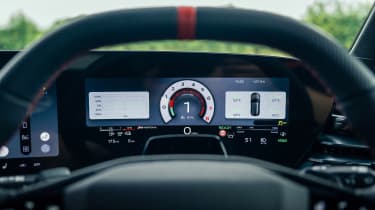
It is, though, immensely comfortable during long days behind its wheel. You do sit on it rather than in it, but ergonomically, once settled on your seat and steering wheel distance settings, it’s not a car you constantly fiddle with to tweak the settings after a couple of hours. It’s not, however, a particularly exuberant interior. Bar some RS badging you could be in an S5. Oh, and the only rev counter is displayed in the head-up display, with a power/charge dial the only one present in the instrument display. Unfortunately, hateful piano black is still considered acceptable by Audi for a car’s interior.
Away from the drifting tyre-shredding focus of the car’s international launch, the RS5 feels far more connected than perhaps you would expect from a car with four rings on its nose. It responds with an immediacy that inspires confidence, something you welcome with a car that has the appearance of bursting through its bodywork, and even though the initial steering response isn’t dripping in clarity, the speed of direction change inspires a confidence to explore the RS5’s talents. It’s not a ‘pivot around your hips’ type car, but the rear axle is synchronised to the front, performing with a sense of athleticism that reminds you that if the mood takes you - and the space is available - that you’re only a drive mode away from visiting a Kwik-fit.
After 7000 miles the RS5 has shone in some areas: engaging, responsive and exciting when the mood takes you, but it’s also operating with a hand tied behind its back in terms of the practical elements people buy such cars for in the first place. – Stuart Gallagher, evo editor-in-chief.
Price and rivals
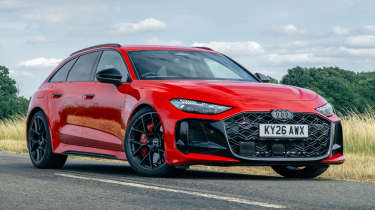
Starting at £91,300 for a standard RS5 Avant, prices rise to £97,385 for a Carbon Black edition and £109,385 for the Performance Vorsprung model. The RS5’s obvious rivals are fast estates from Audi’s fellow German manufacturers, Mercedes-AMG and BMW M. The hybrid C63 isn’t long for this world and nor is the current BMW M3 Touring. The latter however, is expected to receive a replacements – yes plural, with an all-electric and combustion M3 Touring coming in the Neue Klasse era. The latter then, lacking a hybrid powertrain to match the RS5, will enjoy the advantages and suffer the disadvantages the current car has, the former more than the latter…
Audi RS5 Avant (B10, 2026) specs
| Engine | V6, 2894cc, twin-turbo, plus e-motor |
|---|---|
| Power | 630bhp (combined) |
| Torque | 603lb ft (combined) |
| Weight | 2370kg (270bhp/ton) |
| Tyres | Bridgestone Potenza Sport (standard), Pirelli P Zero R (optional) |
| 0-62mph | 3.6sec |
| Top speed | 177mph |
| Basic price | £91,300 |