BMW M3 CS Touring (2025 - 2026) review – M’s ultimate fast estate gone too soon
As far as fast estates go, the M3 CS Touring was one of the very best. Cruelly, it wasn’t on sale for long
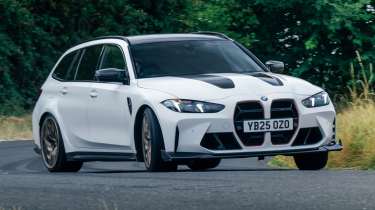
The world probably doesn’t need an estate car with 543bhp, Cup 2 tyres and carbon bucket seats. Nor one with carbon body panels and a cooling package specified for hard track miles. But after driving the new M3 CS Touring extensively on the road, testing it against Audi’s new RS5, lapping it on one of the most demanding circuits in the UK and running one for six months, we can’t help but conclude that, in a strange way, it absolutely does.
The CS Touring is a remarkable package. It was staggeringly expensive at £126,275 before it went off sale, but no other factory-spec wagons can turn a hand to everyday duties and hunt down 911s on track without breaking a sweat.
Engine, gearbox and performance
- You notice the extra performance but it’s not a total transformation
- Most aggressive modes to add intensity to the transmission and powertrain
- Unless you’re on track, a standard M3 is as fast a lot of the time
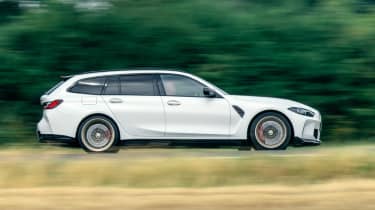
The CS formula is familiar by now, the M3 saloon and M4 having already had the treatment. More power, a little less weight and detailed chassis changes bring out more aggression than Competition models without reaching extreme CSL or GTS levels.
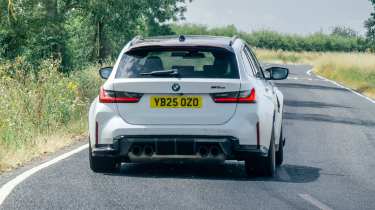
Under the skin the Touring gets the same uprated straight-six as its CS siblings, with increased turbo boost pressure and management tweaks giving it 543bhp and 479lb ft. The engine is secured with stiffer mounts and breathes through a titanium rear silencer, sending power to all four wheels via an eight-speed auto and xDrive four-wheel drive.

All this in combination with standard-fit Michelin Cup 2 tyres means the CS Touring is good for hitting 62mph from rest in just 3.5sec, on the way to a 186mph top speed. For comparison, Audi’s RS5 with almost 100bhp (but also 600kg) more manages the sprint in 3.6sec.
More reviews
In-depth reviews
- BMW M3 (G80) review – still the best reason not to buy a Mercedes C63
- BMW M3 (E30, 1986-1990) review – the greatest M car of all?
Reviews
- BMW M3 Touring (E46) review – driving the perfect super estate that never was
- BMW M3 Touring review – the best candidate for a one-car garage
- BMW M3 (E90 & E92, 2007 - 2013) review: £20k family car with an F1-inspired V8
- BMW M3 CSL (E46, 2003-2004) review – Munich's answer to the Porsche 911 GT3
- Used BMW M3 (E46, 2000 - 2006): an analogue sports coupe icon
Overall the CS feels really special for an estate car, and in reality more like a honed, focused sports coupe. One that never feels as heavy as it is, with monster reserves of performance.
The engine is a force of nature, with immense shove in the mid-range and hitting hard until the 7200rpm cut-off. Even if you short-shift there’s always a sense of enormous potential, and on narrow, winding B-roads there isn’t much opportunity to scratch the surface.
Ride and handling
- Damping has an extra layer of focus, without being too punchy as a daily
- Steering can be sharper and more feelsome, without being tiring
- The CS experience is most felt when pressing on on track
The stability control gets a CS-specific tune, so too the adaptive dampers, steering and standard M Compound braking system, with carbon-ceramics being a very pricey £8800 option. Weight has been trimmed by 15kg compared with the standard Touring, to what is still a chunky 1850kg.
The saving comes from a carbon bonnet, front splitter and rear diffuser, plus M Carbon seats and a bare-bones carbon centre console with no cup-holders. Standard-fit Michelin Cup 2 tyres top off the upgrades, but those wanting to use their CS all year round can fit less aggressive rubber for no extra cost.
The upgrades manifest in record-setting capability around the Nordschleife, with the CS Touring clocking a 7min 29.5sec time around the Green Hell with BMW M development driver Jörg Weidinger at the wheel. Not only is that the fastest lap posted by a production estate, it's half a second quicker than the last-gen 626bhp M5 CS, and beats the base M3 Touring by a full five seconds.
Has all that given the Touring too much edge for an everyday estate? Not a bit of it. It’s a lovely road car, with more grit and precision than a normal M3 but enough compliance to work with the road surface. It’s not too jarring or extreme, dialling in just enough response and freneticism to make it feel special, without making it an irritating car to simply cover miles in.

The right amount of cushioning, in the steering and damping, of the standard car has been hewn away, to make a car that’s edgier without alienating you on all but the perfect drives.
The Cup tyres drum up a fair bit of noise on rough tarmac but, coupled with the suspension changes and a CS-specific aluminium front strut-brace, give the steering fantastic clarity. Our long-term test car had Michelin Pilot Sport 4 S tyres, which did make for a more refined experience, albeit at the slight expense of on-edge response on the road.
The steering is measured, precise and relays surface detail to your hands through the suede rim. In fact, the biggest irritations in this car are inherent to BMW, namely and principally the horribly fat steering wheel. You can lean on xDrive and the M3 really comes alive. It’s so good at managing torque across the axles yet always feels natural and allows you to make the difference as a driver – particularly in the more rear-biased 4WD Sport mode.
Track test
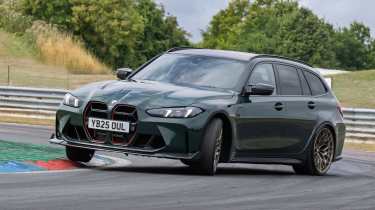
Thruxton is a fearsome, old-school track, with deep-breath high-speed corners, technical chicanes and no run-off if it all goes wrong. You need absolute confidence to get around here quickly, and it takes a while to build up to it in the CS.
It isn’t nervous or spiky, but on semi-warm Cup 2s you find out how much grip there is once the car has started sliding, rather than through feel. This is mainly down to the steering, which feels great on the road but doesn’t build up a clear picture of grip when leaning properly hard on the tyres, particularly over mid-corner surface changes.
But with time and more tyre temperature the M3 becomes more trustworthy, and its stability, balance and drivability come to the fore. Once into a rhythm it’s a blindingly capable car. One with an inherent sense of quality but a wide scope of configurability to change its character, from neat, precise track car to something more lairy and challenging.
The broad expanse of a track can dull the sense of speed, but the M3 still feels mighty when using the full reach of the straight-six. When the surge of boost hits out of slow corners it pulls relentlessly, and on the not-quite-straight run towards the final chicane it touches 145mph. This gives the optional ceramic brakes plenty to do.
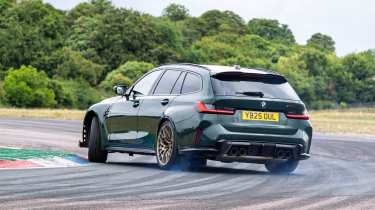
The full bite comes slightly later in the pedal than you expect, which takes some adjusting to, but from thereon they’re powerful with great modulation and show no signs of wilting, lap after lap. Impressive when you consider how much speed and mass they’re dealing with.
At track speeds the M3 still pulls that illusory trick of hiding its weight, but there are moments where you feel it. Changing direction through the chicanes, for example, or braking into Campbell corner. This is a challenging section in any car, with a long flat-out left that feeds into a sudden hard braking zone, in preparation for a ninety-degree right.
Here the combination of huge lateral force and hard braking gets the M3’s weight moving beneath you, but even then it doesn’t get unruly, requiring gentle correction of the steering and modulation of the brakes. Get it slowed down and it turns in with fantastic precision, the front Michelins only losing some of their bite after consecutive hard laps. You can still hit your lines but a little more patience is required.
Turn in, get on the throttle hard and xDrive lets you induce a slide, but with more finesse you can hold it on the edge of slip while the car propels itself forwards, tweaking your angle with steering and throttle as the speed builds. It’s hugely satisfying and, dare I say, even more fun than bonfiring the rears in 2WD mode. Which the Touring will still do, albeit with a bit more commitment required on sticky Cup 2s.
Price and rivals
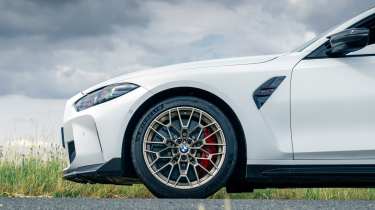
It’s hard to think of something the CS can’t do. Throw a set of Pilot Sport 4 Ss on it and it’s a joy to use on the road all year round, and with Cup 2s on a dry track it can do frankly absurd things for a car with four doors and a 1510-litre carrying capacity. It is painfully expensive – you could buy a standard M3 Touring and a used Caterham 360R for the same money – but no other modern performance car combines so many talents at once.
£126k was an awful lot for an M3, but it’s hard to think of any fast estate with the same sense of purpose as the CS Touring. Audi’s RS6 GT is potentially one, but all 60 UK-bound examples were snapped up in 2024, for a far heftier sum than the BMW – £176,975. Today you’ll still need £160-£200k to bag a used one.
The RS5 is now available but isn’t really even as talented a driver’s car as the standard M3, let alone the CS. You could look at the discontinued Audi RS4 Competition, which bowed last year with the rare Edition 25 Years. It’s lighter than the CS Touring but not as capable or exciting as the M3. It is however, half the price on the used market.
From BMW’s own stable is the M5 Touring, coming in at £135,105. It’s substantially more powerful and comes with the versatility of hybrid drive, but the M3 is smaller, a whole Caterham lighter and so much more exciting to drive. With the seats up its boot is the same size, too, so it’s a no brainer.
The catch of course is you can’t order an M3 CS Touring new anymore. Dealers have stock that’s priced below the list price of £126k it launched with in 2025. Worth considering: the CS Touring being rarer and more desirable, ought to have more robust residuals than the vastly more common standard touring, in the medium to long term.