Best GT cars 2026 – the ultimate continent-crossing grand tourers
The best GTs combine the opulence and comfort of a luxury saloon with the style, performance, and sense of occasion of a supercar – these are evo’s favourites

Few modern cars have quite so much appeal as the traditional grand tourer. They might seem old fashioned in a world where fast estates perform like supercars and supercars can ride like luxury cars. But there’s no denying the traditional appeal and heritage of a proper GT, with cars like Ferrari’s 12 Cilindri and Aston Martin’s DB12 S only the latest in bloodlines started over seven decades ago.
Essentially, the GT has a simple mantra: to transport at least four people in comfort, speed and style, while remaining capable when the roads get twisty. Simple though it might seem, this is a hard balance to find, and while many might skew in one direction or another, all must be able to achieve both of these key roles. These are the cars that perform the GT role best, ranging from trad front engined long-bonetted rear-driven cars, to all-wheel drive machines, EVs, four-doors and even a mid-engined offering, along with some used alternatives.
Best GT cars 2026
- Aston Martin DB12 S
- Bentley Continental GT S
- Ferrari Amalfi
- Porsche 911 Turbo S
- Ferrari 12 Cilindri
- Aston Martin Vanquish
- Mercedes-AMG GT
- Porsche Panamera
- Porsche Taycan
- Audi e-tron GT
- Maserati GranTurismo
- McLaren GTS
Used alternatives
- Aston Martin Vanquish S
- Ferrari 550 Maranello
- Porsche 991.2 Turbo S
- Lexus LC500
- Bentley Continental GT Speed W12
Aston Martin DB12 S
- Priced from: £211,500
- Pros – Everything is improved
- Cons – Other than the infotainment…
- evo rating: 5 stars
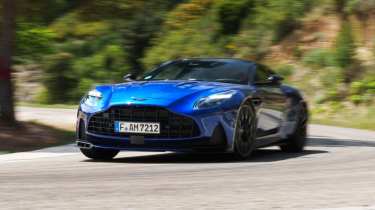
To mark the dawn of its Lawrence Stroll-led era, Aston Martin’s DB12 carved a new, stronger identity with a GT car that blended elegance with serious bite and poise. But it wasn’t quite the perfect GT car, sacrificing the ability to relax in the pursuit of a tautened super sports car flavour.
There was an alertness, an agility to the DB12 that moved it on from its predecessor the DB11 and into battle with the likes of the Ferrari Roma. Except as a sports car, the DB12 never quite made sense either, always feeling a little disconnected and not quite intuitive. Enter the DB12 S, with significant revisions to its steering, damping and differential set-up. As Aston’s recent ‘S’ treatments go, this is the most comprehensive, elevating the DB12 from apologetic middle child, to the best front-engined coupe it currently makes.
Not only does it settle down and relax more than the DB12 ever could, but when you turn the dial and get it up on its toes, it meets you with the intuitive behaviour of a fifth limb. You point it, it goes. You power on, it pivots exactly as you expect. You attack a challenging road and it takes it in its stride, never feeling unsettled or aloof. It’s a masterclass in iterative development.
‘With the original DB12 the feeling was of a car confused, one that didn’t know, or perhaps understand, its remit. Too harsh and nervous as a GT, not precise or engaging enough as a super sports car. The S resolves all this, its ability to flow like the very best GTs and excite as a super-sports car addresses the frustrations of the original. An Aston Martin that can deliver the go to match its beguiling show.’ – Stuart Gallagher, evo editor-in-chief.
Alternatives to the Aston Martin DB12 S
The DB12 S is the Aston at the top of its game, so your best hope of countering its talents will be with Ferrari’s Amalfi and Bentley’s Continental GT S. The Ferrari is potentially the sharper sports car but lacks just a little bit of touring refinement. The Bentley on the flip side, majors on continent-crossing chops, with astonishing driving talent overlaid. The DB12 S is arguably the best compromise.
Bentley Continental GT S
- Priced from £212,500
- Pros – Speed’s advanced chassis brings regular GT to life
- Cons – It feels a bit ‘normal’ inside
- evo rating: 4.5 stars
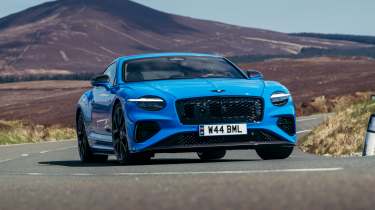
The new Bentley Continental GT’s job is to make the demise of the W12 engine a little less sore. It was an engine we all grew to love, that came to define the marque in the 21st century, but now it’s no more. Happily, the new GT’s V8 hybrid powertrain suits the character of the Continental GT down to the ground, bringing a new kind of versatility that fits the flying B very well indeed. The new two-chamber air suspension works with the limited-slip diff to make for a more capable and playful Conti GT and now, the standard 671bhp version of the powertrain can be had with the tautened hardware of the 771bhp Speed models. In other words, it’s the sweet spot of the range, being plenty fast and characterful enough but with the added focus of the more sophisticated set-up.
Bentley’s Performance Active Chassis features all-wheel drive, an e-LSD, all-wheel steering and front-to-rear torque vectoring. It’s suspended on dual-valve dampers with twin-chamber air springs, while 48-volt active anti-roll control powered by the hybrid system locks the Bentley down. The result is that this large, heavy continent-crossing coupe can feel almost dumbfoundingly agile, resolutely controlled and genuinely enjoyable across a technical stretch of road.
> Bentley Continental GT S review
‘You can feed in the throttle the moment the corner – and your vision – opens up, feeling the torque split across the rear axle as the diff spreads the load. The S picks an attitude that straddles a composed all-as-one four-tyres smearing the surface with the slightest over rotation of the rear wheels to push you through the exit.’ – Stuart Gallagher, evo editor-in-chief.
Alternatives to the Bentley Continental GT S
There isn’t much that blends performance, luxury and exquisite build quality quite like the Continental GT. Aston Martin’s DB12 S isn’t as cosetting, while the Maserati GranTurismo is nowhere near as opulent inside. With that said, the Bentley isn’t at the top of the list when it comes to outright thrills – both the Aston and Maserati are more dynamic to drive.
Ferrari Amalfi
- Priced from: £202,459
- Pros – A GT with huge performance and dynamic bandwidth
- Cons - Lacks a soulful voice
- evo rating: 4.5 stars
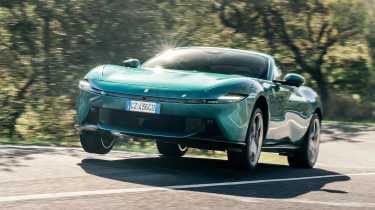
Though it doesn’t wear the Modificata ‘M’ badge ahead of a retained Roma nameplate, the new Ferrari Amalfi is a heavily revised version of what was arguably the first of Maranello’s baby sports GTs to hit the spot. Like the Roma, the Amalfi is a car with a fundamental even split of sports car and grand touring DNA: balancing a bit of sporting pretension is a hallmark of all great grand tourers.
Happily, all of what the Roma was good at remains. The Amalfi retains its ballistic 3.9-litre twin-turbo V8 boosted to 631bhp, now more responsive thanks to a new Bosch ECU, faster turbines in the turbochargers, lighter cams and a higher 7600rpm rev limit. So yes it’s still incredibly fast, albeit still not that musically talented. The damping is deftly-judged, controlling the car’s mass without getting crashy, while the steering is sharp but intuitive. Where it greatly improves on the Roma is inside, with a return to physical buttons (there’s even an engine start button!) and a more rationalised cockpit layout. The Roma’s cabin was nice for being so cockpit-like, the central tunnel hemming you in. But the vertical screen was a bit odd and you did feel a little cramped after a while. The Amalfi’s cabin and infotainment setup meanwhile, is much more reminiscent of the 12 Cilindri. Less distinctive yes but overall, probably an ergonomic win.
‘If the Amalfi was tasked with carrying the torch of the Roma, consider it job done. It’s no radical reinvention of the theme but it’s a car with superb bandwidth, as adept at calm cruising as it is scrambling up a mountain pass with fantastic speed and balance.’ – Yousuf Ashraf, evo senior staff writer
Alternatives to the Ferrari Amalfi
The Amalfi gets the GT/sports car split so right that you could cross shop both an Aston Martin DB12 (if you need the piddly rear seats) or an Aston Martin Vantage (much cheaper, more of a sports car but less practical). There’s also Porsche’s new 992.2 911 Turbo S, McLaren’s GTS and if you want to go the other way and plump for a heavier (but still excellent) GT, there’s Bentley’s Continental GT.
Porsche 911 Turbo S

- Priced from £205,245
- Pros – Staggering speed; more rounded than a GTS; marginal compromises as a drop-top
- Effective rather than truly involving
- evo rating: Four stars
The new 911 Turbo S leaps on technically from the first 992-generation, with electrification throughout but still retaining its GT/sports car billing. The engine uses electrified turbochargers and an in-transmission motor for near-instant response, with a nice 701bhp overall figure to boot. That 911 Turbo calling card of being dumbfoundingly rapid lives on. The Turbo now also features electrohydraulic active anti-roll bars. The system, which runs on the 400-volt electrical architecture, can in theory eliminate roll, though Porsche opted for a more ‘natural’ feeling 0.5degrees per G of lateral grip. Conversely, in normal driving, the roll bars can decouple, allowing independent wheel articulation and a calmer ride.
> Porsche 911 Turbo S review
‘Select a high gear and open the throttle wide and you really appreciate how quickly the eTurbos start delivering boost. It feels out of sync, in a good way, like you’re getting something for nothing – 5-litre response from a 3.6 – before the exhaust gas boost builds and you’re being flung down the road.’ – John Barker, evo editor-at-large.
Alternatives to the Porsche 911 Turbo S
The 911 Turbo S at once does it all but can feel a little cold and emotionless. For those who are happy to trade a bit of ballistic all-weather effectiveness for a splash of soul, the new Ferrari Amalfi is worth a look. The Aston Martin Vantage is a better sports car than it is a GT and certainly isn’t as practical as the 911. Conversely, the Aston Martin DB12 and indeed Bentley’s Continental GT lack focus to rival the 911, even if they’re plusher, more cossetting grand tourers.
Ferrari 12 Cilindri
- Priced from £336,500
- Pros – Outright pace, predictability, GT credentials
- Cons – Interior ergonomics, visibility, price
- evo rating: 5 stars
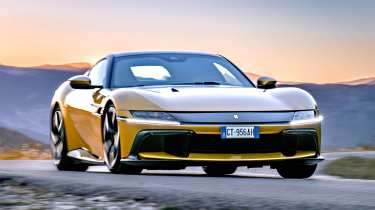
Ever since the Ferrari 599 crept beyond the 600bhp mark with a mildly detuned engine from the Enzo, there’s been a sense the front-engined, two-seat V12 Ferrari has become more of a supercar than a GT. That was only compounded by the howling Ferrari F12 and incredibly intense Ferrari 812. Well, for those who miss the 550 glory days, the 12 Cilindri might be for you, because this is a calmer, more settled Ferrari V12 with a longer fuse. It’s still a 6.5-litre V12, 819bhp monster that’ll hit 62mph in 2.9sec on the way to a 211mph+ top speed but when not calling upon that potency, this car can dull itself quite unlike its immediate predecessors. Does that mean it’s missing the bite and ultimate excitement of the 812 and F12? Perhaps, but it also makes the 12 Cilindri an accomplished, more rounded and still deeply desirable GT.
‘A good part of the 12 Cilindri’s bandwidth is still focused on being a thrilling driver’s car as well as a GT. It responds like a lightweight mid-engined sports car rather than a large front-mid-engined GT car. You revel in the swiftness with which it responds as one, with zero slack.’ – James Taylor, evo deputy editor.
Alternatives to the Ferrari 12 Cilindri
The 12 Cilindri’s closest rival is another V12, 800bhp+, £300k+ super GT – the Aston Martin Vanquish. The two might appear similar on paper but they have starkly different characters, the Vanquish trading the 12 Cilindri’s screaming N/A V12 for a gutsy twin-turbo unit that arguably sounds even better. Both are available as convertibles too, giving you closer access to their sensational engines.
Aston Martin Vanquish
- Priced from £350,000
- Pros – Looks; sound; performance; handling
- Cons – Some road noise; not much space; HMI
- evo rating: 5 stars
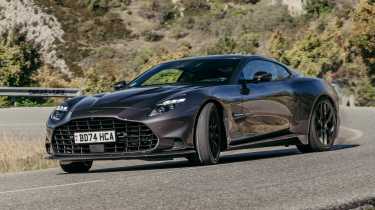
Aston Martin is on a bit of a roll at the moment with a superb line up of sports GTs, and the Vanquish is the best of the bunch. It has all the presence and glamour you’d expect of a flagship Aston, and a compelling combination of brutality and finesse that’s enough to give Ferrari’s 12 Cilindri a headache. Huge performance from its 824bhp twin-turbo 5.2-litre V12, a rewarding chassis and a sumptuous cabin that’s a world away from the old DBS Superleggera ensure it has every basis covered as a GT – it’s not just the best current Aston, it’s up there with the best models of all time.
> Aston Martin Vanquish review
‘The scale of performance in the Vanquish is epic, monumental. Find a decent straight, nail it and hear the V12 roar as it accelerates with such solid determination that it feels like it’s going to keep piling on the speed at an unabated rate until you run out of nerve, or road, or hit 214mph.’ – John Barker, evo editor-at-large.
Alternatives to the Aston Martin Vanquish
If you want a GT with the kind of performance, involvement and wow factor of the Vanquish, there’s only one other place to look – the Ferrari 12 Cilindri. We haven’t driven them back to back yet, but the signs are that it’ll be a close run battle with the Ferrari being more mellow and rounded than its predecessors while still packing a sensational V12, and the Aston taking a leap forward in dynamics and aggression compared to the DBS Superlegerra that preceded it. We can’t wait to get them together.
Mercedes-AMG GT

- Priced from £106,405 (From £143,700 for a V8)
- Pros – A secure, sure-footed and crushingly effective coupe
- Cons – Expensive; still more remote than a 911
- evo rating: 4.5 stars
The disappointing Mercedes-AMG SL didn't exactly fill us with hope as a precursor to the closely related second-gen AMG GT. But we need not have worried – the AMG GT is a different animal. Despite riding on the same platform and using the same fundamental powertrain, it’s more focused and tightly defined as a usable everyday sports car, and a genuine Porsche 911 rival. The V8 models hit very hard indeed (especially the ballistic 805bhp E Performance hybrid), but the AMG GT has always been quick. Rather, it's the extra sharpness and composure of the new model that really moves the game on – despite it being more usable than ever.
‘At anything less than 100mph the kick is savage, the electrical well delivering first, eliminating what little turbo lag the twin-turbocharged V8 has, and then the two pair up to deliver a double whammy. Your unsuspecting passenger’s head will impact the headrest and stay there for as long as you keep the throttle pinned.’ – John Barker, evo editor-at-large.
Alternatives to the Mercedes-AMG GT
At the £142k asking price of the cheapest V8 AMG GT, you can bag a Maserati GranTurismo – a more practical two-door coupe with a more special design, but lacking the AMG’s composure when covering ground quickly. A closer match in philosophy is the Aston Martin Vantage, which also has an AMG V8 but a more boisterous character, and a much more appealing cabin. At £165,000 it’s positioned squarely against the 577bhp GT63 model.
Porsche Panamera GTS
- Priced from £94,575
- Pros – A fast, satisfying and usable supersaloon
- Cons – The GTS needs more power and aggression to take on the M5; expensive
- evo rating: 4 stars
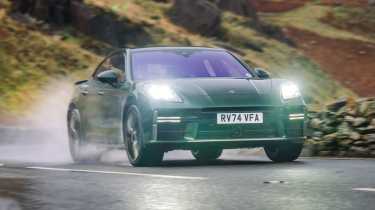
While Porsche doesn’t strictly offer a traditional two-door grand tourer in its range (the last being the 928), the Panamera has been doing an excellent job of filling that role with its two extra doors over two generations now. The current model was developed on a platform shared with the Continental GT, and packs some serious chassis hardware as a result. Hybrid models are available with Porsche’s sophisticated Active Ride suspension that stabilises the platform and cushions the driving experience. Or if you want the lightest, most sporting Panamera, the 493bhp V8-only GTS is the pick. It doesn’t have the firepower of hybrid rivals like the new M5, but without a battery to haul around it’s a satisfying, nuanced car to drive. The GTS has all the appeal of a genuine sports saloon, and makes a fine grand tourer. Conversely, the Turbo E-Hybrid offers serious performance and adds that active ride tech.
‘In cornering, its limits are extraordinarily high, even with the traction control disabled (wholly, or partially, via Sport mode). You have to be pushing quite hard for it to do something untoward, at which point – due in no small part to the 2360kg kerb weight – you’re carrying a considerable amount of momentum. Its feedback might not be as crystal-clear as that of some more traditional sports saloons but the overall sense is of a fundamentally well-sorted car. The wafty limo quality is ever-present at low speeds but, out here in the Welsh wilderness, the Panamera feels poised, controlled and keen.’ – James Taylor, evo deputy editor
Alternatives to the Porsche Panamera
For less money than the Panamera GTS, you can bag the new, hybrid BMW M5 – it may be heavier and less entertaining than previous models, but it’s still a formidable daily supersaloon, and substantially more powerful than the Panamera. For M5-rivalling performance, you need to jump to the Panamera Turbo or Turbo S E-Hybrid, which are much more expensive than the BMW. Both Audi’s RS7 and Mercedes-AMG's GT 4-door are now off-sale, with the electric AMG GT 4-door now revealed.
Porsche Taycan
- Priced from £88,465
- Pros – Exceptional performance, range and dynamic ability
- Cons – Comes at a hefty price; not as roomy as it should be; inconsistent brake feel
- evo rating: Four stars
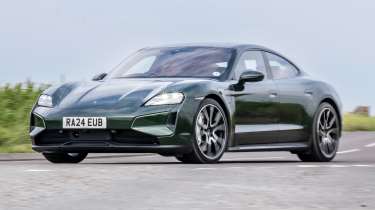
The most remarkable thing about the Taycan is that beyond just being fast and capable, it also drives with the same finesse and attention to detail that defines all Porsches, despite weighing well in excess of two tons. This is felt through the steering, chassis balance and impressive damping, which help to disguise its mass like few rivals can. In 2024 the Taycan was updated with revised styling, more performance, a boost in range and the option of a clever new active suspension system. The standard rear-driven base car can do up to a hefty 421 miles, and range for previously ‘thirsty’ Turbo and Turbo S models has risen to 391 miles. Although you’ll still be at the mercy of the public charging network on a grand tour, these figures are near the top of the electric sports saloon class right now.
‘You’ll recognise the crisp, linear steering response from Porsche sports cars, and the way the Active Ride system counteracts pitch and roll is uncanny. In a car this heavy you’d normally need to slow down your inputs to allow the mass to settle, but not so in the GT. Turn in on the brakes and you can feel the car working all four contact patches rather than leaning heavily on the front axle, and the body stays almost completely flat during hard braking and throttle inputs.’ – Yousuf Ashraf, evo senior staff writer.
Alternatives to the Porsche Taycan
The Taycan’s closest competitor comes from elsewhere in the Volkswagen Group. Audi’s e-tron GT packs the same platform and tech, including optional active suspension, in a different body and with a different range of powertrain options and prices. It’s not as crisp to drive as the Porsche but it’s still extremely competent, and relaxed over long distances. Another EV saloon worth considering is the Lotus Emeya, which delivers a fluid, satisfying drive in S spec and a space age interior. Soon too, the crisp-looking Polestar 5 will be on sale, along with the new Jaguar GT and Mercedes-AMG's GT 4-Door electric.
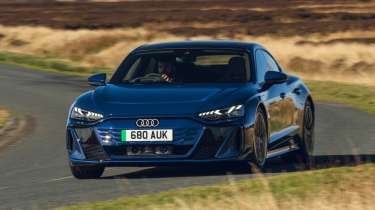
Audi e-tron GT
- Priced from £89,555
- Pros – A comfortable, satisfying and impossibly fast electric GT
- Cons – Expensive in base form; inconsistent brake feel
- evo rating: Four stars
The Audi e-tron GT was updated in 2024 in line with its Taycan sister. Arguably more handsome, the e-tron GT has always had huge appeal by that virtue alone. But that continues on the inside, with an interior that’s less of a pixel fest with more physical buttons. Okay, yes, the new one has haptic steering wheel buttons that are easily grazed but it still gets points for having physical climate controls. To drive, the Audi takes a more languid approach to its dynamics than the Taycan, even though it shares the same sophisticated hydraulically-controlled active damper tech. Over long distances – the longer of which it’s now much more up to thanks to a bigger 97kWh battery and 375-mile range – the Audi generally impresses. While it lacks the ultimate dynamic sparkle of the Taycan, it’s one of the most relaxing EVs to cover ground in.
‘The suspension and steering hardware (including a new quicker rack and rear-wheel steering) are shared with the latest Taycan, but unique software tuning gives it a different feel and character. The e-tron is a fast, accurate GT car, painless to drive quickly but leaning towards being a calm cruiser, where the Porsche can feel more tense and communicative as you ramp up the driving modes.’ – Yousuf Ashraf, evo senior staff writer.
Alternatives to the Audi e-tron GT
The Taycan is the obvious rival to the e-tron GT, but it's a different flavour of the same theme. For something more unique and still hugely capable, there’s the Lotus Emeya. It might weigh as much as three-and-a-half Elises, but there’s fluidity and finesse to the way the Emeya drives, and its cabin looks and feels more special than the Audi’s. There's also the Emeya's Geely cousin, the Polestar 5, joining this market soon too, along with the new Jaguar GT and Mercedes-AMG's GT 4 Door electric.
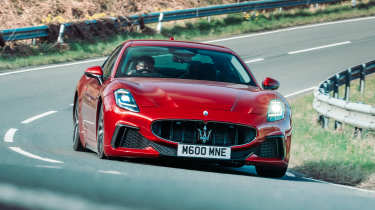
Maserati GranTurismo Trofeo
- Priced from £166,830
- Pros – Gorgeous looks; stunning performance; capable chassis
- Cons – Feels its weight; needs space to come alive; braking performance
- evo rating: Four stars
The clue's in the name. The Maserati GranTurismo taps into the firm's legacy as a maker of achingly gorgeous, fast and engaging GT cars, picking up where the MC20 left off as one of the finest models of its type. In its final years, the last-gen GranTurismo withered against more advanced and more capable rivals from Aston Martin and Bentley, but from a purely visual standpoint, it remained hard to beat. Thankfully, the new GranTurismo carries forward much of its design DNA, but beneath the skin is a car transformed. The top-spec Trofeo version generates 542bhp from its MC20-derived twin-turbo V6, hurling from 0-62mph in 3.5sec and on to a 199mph top speed. But even when you aren't exercising the engine to test those claims, the GranTurismo feels well engineered and indulgent. It’s not as sharp as an Aston DB12, but its more languid character suits the GT role to a tee.
‘As in the MC20 the Nettuno feels like it’s punching well above its quoted power, piling on the revs with a violent surge akin to a flyweight hot hatch. In a blink it’s gone from a car you want to drive across a country in at a leisurely gate to one that you want to use to devour every twist and turn of your favourite road. The harder you push the more composure there is, the harder the gears hit home the more adjustable the throttle becomes.’ – David Vivian, evo contributor.
Alternatives to the Maserati GranTurismo
The GranTurismo sits somewhere between the ultra-luxurious, heavyweight Bentley Continental GT and the harder, more dynamic Aston Martin DB12. The three are different enough in character that there’s room for all of them and taste could dictate your choice, although the Maserati is kindest on your wallet – the DB12 is £22k more, and the Bentley has jumped up to over £200k in its latest guise, with the Speed costing over £235k.
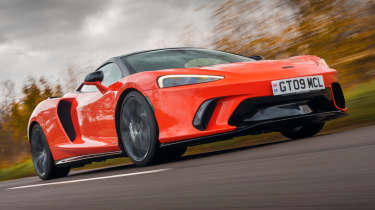
McLaren GTS
- Priced from £179,260
- Pros – A fast, rewarding, genuinely usable supercar
- Cons – Not a true GT; feels its age in some areas
- evo rating: Four stars
The McLaren GTS is a new car that almost certainly slipped your radar, because it’s not really all that new and McLaren didn’t make much noise about it. It’s an upgrade of the McLaren GT, itself an underrated and slightly overlooked car. Its 4-litre twin-turbo V8 is up 14bhp to 626bhp, the visuals have been revised (with extra cooling for the V8) and there are some trim revisions to the interior. But otherwise, it’s the GT as it was – which is no bad thing. Where most GTs are comfortable cruisers that make play as performance cars, the McLaren GTS flips the script as a supercar that’s been softened and made more practical. From our perspective, this is the right approach – it’s a responsive, well-balanced driver’s car, in spite of lacking the limited-slip diff of the Artura and the hydraulically-linked suspension of the 750S. It suffers more as a GT for the latter point, given the magic carpet ride adaptive chassis control allows. The problem is, you wonder whether any other McLaren might best it.
‘It’s largely smooth and controlled, but sharp bumps and intrusions can thunk through the tub and kick back through the wheel, and the rush of the tyres filters in over rough tarmac. As a result you don’t feel totally cocooned and isolated from your surroundings as you would in a true GT. But there’s a flip side, because the GTS is more alive and involving than, say, a Maserati GranTurismo when you aren’t cruising, and guiding it from corner to corner, riding the torque and enjoying its clear, measured responses, can be immensely satisfying.’ – Yousuf Ashraf, evo senior staff writer.
Alternatives to the McLaren GTS
You work backwards from the McLaren GTS as a GT sports car, with each of its closest alternatives more talented when it comes to touring but less thrilling as driver’s cars. Ferrari’s Amalfi shares its predecessor’s balance of refinement and thrills and might be a better GT/supercar/sports car compromise. For GTS money, an Aston Martin Vantage mixes the genres of sports car and cruiser with aplomb and very little compromise.
Five used GTs
Aston Martin Vanquish S
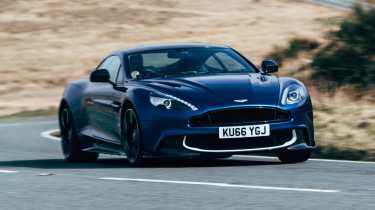
Few manufacturers have such a long and remarkable history of making grand tourers as Aston Martin, though some might now in its turbocharged era pine for the atmospheric V12s bygone. For those, we’d recommend you look to the old Vanquish S, with the most potent, near-600bhp version of that 5.9-litre V12, bolted to the transaxle rear end and bonded aluminium chassis we grew to love. It feels comfortingly old school, but a modern, well-appointed interior and a quick and efficient automatic gearbox keep things firmly in the 20th Century and make it a nice compromise of Aston’s old and new eras. It’s a little cramped inside, but there’s enough space for two people to spend a long journey together in comfort – though the rear seats are best left unoccupied.
Ferrari 550 Maranello
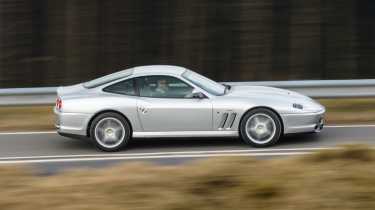
Stare at the modern Ferrari 12 Cilindri and you can see little references to the 365 GTB/4 Daytona of the 60s and 70s. In 1996’s 550 Maranello, the references weren’t quite as overt, but in bringing back the two-seat, sports grand tourer, Ferrari was very much referencing the Daytona in spirit. It took over from the 512M as the brand’s new super-GT and was a more rounded product – not least because Ferrari had dialled some sports-car magic into the Maranello’s front-engined, rear-drive chassis, blending agile handling with long-distance comfort. 578bhp from the 5.5-litre V12 was pretty healthy in the mid-90s too, so the 550 had real supercar pace.
Porsche 911 Turbo S (991.2)
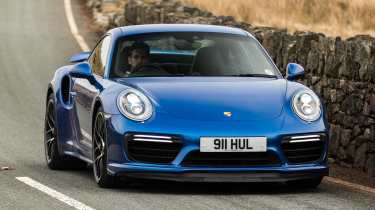
With each generation the 911 Turbo gets closer to the everyday-supercar ideal. Take the 991.2 generation 911 Turbo S: a car whose 3.8-litre twin-turbo flat six made 572bhp and 553lb ft of torque, delivered through a 7-speed PDK that’s both creamy smooth and lightning fast, and a clever four-wheel drive system that can divert power around like it’s the most natural thing in the world. While it admittedly lacked the excitement factor of rivals like the Nissan GT-R, the Turbo S’s intuitive handling, reassuring traction, and the quality of the 991’s cabin (at this point, not yet overrun with screens) made it a hell of an all-rounder, and easier to use every day than Porsche’s GT3 models.
Lexus LC500
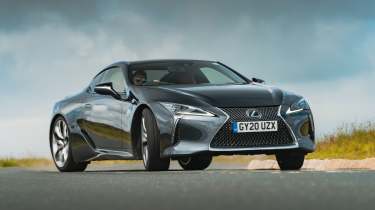
The Lexus LC500 even in discontinuation still looks like nothing else and like it’s from the future, not the past. But as unusual as it looks, it’s equally as conventional and natural to drive. Its 5-litre naturally aspirated V8 not only makes it feel fast thanks to a 470bhp output, but it responds instantly to every squeeze of the accelerator and makes an intoxicating induction howl as you rev it. The engine allows you to easily exploit the rear-wheel drive chassis, too. You have the control to keep things neat and quick around corners or flamboyant and sideways. It’s an incredibly fun car. If anything, the Lexus’s GT attributes have been sacrificed to make its persona sportier; it’s a little too firm and a little too noisy to be the perfect cruiser.
Bentley Continental GT Speed
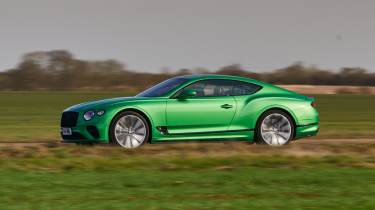
The new car with its hybrid powertrain and two-chamber air suspension may be the best Continental GT there’s ever been, but the previous-generation car perhaps represented the biggest leap in progress. It also has the novelty of being the last W12, which while dynamically not as desirable as the V8s in most forms, for the full experience, we think the 626bhp W12-powered Continental GT Speed is still the place to go. The Speed features an electronically-controlled locking rear differential that alongside an active anti-roll system and monster carbon ceramic brakes makes it amazingly capable over challenging roads.
Yet the Continental GT isn’t really about on-the-limit handling, rather its ability to embrace the driver at any speed. Its superb refinement, exceptional ride quality, total insulation from the outside and beautifully finished interior make it one of motoring’s great experiences to effortlessly thunder across vast distances. It’s about as traditional GT as it gets.