Andreas Preuninger on 25 years of perfecting the Porsche 911 GT3
The Porsche 911 GT3 went from near-anonymous homologation special to the world’s most coveted sports car. Here’s how
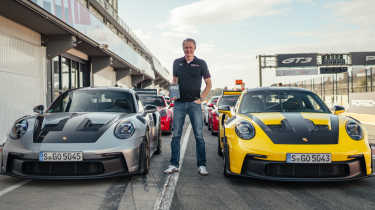
That first 996 GT3 became the nucleus of a new GT department within Porsche, a kind of special ops division that has created each subsequent generation of the 911 GT3 and GT2 families, along with the Cayman GT4 and Boxster Spyder series and much more besides. From the department’s inception, it’s been run by Andreas Preuninger, Director GT Model Line, aka ‘Mr GT3’.
‘I'm not the inventor of the GT3,’ he says, matter-of-factly, ‘it was there before me. I was working as a sales engineer for an external engineering service here in Weissach and worked my way into Porsche’s Sport Driving School. I joined the team of instructors, and among the cars we were using were two pre-series development cars of the first-gen GT3: a yellow one and a metallic orange one. We called it “Sausage Metallic” because it resembled the colour of a kind of sausage that is famous in Germany. And I loved that car. The idea in me grew: I wanted to do something with it, to develop that product.
‘Back then I was an enthusiast of the 964 RS – that car was my role model, absolutely. I wasn’t so much a fan of the first 996 911, because I thought they lost a little bit of character, but it was all there in the GT3: it reminded me so much of the virtues the 964 RS had. And that made me apply to the former boss of Porsche Motorsport [Herbert Ampferer] – because the car was a Motorsport product – to be the next project manager for the second-gen GT3. And the rest is history…’
Nearly a quarter-century of history, in fact. From the 996.2 GT3 onwards, Preuninger has been responsible for each GT3 model, and also for specials such as the 911 S/T and R. ‘I counted them, I’ve done 25 so far,’ he smiles. He took over the second-gen 996 GT3 project in 2001. ‘A lot of people in Porsche were quite astonished that we needed a second batch of the first-gen GT3 to meet the demand. Only then came the idea we needed a second generation, and to build up a small organisation within Motorsport, which I was heading, to be able to go on developing GT3s with a licence plate.
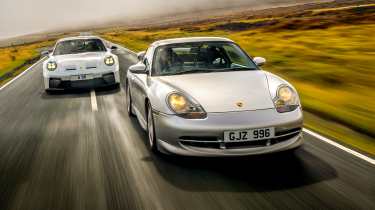
‘I had ideas to differentiate the car more, without stuff you could order on a normal Carrera 996; it deserved bespoke wheels, its own aero kit, a different instrument cluster, all that stuff. We continued that route with more differentiation on the 997 GT3, and it really opened up a niche. Everybody with some petrol in their blood loves the car now. It’s become a brand in itself.’
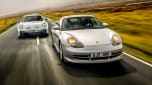
To the man in the street, the term ‘GT3’ is now more synonymous with a Porsche model than it is with the racing category it was originally named after. Since the GT department works so closely with Porsche Motorsport, the link to racing is tangible. ‘Financially for the company, the original GT3 was not an important project: we needed it as a homologation special for the race cars. Back then, you had to have something with a licence plate attached to legalise the 996 RSR, or, in those days, it was the 996 RS: it was only named RSR after I stole the RS moniker for the street car…’
The RS versions of the 911 GT3 have become cult cars in themselves, hugely sought-after and winning comparison tests far and wide. But, as Preuninger alludes to, it would have remained a label for 911 racing cars were it not for his fondness for the 1970s 2.7 Carrera RS. ‘When I was a kid, my neighbour had one, and my mum always had to clean the windows in my room because my nose was pressed up against them to see the car. It was burned into my mind.
'The idea [with the 996 GT3 RS] was to bring it back to life with these polished rims and decals. It came about because for racing we needed different front-end uprights, to be able to drive longer stints on the tyres. To legalise that, we needed an additional 200 second-gen GT3 road cars so equipped. The first idea was just to equip the cars with these new uprights, without telling anybody anything. And I said, “No, let’s do a special model out of that.” That was my chance to bring the old RS back to life, and its visuals. And that’s exactly what we did.'
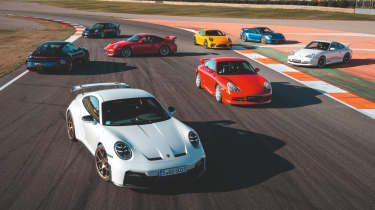
‘I remember especially the reaction of our English marketing colleagues; it’s more than 20 years ago so I can give this away now. They didn’t believe the model would be successful. They said: “Oh, this is too pornographic. We can’t sell something like that. And the clutch is too hard. Nobody will buy this.” But they were wrong…’
The transition from 997 to 991 GT3 for 2013 was one of the biggest shifts – and challenges – for Preuninger and his team, not least because it meant an all-new engine (with some highly publicised failures in early cars). ‘Definitely the leap from the second-gen 997 to the first-gen 991 was maybe the biggest and most challenging in regards of technology, because it was a new engine.

And it was PDK gearbox for the first time – another sacred cow slaughtered! – no more manual, another communication challenge we had to face. And rear-axle steering. We threw a lot of tech into the car. We felt we had to, because there was competition coming on from all sides. The first time on 996, we had no competition. There was no such thing as a high-performance, lightweight, track-focused sports car in that category, but then the Nissan GT-R came along, so we had to throw some tech at our car too to be able to keep pole position. And I think it was absolutely the right decision.
‘I remember sometimes on the edge of my nerves saying [to critics]: “Shut up and drive! Drive the car before you knock it, or before [deciding] you dislike features – because they don’t dilute the precision or the emotional side of the car. On the contrary, they help you go faster, with more fun. And the engine was a screamer, the first time at 9000rpm.’
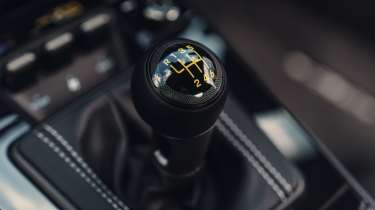
That stratospheric red line has become a GT3 USP, something customers expect and demand. And it’s through listening to customers that the GT3 has been able to stick with natural aspiration, reintroduce a manual gearbox option, add a rear-seat option for the GT3 Touring and much more besides, all while maintaining its essential character. ‘Our customers prioritise sportiness over comfort, and if a brake squeals sometimes, or if the ride is not as comfortable as in a 911 Turbo, that’s fine, because that’s exactly what these people are looking for – they want a no-compromises car. It is not a car for everybody, but for those that want it, it is almost 100 per cent of what they need.
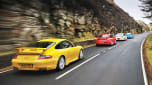
‘It helps that all of us in the team would be customers if we were outside the company and had the money. So we kind of develop the cars a little bit for ourselves as well, because we know that if we like the cars and we are happy with them, then the customer most likely will feel the same.’
Despite growing in size over the years, the GT3’s weight has remained remarkably trim. With a manual gearbox and lightweight options, the 992’s kerb weight is within 100kg of that of the original 996. ‘We really discuss every 100 grams that goes into the car,’ Preuninger says. ‘We believe the sweet spot for a sports car is around 500 horsepower and 1500 kilos with driver and fluids, because the higher the horsepower gets, the more beefed-up the chassis must be, and the more agility suffers. I’m absolutely sure driving connection has to do with weight and the engine. It’s not only power, it’s power-to-weight, and how this power feels in the car.’
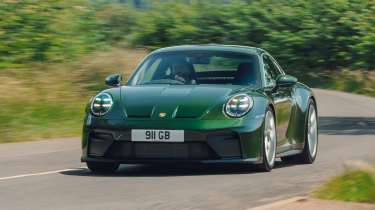
To that end, sometimes Preuninger and his team leave the desks behind and spend a day just driving. ‘It’s very important to spend time in the cars. It’s something that’s dangerous to forget. It’s difficult to make the time, but at least once a week you have to get into a car with the team, without your phone, drive out, and discuss things – with the body guy, with the gearbox guy, the applications engineer – and find compromises. It is so worthwhile to do, more effective than being in a meeting room and looking at PowerPoint presentations. That’s where we get the ideas. It’s a process that’s fun – intensive and exhausting at times, but it’s blood, sweat and tears for the cars. And if we don’t burn for the cars ourselves, how can it be a product that people can burn for?’
> Porsche 911 GT3 (992.2) review – the best GT3 yet?
With ever-tightening emissions, noise and ADAS regs among myriad other pressures, how much more difficult has it become to develop a product like the GT3? ‘More complex by far,’ Preuninger replies. ‘The legislation situation is always a big challenge for us because, in many ways, it is counterproductive to fun in the car. Noise regulations are a natural enemy of good sound in the car, so you have to find ways to keep it attractive for people looking for that, and still fulfil all the rules and safety regulations that are completely different now than they were twenty, ten or even five years ago.
'Most of them call for more weight. I would say 70 per cent of our engineering capacity goes into keeping the car as it is under new legislation boundaries and the other 30 per cent can be used to make better. But we have more people [working on the projects] as well, and we have more advanced technology at hand. So, knock on wood, we have always found a way before, and I think we’ll do so in the future as well.’