Porsche 911 (992.2) GT3 Manthey Kit review – a road-legal race car with a warranty
The monster rear wing and diffuser tell you this is no ordinary 911 GT3. This 992.2-generation car is the latest to benefit from the attentions of Manthey Racing, and we’ve driven it on road and track
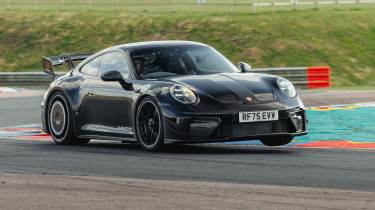
It’s not one of my favourites, but the tumbling arpeggios that open Jamiroquai’s ‘Black Devil Car’ are spilling from the speakers as the first few miles tick by in the latest Manthey-kitted Porsche 911 GT3. I’ve cued it up on the Bluetooth system because the title phrase has been stuck in my head ever since I clapped eyes on the car for the first time at Porsche GB’s Reading HQ an hour or so ago. Every surface seems to swallow the daylight, from the carbon aero discs over the rear wheels to the headlamp inners. There’s a definite touch of malevolence to this 911, with its gigantic pointy diffuser at the rear and a wing that wouldn’t look out of place on an endurance racing car.
What exactly is this thing? Manthey Racing, the road and race engineering specialists based right next to the Nordschleife, have been winning races with Porsches (including the Nürburgring 24 Hours seven times) and making Porsche road cars quicker since the 1990s. Porsche itself acquired a majority stake in the company in 2013, and Manthey has since run its official GT race programmes and created fully homologated packages of upgrade parts for Cayman and 911 models, made available as ‘kits’. This is its new kit for the current 992.2-generation 911 GT3.
More reviews
In-depth reviews
- Porsche 911 Carrera GTS review – why Porsche's T-Hybrid is also one of the best
- Porsche 911 Targa review – the opposite of a purists 911, but still superb
- Porsche 911 Cabriolet review – going top-down is no longer a compromise
- Porsche 911 Carrera S review – the daily 911 that’s quicker than a GT3
Long term tests
Reviews
> Porsche 911 GT3 RS Manthey kit review – the ultimate Nürburgring toy tested to the limit
This isn’t the first time we’ve got our hands on a Manthey-kitted GT3. The previous-generation version featured in 2024’s Track Car of the Year test at Cadwell Park (evo 322), where it thoroughly impressed, feeling noticeably different and more incisive than the stock GT3. In between, Manthey has released its wild-looking high-downforce kit for the 992 GT3 RS, which last year became the fastest two-seater road car we’ve ever timed for evo’s Anglesey Circuit leaderboard.
Aerodynamics and technical highlights
- Upgrades enhance aerodynamics and adjustable suspension
- Generates over double the standard downforce
- Optimised for maximum track performance
From a distance, it looks more like an RS model than a regular GT3, so purposeful are the aero upgrades. What exactly does the kit include? As with Manthey’s GT3 RS offering, there are no changes to the powertrain; instead the main focus is on aero and suspension. Starting under the skin, the regular GT3’s adaptive dampers are exchanged for a coilover setup with passive, hand-adjustable dampers. They adjust four ways, for compression and rebound at high and low speed, while the front spring rates are 20 per cent stiffer than the standard car’s.
At the front, the splitter has a slightly upward slant compared with that of the standard car, to catch airflow as early as possible. It’s 12mm longer too – the maximum possible without infringing pedestrian impact regs. All the kit’s aero surfaces must comply with various legislative demands in multiple markets, and that includes the diveplanes bookending the nose at either side, helping to balance the rear wing’s downforce at the front.
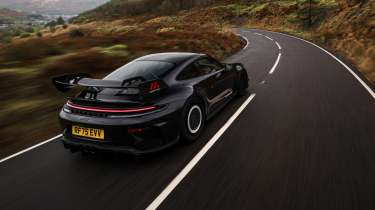
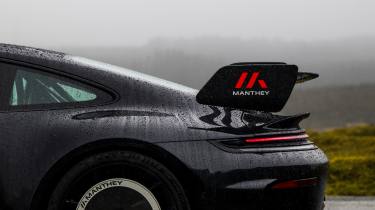
There’s no missing that rear wing. Made from carbonfibre, it’s a different shape to the regular GT3’s, and its ‘underwrap’ endplates are designed to work together with the airflow onto the GT3’s ducktail-style lip, which sits on the tail just beneath the wing. The wing has two manually adjustable angles: a near-flat setting for road use and a steeper angle for the track. Regardless of setting, the kit produces more than double the downforce of the standard GT3. At top speed with the wing in its high-downforce setting (183mph), that translates to 575kg, over 100kg more than the previous, 992.1 kit.
In the lower-downforce setting, the 194mph top speed is the same as the standard GT3’s, because the drag coefficient is the same. In order to retain the GT3’s road-approval homologation, its CO2 and fuel consumption figures must be unchanged. This means, despite the extra downforce, Manthey has had to work to keep the drag coefficient identical. It’s a remarkable trick – a bit like eating more food, yet somehow weighing the same. To achieve it, some of the magic comes from beneath the floor, where aerodynamic surfaces along its entire length help put the air where it’s needed. That includes a variety of turning vanes, made from plastic rather than carbon because they’ll inevitably wear down on track. It’ll no doubt be a point of pride among customers as to how many sets they get through; the more worn down they become, the faster you’re likely to be lapping. The rear diffuser is made entirely from carbonfibre, with a two-step design based on Manthey’s 992 RS kit. Roughly speaking, almost half the downforce comes from the underbody and the rest from airflow above the car. Adding further visual drama are those aero discs over the rear wheels, for reducing turbulence.
Not part of the pack, but available as an extra option and fitted here, are ultra-lightweight alloy wheels, made by Manthey in its own factory. They save a total of 6kg per set compared with the GT3’s regular alloys, and are only 1.4kg heavier than Porsche’s own, very pricey optional magnesium rims. The spidery spokes make it easy to spot a further extra option: Manthey’s special, fade-fighting brake pads painted in bright green. They’re available only for the GT3’s PCCB carbon-ceramic disc option at present, but work is underway to homologate pads for the standard iron brakes too. Braided brake-lines are also part of the kit.
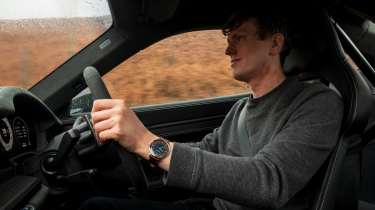
Topping it all off are Manthey decals and an illuminated logo in the door sill panels. This car also has an optional carbon trim package for the vent shrouds in the nose and the engine cover vents at the rear, and tow hooks (optional for the car, mandatory on most trackdays). Even they are a special hybrid blend of alloy and titanium. Some parts of the kit can be ordered separately, but since the components have been designed to work in harmony together, Manthey describes the sum of the kit as being greater than the individual parts.
The kit’s been developed primarily to boost performance on track, and later that’s exactly where we’ll experience it, but in the meantime we have the GT3 to ourselves on the road, with a little over 24 hours before it’s due back at Reading. With that in mind, we’re heading over the border into south Wales to roads the car should relish.
Performance, ride and handling
- Razor-sharp steering offers precise front end response
- Firm suspension balances road pliancy and track stability
- Manthey kit adds track-focused ability, and a warranty...
Even on the urban and motorway drudgery that makes up the first leg of the journey, the responsive, alert steering makes an impression. Modern GT division Porsches invariably have remarkably responsive front ends, but with this car’s touch of extra camber it’s particularly darty, almost disconcertingly so for the first few corners. But you quickly tune in and come to revel in the front tyres’ instant, precise response. In this case, they’re some very fresh-looking Michelin Pilot Sport Cup 2s, with N1 markings denoting them as Porsche-specific tyres.
It’s a moderately noisy car on the road: expansion joints ricochet rowdily, there’s even more tyre noise than in a standard GT3 and, at low-ish speeds, you can actually hear the rear dampers at work. But this is still a very useable car; civilised, even. I can still stream Jamiroquai album tracks with questionable lyrics, even if there’s more background noise for the speakers to compete with than there would be in a more mainstream 911. The bucket seats are even heated.
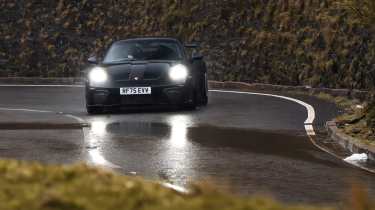
Looks like I may need them, as the Welsh weather gods welcome us with open arms by opening the heavens and turning the temperature down a few degrees as we climb higher into the hills. This is going to be a very wet test.
Driving such a track-focused car with relatively lightly treaded tyres in relentless rain should be scary, but their soft compound is biting into the surface very well, and the flat-six’s linear, naturally aspirated throttle response makes it easy to put the power down precisely. It helps that there’s not a big wodge of torque at low revs; since there’s no change to the engine’s mechanicals nor its software, the 332lb ft of torque reaches its peak above 6000rpm and peak power is up past eight. The magical 9000rpm red line is still there, and sounds as divine as ever.
A surprising degree of pliancy to the suspension helps, too. While the ride’s certainly firm, it’s not busy or crashy like some track-focused cars. There’s still plenty of composure for road use, and it makes the GT3 really driveable on these rural, soaking roads. Brake pedal feel is fantastic, even through my waterproof boots’ stiff soles. The pads don’t squeal, either, unlike many high-performance brakes.
With the space to run at a swiftish pace, the steering response comes into its own. The car feels like a normal GT3 only even more precise, even higher-fidelity than before. For every input in a GT3 you get a precise output, and in this car even more satisfyingly so. The body’s movements upon the suspension feel even more measured with speed, too.
The low (albeit adjustable) ground clearance is one of the few weak points from a road useability perspective. This car has a lift function for the nose to get over speed-bumps, however the low-lying diffuser at the rear is vulnerable, and you do need to take particular care over steep inclines and ramps to avoid grounding it – especially since a replacement is priced at around £6000. Still, the all-round useability in such challenging weather has seriously impressed.
Three days later, we’re back with the Black Devil Car. This time its surfaces are shining in the sun at Thruxton race circuit, and this time its rear wing is set to its steepest setting with the suspension two clicks stiffer. For our opening laps, we’re on the same Michelin Pilot Sport Cup 2 tyres as on the road drive. I’ve never been to Thruxton before and it’s a bloomin’ fast track, with long corners that are hard to see through, and some surface changes and bumps to contend with, too.
The driveability on the road is here in spades at higher speeds on the track, and it gives you a lot of confidence from the get-go. A standout quality is the stability under braking. You really feel the benefit of the stiffer spring rate at the front when braking into the final chicane, sometimes with a little bit of lock on due to the curved approach path. As Manthey intended, it doesn’t ‘fall over’ the outside front wheel, but rather stays stable like a racing car.
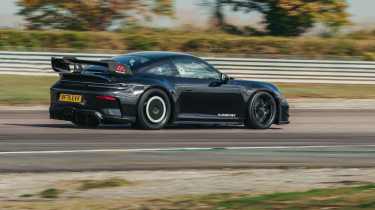
You shift into sixth gear at 150mph on the curving back straight on the approach to the chicane; I’m not sure what speed I’m doing when I actually hit the brakes, since my widened eyes are too busily focused on the jagged-looking apex kerbs, but you can leave your braking really, really late. And the pedal feel is just as transparent and easy to modulate as on the road. The dampers ride the kerbs well, too.
Front-end grip feels relentless on the road but the 911’s weight distribution is more evident on track, and there’s more understeer until the front tyres warm up. But they bite well once there’s heat in them and you can feel the additional downforce over a regular GT3 in the extra stability in high-speed corners (i.e. most of them at Thruxton). But it’s not nailed down on rails like a race car. You’re still working at the wheel, staying on top of the car. You’re really driving it.
I start with stability control switched off but traction control on, assuming I’ll only need it out of the chicane at the end of the lap. But the TC light is winking in some fifth-gear corners over Thruxton’s bumps. There are some particularly wicked thumps through the quick Noble left-hander. It’s a case of hanging onto the wheel tightly, knowing the GT3 will likewise cling to its line.
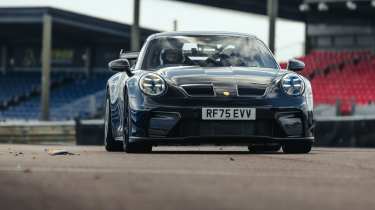
After a break, the tyres are swapped for stickier, more aggressive Cup 2 Rs and I run with both ESP and TC disabled. Once there’s heat in the rubber, the extra grip from the front is immediately apparent. Through the medium-speed complex of the Campbell, Cobb and Seagrave corners near the start of the lap, where you must wrestle the car right, left, right, the nose hits the apex more eagerly. The rear follows obediently – and in some of the faster corners there’s actually a fair bit of oversteer because the front is biting so much better. You need quick hands to stay on top of things in the quicker turns, but the Manthey reaches its limits in such a progressive way that it’s exciting rather than scary.
Most of the time a standard 992.2 GT3 is more than good enough on a circuit. Our previous tests on track at Valencia and the Nürburgring Nordschleife have proven it’s a cut above the vast majority of sports cars for both stamina and stability. But for those who want more, the Manthey kit brings more precision and ultimate ability without compromising what makes the GT3 great. It’s certainly not a small sum of money, although whereas modifying a car such as a GT3 could ordinarily devalue it on the used market (therefore meaning you effectively pay for the mods twice), the Manthey’s Porsche-ratified and warrantied parts may make that less of an issue. It’s a car of devilish abilities, and a heavenly driving experience. As it turns out, that’s the case on the road as well as on the track, and in all weathers.
Price and rivals
This new kit for the non-RS, 992.2-gen GT3 was made available only six months after the car’s launch – a shorter lead time than previously because Manthey had access to the car’s blueprints and data early in the design process, along with early-bird development time at Porsche’s Weissach wind tunnel and test track. For the first time, the kit can be ordered directly from the 911 GT3 configurator. However, due to homologation requirements the car cannot be delivered with it already fitted – an official Porsche centre must apply it later. In the UK, the kit is priced at £56,000. And you’ll need a 992.2 GT3 for it to be fitted to, so make that approximately £223,000 for the complete package – before adding the separate fee for fitting. Bearing in mind this demo car also features various Porsche factory options (including the Weissach Package, ceramic brakes and folding bucket seats, among many others), the total can quickly add up: this car’s total gross price would be around £280,000… The majority of the UK’s 47 Porsche centres are qualified to fit and service the kit, and replace parts with spares in the future. All the components carry Porsche part numbers and the kit comes with a full factory warranty.
Whilst it’s certainly not a small sum of money, there’s no questioning the extra ability it unlocks for those who need it. Whereas modifying older generations of 911 GT3 models could ordinarily devalue their worth on the used market, the Manthey kit’s Porsche-ratified and warrantied parts may make that less of an issue.
Direct rivals are hard to identify, since this car operates in a niche within a niche. You could argue that for a little more money, you could upgrade to a second-hand 992 GT3 RS, and benefit from its active aero and adjustable-from-the-wheel dampers and diff. Other road-legal cars with track ability such as the KTM X-Bow GT-XR are much harder work on the road. The Caterham Seven 420 Cup is half the price and incredible fun but you do get wet if it rains. Or you could buy a used GT4 car such as a Cayman Clubsport – but then you wouldn't be able to drive it on the road.
Porsche 911 (992.2) GT3 Manthey Kit specs
| Engine | Flat-six, 3996cc |
|---|---|
| Power | 503bhp @ 8500rpm |
| Torque | 332lb ft @ 6250rpm |
| Weight | c.1479kg (with PDK) (c.346bhp/ton (PDK)) |
| 0-62mph | 3.4sec (est., PDK) |
| Top speed | 194mph |
| Price | Approx £214,000 (GT3 plus kit) |