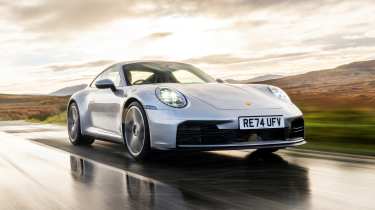
Porsche 911 review – more complex than ever, but still the best sports car
The 992-generation 911 has taken time to reveal its character, but it’s evolved into a sports car with enormous breadth and ability

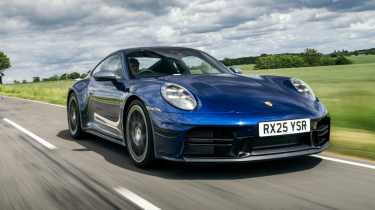
When the 992-generation Porsche 911 first arrived, we had our reservations about whether it was an evolutionary step too far for the iconic sports car. Yes, it was more capable than the 991 it replaced, but also bigger, heavier and less readily exploitable, with that typical 911 magic only showing itself when you worked the car hard.
With time, however, we’ve grown more fond of the 992 – particularly as the range has been fleshed out with more involving versions like the Carrera T, Carrera GTS and of course the GT3, GT3 RS and S/T. The weird, wonderful and ultra-limited Dakar and Sport Classic are other highlights.
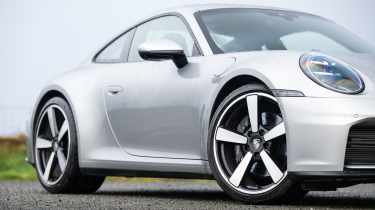
In 2024, the updated 992.2 model arrived with a series of updates to keep this momentum going – some small, and some hugely significant. For example, the 992.2 GTS launched as the first hybrid-powered 911, bringing a new dimension of performance, personality and efficiency to the package. The rest of the range is as broad and varied as ever, featuring coupes, cabriolets and Targas, and everything from a 389bhp base Carrera to a 701bhp hybrid Turbo S. At present, GT department models are limited to the GT3 and GT3 Touring, but expect an updated 992.2 GT3 RS to arrive in due course, along with more specialised and limited variants.
More reviews
In-depth reviews
- Porsche 911 Targa review – the opposite of a purists 911, but still superb
- Porsche 911 Cabriolet review – going top-down is no longer a compromise
- Porsche 911 Carrera S review – the daily 911 that’s quicker than a GT3
- Porsche 911 review – more complex than ever, but still the best sports car
Reviews
So no matter your priorities, there’s almost certainly a 992 to suit. But is the 911 still at the top of its game after its latest evolutionary step?
Engine, gearbox and performance
- Range of flat-six engines, from a 389bhp 3-litre to a 701bhp 3.6-litre hybrid
- All models bar the Carrera T and GT3 are PDK-only
- GT3 continues with a naturally-aspirated, 9000rpm motor
The 992.2 engine range is a mix of the familiar and somewhat groundbreaking. The base Carrera continues to use a 3-litre twin-turbocharged flat-six, with the latest car gaining uprated turbochargers and an intercooler from the 992.1 Turbo. This increases power from 380bhp in the 992.1 to 389bhp, with torque standing at 332lb ft. This engine also forms the basis of the lightweight Carrera T – the only Carrera available with a six-speed manual in place of the 992.2’s eight-speed PDK.
The Carrera S receives a big power hike over lesser models, generating 473bhp (up from 444bhp in the 992.1) thanks to upgraded turbochargers and revised charge-air cooling. Peak torque is rated at 391lb ft, and while the Carrera and Carrera T are rear-drive only, a four-wheel drive Carrera 4S is available.
911s have always punched above their quoted power figures, and the same is true of the 992.2. Even the regular Carrera is so quick these days that you don’t need much more in a road car. The PDK shifts quickly and seamlessly to make the performance almost instantly available to you, yet there’s still joy in running to the redline – the turbocharged flat-six almost mimics the delivery of a naturally aspirated unit. The Carrera S has a similar character but more of everything, with enormous punch and flexibility.
The GTS is more potent still with 534bhp and 420lb ft of torque, and brings a significant character shift from other Carreras. Its hybrid powertrain is one of the biggest developments for the 992.2, and built around a specially developed 3.6-litre flat-six with no belt drive for the air-conditioning system, with that being handled by a high-voltage electrical system. This makes space for a pulse inverter above the engine for the hybrid system, which uses a 54bhp electric motor integrated into the PDK gearbox.
There’s another electric motor integrated into the GTS’s single turbocharger, which spins it up to build boost faster and improve response. Powering these is a 1.9kWh battery positioned at the front of the car, where the 12-volt battery is normally located. The weight penalty over a Carrera S is a modest 55kg, but the extra power and torque more than offset this – it feels ballistic, with sharp, linear responses and a gravelly, almost V8-like engine note.
The GT3 is the only naturally aspirated 911 available, coming with a 9000rpm, 503bhp 4-litre engine and a small bible’s worth of technical track-focussed upgrades. The 992.2’s motor has been thoroughly reworked to comply with latest emissions regulations, and it’s one of the world’s great engines. It still has that familiar GT car shriek when you wring it out, and closer gear ratios than the 992.1 make those addictive sensations easier to access than before. The GT3 RS uses a development of the same engine with a wild aero package, revised suspension and a highly configurable chassis, but an updated 992.2 version hasn’t been launched yet.
As a result, the Turbo S sits at the top of the 911 tree for now. It builds on the GTS’s hybrid 3.6-litre engine and uses a pair of electric Turbos to generate 701bhp and 590lb ft of torque. It deploys this with startling efficiency and the hybrid system covers up nearly all of the lag from the turbochargers – fully wound up, the Turbo S is brutal yet almost drama free in its delivery.
Driver’s note
‘The Carrera S offers a convincing uplift in performance and agility over the Carrera for well-heeled buyers to consider (or those with an eye on residuals). But the base car possesses most of the S’s strengths, and the rawer, manual transmission Carrera T is even more fun and involving for less money.’ – James Taylor, evo Deputy Editor
Ride and handling
- Superb adaptability, feel and traction is ingrained in the package
- The GT3 is as visceral as you’d want, with fantastic precision and clarity
- Turbo S is enormously effective but not the most tactile and involving in the range
The 992’s structure is more aluminium-intensive than previous generations, but retains a mixed-metal construction. Only 30 per cent of the shell is steel, and the main body pressing is aluminium. The lightest Carrera – the T – comes in at 1478kg, stretching up to 1810kg for the Turbo S Cabriolet.
There’s only one body shape for Carrera models (but still three body styles – coupe, Cabriolet and Targa), in contrast to previous versions that had varying bodies depending on whether they were rear- or all-wheel drive. Suspension is by MacPherson struts up front (except the GT3, which uses double wishbones) with a multi-link rear axle, and the steering is electrically assisted.
All 992.2s come with PASM adaptive dampers as standard, with the Carrera S including Porsche Torque Vectoring Plus in the asking price. The Carrera T and GTS models go further with standard rear-axle steering and PASM Sport suspension, which drops the ride height by 10mm. On the options list, you’ll also find Porsche Dynamic Chassis Control (active roll stabilisation) and PCCB ceramic brakes. The Turbo S goes further with an electrohydraulic PDCC suspension system that uses the car’s 400V electrical system to control its active anti-roll bars.
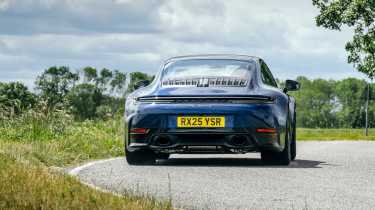
The 992.2 is thus the most complex 911 yet. That might worry purists, but in practice the tech melds together in a cohesive, deeply capable whole. Admittedly, older 911s deliver more sensations to the driver more of the time, but by modern standards (and in comparison to rivals like BMW’s M4 Competition) the 911 still feels connected and intuitive in a way that speaks to the decades of development Porsche has lavished on it.
This becomes more apparent as you up your pace and commitment. The 3-litre Carrera engines are linear and responsive, the brakes are strong and progressive, and there’s a good sense of load through the steering as you lean on the tyres into a corner. On the way out you can get on the power good and early, knowing that the rear tyres will hook up and launch you down the next straight. This feel and natural rear-engined traction and capability make the 911 supremely effective in the wet, too.
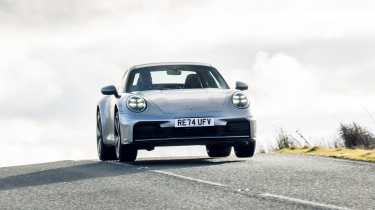
The character shift brought by the GTS’s hybrid powertrain is stark, but in all the right ways. It feels like a mix of elements of Turbo and GT3, with its standard-fit chassis upgrades giving fantastic precision and incisiveness. It’s firmer than the Carrera and more reactive to surface imperfections, but there’s extra crispness to the way it steers and the way the chassis responds at speed, the body settling more quickly on turn in. The more muscular engine also gives you more freedom to neatly adjust and balance the car through a corner – it all culminates in a rich driving experience that shuns any notion that the 992 isn’t a true sports car.
To a greater extent, the same is true of the GT3. Despite being hobbled by more stringent noise and emissions regulations, the 992.2 still feels as raw and spectacular as the previous-generation car, but with S/T-inspired upgrades bringing a higher level of polish and capability. It remains a grippy and intense track car, but also one that’s malleable and playful over the limit, and totally absorbing on the road (if perhaps a little too raw in its most lightweight spec.)
A manual transmission is, of course, an important additive to the 911’s viscerality, bringing an inherently more connected experience that no automatic transmission can offer. The Carrera T's meaty, satisfying six-speeder makes for a more absorbing, less clinical driving experience than a Carrera, and there's extra rawness and edge from its specially-tuned, 10mm lower suspension and reduced sound deadening. The ride can be tough on bumpy roads but it feels more connected and that bit more exciting than the base car.
The Turbo S is a different character altogether, more clinical than a GT3 but substantially more muscular and easier to exploit on the road. It’s not the 911 we desire most, but for what it gives up in terms of outright engagement it gives back in its fantastic sense of security, and a more polished (but still firm) ride quality than the GTS. There’s playfulness if you go looking for it too, but that’s not really what the Turbo S is about. Instead it’s a car that makes its potential accessible in pretty much all conditions, to drivers of all skill levels, like very few can.
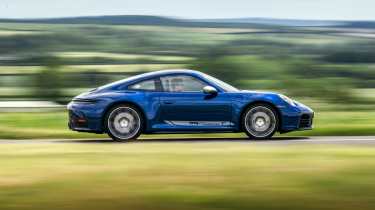
As a GT, the 992 is more usable and refined than previous models, but still falls short of being able to morph into a truly cosseting cruiser – particularly in T spec. There’s still plenty of characteristic 911 road roar, but wind and engine noise are well suppressed. And while the ride is quite firm at low speeds, it improves as your velocity increases.
Cabriolet and Targa models do a great job of transferring the 911s abilities to an open top package. In dynamic terms both get impressively close to the coupe, with the Cabriolet being a little lighter and sharper than the Targa. The Cabriolet is more refined at a cruise with less buffeting too, but both have a strong sense of structural integrity, with only the roughest surfaces exposing more shimmy and vibration than a hard top.
Driver’s note
‘This really is one of the best cars on sale. It’s also unique, not only for its naturally aspirated engine – wonderful though that is – but for the fact it has three pedals and a H-pattern manual gearbox.’ – Henry Catchpole, evo Contributing Editor
Interior and tech
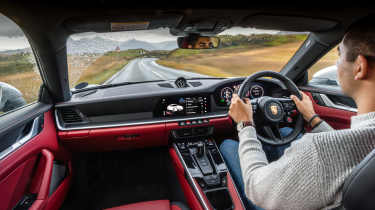
As with the exterior design, 911 cabins have been a largely evolutionary affair, and the same is true of the 992.2. Amongst a few classic details like the five-ring dial pack (now fully digital and configurable), the 992’s interior is well appointed and solidly built, and can of course be enhanced even further with an almost endless list of optional finishes and accessories.
Certain details aren’t as appealing as earlier generation cars, such as the apologetic gear selector in place of the 991’s more tactile pistol-grip lever, the lack of an analogue rev counter and a start button instead of the 992.1’s turn switch. The Carrera T does at least get a tasteful nod to the past with a walnut gearknob for its six-speed manual 'box, although the H-pattern stickers on the side windows and dash are a bit much. On the whole it’s a pleasant and intuitive cabin, with sound fundamentals and a great driving position. The wheel is pleasingly small and slim-rimmed, and the optional 18-way Adaptive sports seats offer plenty of fine adjustment.
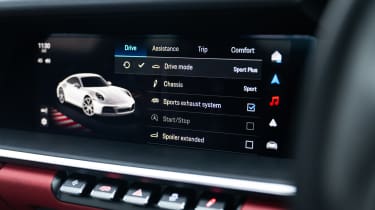
As a 2+2 with a surprisingly large luggage area under the front cover, the 911 continues to offer more practicality than many cars you’d consider rivals. And though it’s more digitised than ever, with a crisp and relatively intuitive central touchscreen handling most functions, there are still physical controls for climate settings, and buttons for the likes of ESC, exhaust and damper settings. It’s a shame, though, that in the move towards a more GT-like feel, the old 911 bugbear of excessive road noise hasn’t been banished – it’s one of very few things that detracts from the cabin ambience.
In the GT3 this is easier to forgive, given how purposeful and racy its suede-trimmed cabin already is – particularly if you go for the no-cost Club Sport package, which adds a roll cage and fire extinguisher inside. This is only available if you go for the £5390 lightweight folding bucket seats, however, which now feature removable headrest cushions for improved comfort while wearing a helmet.
MPG and running costs
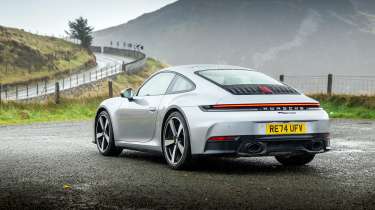
Economy figures for the Carrera and Carrera S are 28mpg on the WLTP cycle. The T achieves a marginally worse 27mpg, presumably because of its manual gearbox, while the 4S gets the same.
Thanks to its hybrid system, the GTS achieves similar results despite being significantly more powerful and a little heavier than other Carreras. And from our experience, the claimed figures are well within reach – and sometimes surpassed – on a relaxed cruise.
It's worth noting Porsches are generally expensive to both buy and run. Aside from fuel, consumables such as tyres and brakes (particularly carbon ceramics) are expensive to replace, while general servicing and maintenance will also be at the high end.
Price and rivals
At launch, the 992 represented a fairly serious jump in pricing compared to previous generations, but inflation and strong demand has encouraged those prices to keep rising since its 2019 debut. As a result, the 992.2 now starts from £103,700 in base Carrera form – serious money for a sports car.
For the more driver-focussed Carrera T, you’ll pay £115,400, and just over £120k for a Carrera S – or £127,000 for the 4S. Topping the Carrera range is the £137,900 GTS, with the four-wheel drive version commanding an extra £6500. All of the aforementioned models are available as Cabriolets, with only the 4S and 4 GTS offered as Targas.
Then come the GT products, with the GT3 costing £158,200 in both winged and Touring forms. We’re still waiting for a 992.2 GT3 RS, however, which is expected to top the range at around £200k. The hybrid Turbo S, meanwhile, costs from £199,100 or £209,100 as a Cabriolet.
With such a spread of models, specific rivals are difficult to pin down. At the lowest level, cars like the Lotus Emira, BMW M4 or even Alfa Romeo’s Giulia Quadrifoglio could be considered Carrera rivals, while everything from the Mercedes-AMG GT to the Aston Martin Vantage or McLaren Artura could be compared to the Turbo. The GT3, meanwhile, has few track focussed competitors in the £160k price bracket. The AMG GT63 Pro is one potential alternative, and if you’re buying used, you can bag a 991.2 GT3 RS for similar money.