Best electric cars – these EVs deserve the attention of car enthusiasts
There's a huge variety of electric cars on sale in 2026, and we've picked the best of the breed for those looking for performance
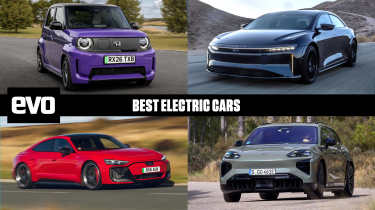
Many drivers have already made the switch to electric thanks to the performance benefits, refinement and on-paper green credentials, with ever-tightening emissions regulations and government ICE bans making them more widespread in the new car market each year. For many driving enthusiasts, however, the electric car has long been seen as a threat, losing character and gaining weight over combustion counterparts.
Regardless, there is a wave of new performance-oriented EVs on the way. The incoming Peugeot e-208 GTI is soon set to gnash at the heels of the Alpine A290, while an electric variant of the next BMW M3 is nearing production readiness. When it arrives, it’ll have the new Hyundai Ioniq 6 N to contend with, and Polestar's already launched its alternative to the popular Porsche Taycan with the 5. Even Ferrari has joined the electric party (perhaps a little late) with the Luce...
So, which are evo’s current favourite EVs? From sports saloons to crossovers and hypercars, we’ve listed the best models on sale in 2026 below.
The best electric cars to buy in 2026
- Honda Super N
- Lucid Air Sapphire
- Polestar 5
- Porsche Taycan
- Audi e-tron GT
- Alpine A390
- Porsche Macan GTS Electric
- Alfa Romeo Junior
- Hyundai Ioniq 5 N
- Renault 5
- Rimac Nevera R
- Hyundai Ioniq 6 N
- Alpine A290
- Abarth 600e
- Kia EV6 GT
- Porsche Cayenne Electric
Lucid Air Sapphire
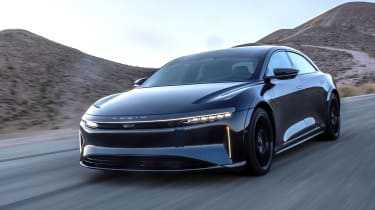
- Pros – Ambitious, innovative, embraces true torque-vectoring
- Cons – Heavy, brake feel, will probably make your family vomit
- evo rating: 4.5 stars
We all know power isn't everything, but that's often the sole metric by which performance EVs excel over their combustion-powered counterparts. You'd be forgiven for thinking the 1200bhp Lucid Air Sapphire was more of the same story, but thankfully, there's much more depth to its offering.
Having used models such as the excellent BMW M5 CS as a benchmark during development, the range-topping Lucid saloon doesn't only have hypercar power, but excellent dynamics too. Jethro Bovingdon said: '...a focus on a fluid, easy-going balance with an unfashionable amount of pitch, roll and dive goes some way towards recreating an enthusiast’s imagined past.'
Given the extreme adjustability a triple-motor setup allows for, it has full torque vectoring capabilities which shrink its vast dimensions around you. Bovingdon added: 'In slower turns it quickly chases understeer away with aggressive over-speeding of the rear axle; through quick turns you can feel it tweaking and cajoling the balance and holding the car in the perfect yaw angle.' It's one of the best quick saloons on the market as a result, if you can get your hands on one in the UK, that is.
Honda Super N
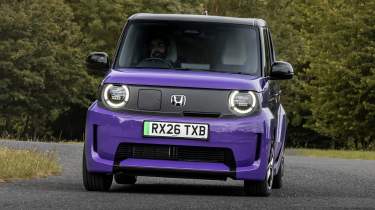
- Pros – Fun looks, fun drive, virtual shifts, well priced
- Cons – Definitely not quick, range will be a hard sell
- evo rating: 4 stars
The Japanese Kei car has always been a fascination of those from the west, with ultra-compact dimensions, subsequent low kerb weight and charming styling all part of the package. The Kei-derived Suzuki Jimny was sold out for almost the entirety of its time on sale in the UK, and while we haven't seen another model like it since, the new Honda Super N brings some of the magic back.
Its fun, boxy design makes it immediately clear that this is derived from a Kei car, with dimensions only marginally increased to allow for an increased track width. The reason for that change is that the Super N is a driver-focused model, but not in the same sense as a Type R.
Power stands at a very modest 94bhp for an even more modest 10sec 0-62mph time, but the use of virtual gears and a piped-in combustion engine sounds makes it feel much less dull than it sounds. It handles well too, with a firm but well-rounded ride and responsive steering making it just as chuckable as its looks would suggest. Better still, it's available from just £18,995 in the UK to make it one of the most accessible driver's cars on sale today, EV or not.
Polestar 5
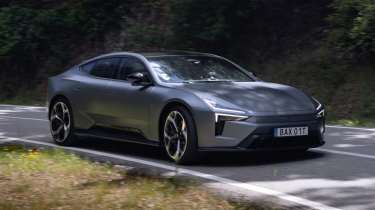
- Pros – Great looks; superb steering and damping; not as frenetic as a Taycan
- Cons – Lacks a Taycan’s precision; a whole lot heavier; cabin falls a little short for £100k; questions over range
- evo rating: 4 stars
The Polestar 5 is finally here, going on sale a full six years on from the debut of the Precept concept that previewed it. Happily, its crisp Scandinavian design hasn’t aged a day. What has is the market the 5 now joins, with premium electric cars not proving to be the sales successes many expected when its chief rival, the Porsche Taycan, went on sale.
Polestar persisted undeterred with the 5, with the focus on creating a worthy halo model; a flagbearer for the brand and a flex of its engineering muscles. To that end, it uses a bespoke bonded aluminium platform, electric motors, steering and damping systems – MagnerRide on the flagship and passive on the Dual Motor.
The result is a genuinely entertaining performance car, with good feel to its steering and fidelity in its damping. It wears the endless hours spent on its development on its sleeve. Conversely, it’s also more practical than the Taycan, less frenetic at a cruise and priced incredibly competitively. Though fewer are now cross-shopping this segment than perhaps Polestar would like, the 5 is nonetheless a genuine competitor worthy of consideration.
Porsche Taycan
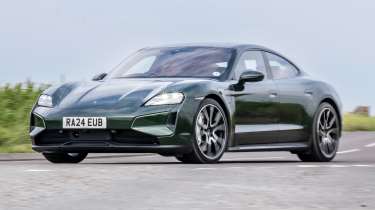
- Pros – Fast, 421 miles is good range, drives as a Porsche should
- Cons – Expensive, touch-heavy UI, practicality
- evo rating: 4.5 stars
The Porsche Taycan has had a while to mature into the marketplace since it launched in 2019, and in the process it's become one of the very best electric cars on sale. Having received comprehensive updates to its powertrain, battery tech and chassis in 2024, the Taycan is now almost without weakness (ignoring question marks over residual values, that is...).
Every Taycan is quick – even the base rear-drive version hits 62mph in 4.8sec – but more important is that the driving experience feels distinctly Porsche-like. It steers with supreme accuracy and precision, and despite weighing 2090kg in its lightest form, it corners with the sure-footed poise of a genuine sports saloon. Porsche's Active Ride suspension technology comes to the fore here, giving the Taycan a freakish ability to resist roll and working all four tyres evenly through corners. It's one of the very best handling EVs you can buy, and the Taycan now has the range and efficiency to back this up, achieving up to 421 miles from a charge in single-motor guise.
Audi e-tron GT
- Pros – A comfortable, satisfying and impossibly fast electric GT
- Cons – Expensive in base form; inconsistent brake feel
- evo rating: 4.5 stars
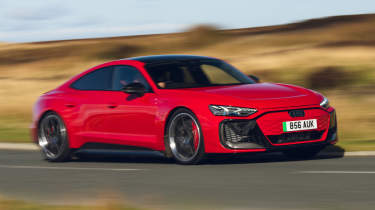
Building on Porsche’s hard work with the Taycan is Audi’s take on the large premium EV, the e-tron GT. Using the same J1 platform as the Taycan, the Audi takes a more laid-back approach with more emphasis on cruising ability rather than trying to feel like a sports car. The e-tron GT was updated in 2024 to bring its powertrain, range and chassis tech up to speed with the latest Taycan, and it makes for a compelling alternative to its relative from Stuttgart.
It's less tactile and intuitive to drive quickly, but the e-tron GT still has impressive polish, speed and control. The facelifted version gets up to 912bhp in RS Performance form for truly astonishing levels of performance, but the S e-tron GT offers all the power you'd ever need (671bhp) and a healthy 374-mile range, supporting its GT credentials. Another string in its bow is an optional active suspension system, which gives the e-tron GT a sometimes freakish level of ride comfort and enormous support at each corner. This blend of talents makes it one of the best electric supersaloons you can buy.
Alpine A390 GTS
- Pros – Impressively fun to drive dynamically
- Cons – A bit too frenetic when you're not; Not the best range or charging
- evo rating: 3.5 stars
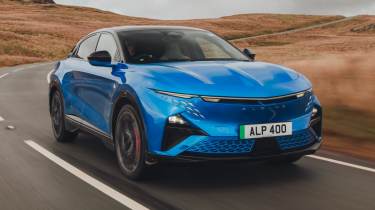
Alpine is going electric, and it’s going mainstream. That might not be music to the ears of enthusiasts, but the brand needs to be profitable to produce the sports cars we love, and that means branching into new areas of the market. The A290 hot hatch was the first step in this mission, and the A390 is the second. As a four-wheel drive fastback crossover it goes head-to-head with Porsche’s electric Macan, and in flagship GTS trim packs 464bhp, with a torque vectoring dual-motor rear axle.
To drive, you wouldn’t mistake it for an A110, but the A390 is sharp, agile and more engaging than most EVs of its type. It’s quick and capable but offers a degree of satisfaction in how it tackles a road, with quick steering and scope to drive it on the throttle thanks to that torque vectoring rear end. It’s not as much fun as Hyundai’s Ioniq 5 N, nor as polished and plush as Porsche’s Macan, but it’s more competent and desirable than most crossovers of its type.
Porsche Macan GTS Electric
- Pros – Polished and capable dynamics; impressive performance and range
- Cons – Expensive; heavy; chassis upgrades could have gone further
- evo rating: 4 stars
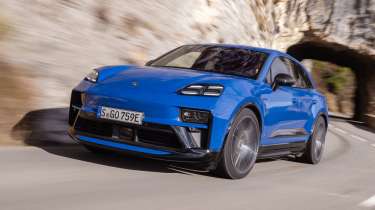
Porsche’s second-generation Macan arrived with a lot resting on its shoulders. Not only has it been tasked with following the runaway sales success that was the original Macan, it debuted a new PPE electric car platform jointly developed with Audi to offer next-gen performance, range and dynamic ability. It’s a calling card for what’s to come from a forthcoming wave of Porsche and Audi EVs.
Drive one and it doesn’t take long to realise that Porsche has executed the electric SUV formula very well at the first time of asking. The Macan drives with the polish you’d expect from a Stuttgart product, and in its most potent forms, there isn’t much that could stay with it on a technical road – sports cars included. It’s quite sensitive to spec, however, with various power levels, rear or four-wheel drive and a host of chassis and suspension configurations available. The GTS version makes things simple, including all the bits you want (bar rear-wheel steering) and 563bhp for substantially less money than the Turbo. It’s still nearly £90k, but it’s one of the most rounded and capable electric SUVs out there.
> Porsche Macan GTS Electric review
Alfa Romeo Junior Veloce
- Pros – Engaging dynamics, different design, limited-slip diff in Veloce
- Cons – Poor electric range, ergonomic quirks, not the most soul-stirring of Alfas
- evo rating: 4 stars
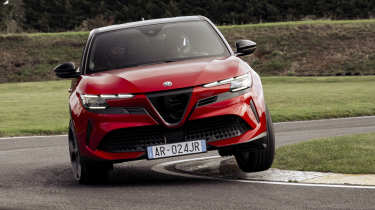
Alfa Romeo’s first (and so far only, if you exclude the 33 Stradale EV) stab at an electric car is the rather promising Junior crossover. Yes, it doesn’t deliver the kind of glamour and allure you’d typically associate with Alfas, but there’s a definite sense of sporting DNA in the way it drives – particularly in 276bhp Veloce form.
So equipped, the front-drive Veloce reaches 62mph in under 6sec, and thanks to a Torsen limited-slip diff and a tautly-tuned chassis, there are glimmers of hot hatch-style agility and fun when you go looking for it. The Junior is no flyweight at 1560kg, but a keen front end and strong roll support help disguise the mass at play. The only snags are a firm ride, poor brake feel and a 200-mile range that’s significantly shorter than that of rivals like the Cupra Born.
Hyundai Ioniq 5 N
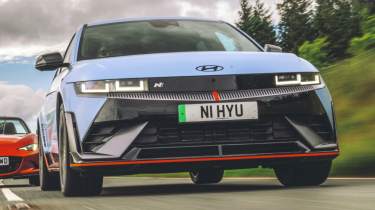
- Pros – Genuinely involving and engaging to drive; practicality; track capability
- Cons – Heavy; expensive to buy; naff synthesised engine noise
- evo rating: 4.5 stars
We had high hopes for the Ioniq 5 N ever since we first heard whispers of its unique approach to driving dynamics. This is the first mainstream EV to not only make full use of the software augmentation possible with an electric powertrain, but to give the driver full access to that box of tricks. Everything from the torque distribution, brake regen response and powertrain energy deployment can be adjusted, and it can even simulate the feel and response of an 8000rpm petrol engine.
The result is one of the most involving EVs we've driven, at any price. Fundamental engineering changes over the base Ioniq 5 – including a stiffer structure and a 641bhp dual motor setup – conjure the feel of a genuine performance car, and the plethora of modes add a new dimension that's missing in pretty much any other EV. Switch to a rear-biased torque split and the Ioniq 5 N is thrilling, rewarding and just plain fun, with a more expressive handling balance than even a Porsche Taycan. As a sign of things to come from future N products, it couldn't be better.
Renault 5
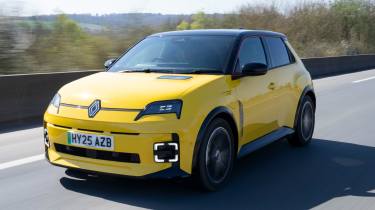
- Pros – High quality engineering, premium feel
- Cons – Battery doesn’t like the cold weather
- evo rating: 4 stars
Since we first set eyes on Renault’s reborn 5 hatch in concept form in 2021, we had high hopes for what appeared to be exactly what the market needed: a small, desirable, affordable EV designed around the right priorities, hopefully for the right price. Now, having driven the final production version, the R5 has met all of our expectations.
The R5 has the kind of feel-good factor not found in this sector since the likes of the original BMW Mini, but that goes beyond its charming retro design. It's slick and satisfying to drive too, and though it was never going to be an intensely engaging hot hatch (Alpine was given that task with the technically-related A290), there is some fun to be had and enough zip for an 8sec 0-62mph time. Combine that with a respectable real-world range of 200-miles and an affordable £23k asking price (before you've lopped off £3500 with the electric car grant), and you have the makings of a mass-market EV success.
Rimac Nevera R
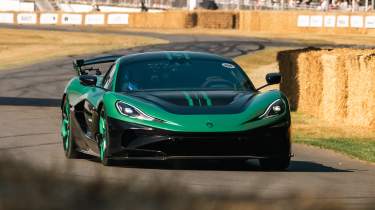
- Pros – A mesmerising, freakishly fast and totally absorbing hypercar
- Cons – We haven't driven it on the road
- evo rating: 5 stars
The spectacular Rimac Nevera uses some of the most advanced hardware and calibration ever seen on a road car to conjure an intuitive, organic and simply mesmerising driving experience. That it’s able to do so without the character and noise of a combustion engine has ignited our hopes for the future of performance cars – it’s that good. But as electric car technology continually progresses, Rimac hasn’t rested, the Nevera evolving into the even faster, more track focussed R version.
Compared to the ‘standard’ car it gets even more power – 2078bhp compared to 1887bhp – more aggressive aero and revised chassis tuning. The results are sublime. It’s not just the ludicrous manner in which the R deploys its power to the road, nor the enormous cornering forces it can generate. The Rimac achieves so much more than this, clearly communicating to the driver through every touch point and opening up a world of different driving behaviours via its torque vectoring quad-motor setup. Fully unleashing it is one of the most intense experiences you can have in a car.
Hyundai Ioniq 6 N
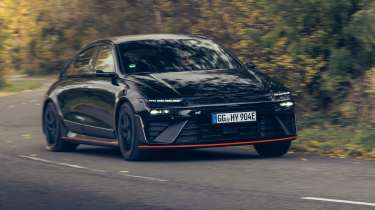
- Pros – Class-leading powertrain; engaging chassis; premium ride
- Cons – Weight; awkward design
- evo rating: 4.5 stars
Hyundai hit it out of the park with its first performance EV, the Ioniq 5 N. It launched in 2023 as one of the most bold mainstream electric cars yet, with a huge array of software features and chassis configurability – including everything from a switchable torque-split to a simulated internal combustion engine mode, complete with virtual gearshifts, engine braking and a rev limiter. The result was the most interactive and fun EV we’ve driven this side of £100k, and the Ioniq 6 N saloon takes the same ingredients and applies them to a lower, sleeker saloon – to great effect.
With a 601bhp dual-motor setup (or 641bhp on overboost) it’s rapid, of course, and it has the same sense of deeply ingrained engineering quality as the 5 N. There’s a stiffer body structure than the standard Ioniq 6, revised suspension with different geometry, an e-LSD and again, a high level of configurability. The result is an electric supersaloon that’s more polished and rounded than the 5 N in some respects, but equally as much of a laugh. The driving experience pulls you in with accurate steering, controlled damping and handling that can be as expressive and adjustable as you’d want from a supersaloon. It’s another hit from the N division.
Alpine A290
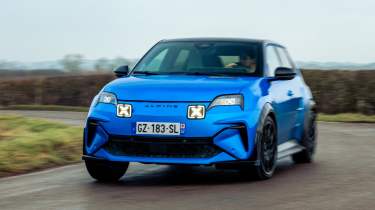
- Pros – Excellent handling; balanced driving experience; design charm
- Cons – Comes to life on track, where you’d drain the battery in 20 laps…
- evo rating: 4 stars
Once we’d driven the Renault 5 we knew the more driver-focused Alpine version would be a hoot and we weren’t disappointed, it’s a cracking little hot-hatch, even if it’s not quite as inspiring as some of its distant relations from Renault Sport. There are two power levels, the 178bhp GT or the GTS that’s been wound up to 217bhp for a 6.4sec 0-62mph and a top speed of 106mph with its ultimate performance being blunted by its nigh-on 1.5-ton kerb weight.
No matter, it’s still an entertaining if not exhilarating car to drive with excellent balance, great stability, impressive brakes and a neutral feel to its handling. It’s good fun to drive quickly even if it’s not right up there with the best hot hatches of old. The GTS has an official range of up to 226 miles so it’s still saddled by having a relatively small 52kWh battery, but it is a small hatch so perhaps its unrealistic to expect a more impressive range figure. As a first attempt at an electric hot hatch it’s very impressive and gives us hope for the future models.
Abarth 600e
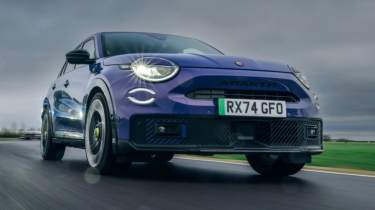
- Pros – Chassis balance; playful dynamics; accessible performance
- Cons – Range; cabin materials
- evo rating: 4 stars
Abarth has served up some intriguing cars over the years and it’s now hoping to make waves with its electric offerings. The 600e is the most powerful Abarth road car to date and it’s built on the same platform as the Alfa Romeo Junior meaning a larger and more practical machine than the diminutive Abarth 500e. It’s available in two guises, the standard car and the limited run Scorpionissima, and while both use the same hardware the latter has more power – 276bhp and 254lb ft of torque – the same as the Alfa Junior Veloce.
Like the 500e the Scorpionissima features Abarth’s sound generator and while it’s better resolved than in the smaller Abarth it’s still a bit of a gimmick. It’s quick though, with 0-62mph coming up in a whisker under 6sec and it puts its power down enthusiastically thanks to a proper mechanical limited-slip diff. It’s entertaining to drive despite its 1640kg kerbweight and stops effectively thanks to hefty front discs and four-piston callipers. The only drawback is a limited 207-mile WLTP range, but if you can live with this limitation it’s an excellent addition to the list of entertaining electric hatches.
Kia EV6 GT
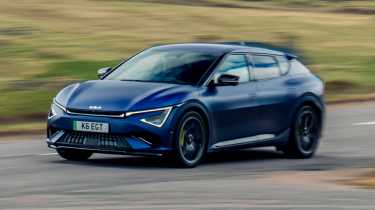
- Pros – Clever powertrain tech; chassis balance; point-to-point pace
- Cons – A 2.2-ton SUV is hardly going to save the world; aero-led looks
- evo rating: 4 stars
The first-generation Kia EV6 GT showed promise but left a little on the table in terms of dynamic finesse. It was rip-roaringly fast but then, that’s the easy bit when it comes to performance EVs. The hard bit is harnessing all that potency with a balanced and tractable chassis, managing the inevitable bloated weight figure and at the end of it all, cultivating something resembling a sense of connection. The first EV6 GT was fast, incredibly responsive but lacking any kind of emotional resonance.
Approaching the newly updated car however, things are different. Even just looking at what’s new, there’s influence coming in from the excellent Hyundai Ioniq 5 N, not just with the added power (now 641bhp) and the addition of synthetic sounds and gears, but with multi-stage adaptive dampers and revised steering. Set the new EV6 GT up with the gears and the sound, and the dampers in the right setting (one off firmest) and it’s a car that can be genuine fun. At least it was up the Old Military Road in Scotland. Range is still not the best (its performance means it doesn’t breach 300 miles according to WLTP) but 279 miles is an improvement over the old one.
Porsche Cayenne Electric
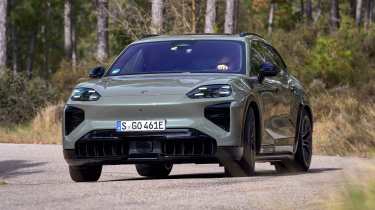
- Pros – Astonishing performance; dynamic ability; refinement
- Cons – It needs expensive options to be at its best; excessive price and performance; middling range
- evo rating: 4 stars
Porsche’s Cayenne strategy has changed dramatically in the years since the Electric model was approved for development. Initially intended as a wholesale replacement, the Cayenne Electric will now be sold alongside its combustion and hybrid badge-mates.
Don’t mistake Porsche’s flagging confidence in the market for a lack of confidence in its own product, however. This is a highly impressive, technically advanced, well-engineered and resolved electric SUV. In the high-performance Turbo model, Porsche uses Formula E-inspired direct oil cooling. With almost 900bhp in standard mode, or over 1100bhp (yes really) in launch mode, it can trouble a Bugatti Veyron for acceleration performance.
However, being a Porsche, it’s also responsive, steers crisply and is comfortable yet controlled. With Porsche’s hydraulic active ride suspension system, it drives more like a fast estate than a higher-riding SUV.
The only thing you need to be aware of when looking at a Cayenne, is getting the right version, with the right options. The Turbo model’s extra performance is almost pointless compared to the S, so our recommendation is the S, with active ride, rear steering and Porsche’s PTV-Plus limited-slip diff. Watch how much of the power you use too. It’s claimed the Cayenne S Electric can go over 410 miles on a charge. That halves if you dig into its performance.
> Porsche Cayenne Electric review
Frequently Asked Questions
Most electric cars don’t have gears at all, with only forward, neutral and reverse. Some EVs, like Porsche’s Taycan and Mercedes’ CLA, have two forward gears, the second engaging at higher speeds for efficiency. An increasing number of performance EVs are also adopting fake ‘gears’ created with software to mimic the sound and feel of a gearbox in a petrol car and increase driver involvement.