Honda Civic Type R (EK9, 1997-2000) review – 1990s JDM icon makes a Peugeot 205 GTI look agricultural
The EK9 was the beginning of the Civic Type R story, but Honda never officially sold it in the UK. Unicorn status on our shores is a given, then
Honda was – and still is – renowned for the transfer of technology from its motorsport programmes (on both two and four wheels) into its series production cars. The acronym ‘VTEC’ soon became synonymous with screaming, small-capacity engines. In the UK, our first official exposure to Honda’s most extreme four-pots was the DC2 Integra Type R in 1996. This featured a 1.8-litre four-cylinder engine good for 187bhp – still an extraordinary figure for the day – but we were denied the banshee-spec EK9 Civic, which arrived in Japan the year after.
A few did make it to the UK. Indeed, I can recall driving one for a Performance Car magazine group test in 1998. One of the rivals was a Renault 5 GT Turbo Raider. A fine car, but one that mustered 118bhp from a turbocharged, 1.4-litre engine that still featured pushrods and a carburettor. I’m not sure what a Honda engineer would have made of the Renault engine – an anchor, most probably – but in pure engineering terms the comparison was akin to that of a musket and a machine gun.
Fast-forward almost two decades and the EK9 remains something of a mythical beast. There’s still only a handful in the UK – the owners’ forum reckons no more than 150, with fewer on the road – and while classic European hatches such as the Peugeot 205 GTI, VW Golf GTI and, yes, the R5 GT Turbo have become deities, the original Civic Type R only enjoys cult status amongst the true cognoscenti.
Engine, gearbox and performance
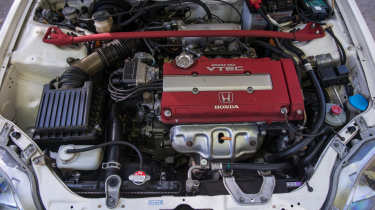
- It’s (almost) all about that wild 114bhp-per-litre engine
- Powertrain oddly ‘normal’ at low speeds, very little performance below 6000rpm
- Clean, precise gearshift
More reviews
Group tests
- Ford Focus ST Track Pack v Honda Civic Type R: sharpened Focus tackles the hot hatch king
- Honda Civic Type R v Volkswagen Golf R v Hyundai i30 N v Audi RS3
In-depth reviews
- Honda Civic Type R (FL5, 2022 - 2026) review – the hot hatch that may never be beaten
- Used Honda Civic Type R (FK2, 2015 - 2017) review – the forgotten hardcore Focus RS rival
- Used Honda Civic Type R (FK8, 2017 - 2022) review – 169mph hot hatch bargain
Reviews
To understand what makes the EK9 Civic Type R so special, you need two pieces of information: 182 (bhp) and 1.595 (litres of displacement). In isolation, those figures mean nothing, but divide the former by the latter and you get 114, a figure that for years placed this humble Honda hatchback above all but the most exotic supercars.
Specific output is one of the more esoteric measures of a car’s performance. Where basic acceleration times win beer-fuelled arguments in pubs and power- or torque-to-weight ratios provide a sense of what squeezing the throttle will do to your internal organs, specific output is an intimate character reference of the engine itself.

When that engine is naturally aspirated, anything over 100bhp per litre is pretty special, and anything beyond 110 the preserve of exotica. The EK9’s 114 places it on a par with precious metal such as Ferrari’s 430 Scuderia. In fact, it’s only recently that it has been significantly surpassed by the likes of the 458 Italia, Porsche GT3 RS 4.0 and now, Aston Martin’s Valkyrie and the GMA T.50.
This number says a lot about the remarkable nature of the EK9’s engine, but it also offers a window to Honda’s mindset in the late ’90s. Though in hiatus between spells as an engine supplier in Formula 1, the Japanese manufacturer was still riding high after a magical period in which Honda-powered teams (Williams and McLaren) secured five consecutive Formula 1 constructors’ titles and five consecutive drivers’ championships, including Ayrton Senna’s three. Clearly, when it came to power, reliability and efficiency, Honda’s screaming V12 and V10 Formula 1 motors reigned supreme.
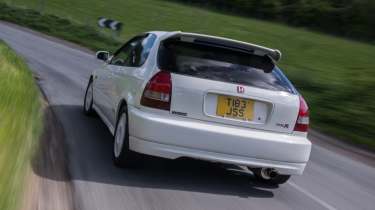
Slide the key into the ignition, give it a twist (no gimmicky start button here) and the starter motor spins the engine into life. A full Spoon exhaust and induction system are present here – high-quality kit but makes for a raucous noise, even at idle. The titanium gearknob is brilliantly tactile – cool and smooth to the touch, and perfectly weighted so the lever navigates the precise gate and slots into first with a clean, satisfying action. Considering the engine revs to the skies, you don’t need to make any allowances when pulling away, just feed in the clutch and away you go.
After all the anticipation, the first few miles in the EK9 are a bit bemusing. Here is a car with an engine every bit as special as one you’d find in the most focused Italian or German road-racer, yet once you get beyond the exhaust noise of this particular car, the docility and – dare I say it? – normality of the EK9 makes you wonder if history has overlooked it for a reason.
Similarly, where a European hot hatch of the same or earlier vintage would immerse you in feedback and connect you directly to the road through hands and buttocks, the Civic is a bit of a cold fish. The steering is a bit numb, the damping a little brittle. None of it is very inspiring.
So you push the throttle a bit harder in second gear. Still nothing much happens. You might have heard racing drivers say that time slows down during a crash or near-miss. Well, much the same is true of accelerating in an EK9 Civic. Drive as you would in any other hot hatch and that natty yellow tacho needle creeps round the dial as though slogging through treacle.
You can almost hear the VTEC system snoring as rust begins to form on the dormant cam lobes – 3000, 4000, 5000rpm come and go, yet still the Civic slumbers. This is ridiculous. Then, as the needle nudges beyond 6000rpm – the stage where most hot hatches have already given their best – the EK9 channels its inner Ayrton and does something rather extraordinary.
The switch-like transition in the VTEC’s power delivery has become something of a motoring cliché, but I defy anyone not to be amazed by its Jekyll and Hyde duality. If anything, time – and the softening effect of turbocharging – has only served to intensify the experience. At first you can’t quite believe what you’re hearing or feeling, so you back-off, let the revs drop below 6000rpm, then gas it again just so you can hear its other-worldly howl. What you still don’t fully appreciate at this stage is just how much the motor has to give. In fact, it’s not even hit its stride.
Even typing this seems absurd, but this mad, wonderful motor – code number B16B – develops its maximum power just 200rpm shy of its 8400rpm limiter. Maximum torque – all 118lb ft of it – comes at 7500rpm. No wonder it feels like nothing happens below 6000rpm!
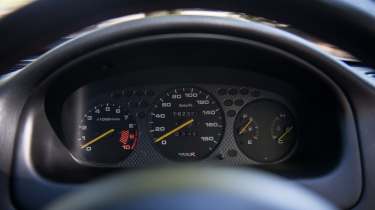
To get the best from it, therefore, you need to drive it like you want to blow it to smithereens and keep your right foot pinned for that final, manic assault on the red line. Show it a moment’s mercy or short-shift even a few hundred revs shy of 8200rpm and, rather like a soufflé taken from the oven too soon, the towering, triumphant crescendo falls flat as a pancake.
I can distinctly remember it was enough to make me wince when driving that box-fresh EK9 back in 1998. Now, in a privately owned example with the best part of two decades and 80,000 miles beneath its wheels, working this pride and joy so hard seems like a recipe for disaster, yet it feels fresh as the day it left the factory. Forget titanium, this B16B feels like it has internals forged from Valyrian steel.
The difference between driving the EK9 and driving it is startling. Wind it right up through the gears and it’s a totally different experience, the revs always remaining on the hot side of the cam with each upshift. It’s a glorious, exuberant and invigorating process. One that leaves you marvelling at the smoothness and extraordinarily fine tolerances the engine must be engineered to, and revelling in the sharpness and aggression. It does the numbers, too, hitting 60mph from a standstill in just 5.7 seconds – a figure we recorded back in that Performance Car test.
Ride and handling
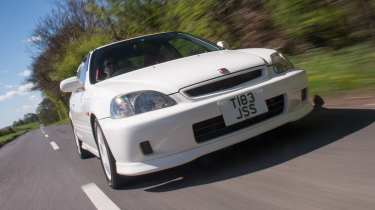
- Feel-some steering and settled damping
- Glorious adjustability through the corners
- The DC2’s otherworldly talents are latent in the EK9
There’s a danger all this talk of stratospheric revs and wafer-thin powerbands portrays the EK9 as a one-dimensional science experiment. Yet just as the engine explodes into life when you make the effort, so the rest of the car begins to shine.
The damping settles with speed, feeling just pliant enough but with an overriding sense of sharpness that matches the crispness of the powertrain. Life simmers through the steering, too. It’s never talkative in the manner of a 205’s or R5’s, but the precision and rate of response is ideal.
The biggest and most pleasant surprise is the EK9’s agility and adjustability through corners. Medium-speed curves are especially enjoyable. Spot your braking, heel-and-toe into third and get it set for turn-in and you can really carry some speed. There’s plenty of bite from the front end, but not so much that the tail can’t live with the initial direction change.
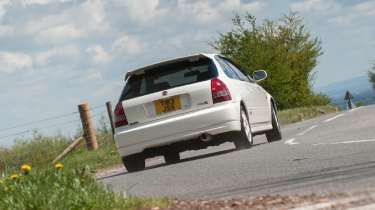
Get back on the power and you feel the lateral load increase, then fade ever so slightly as you reach the limit of the tyres. Ease back on the throttle and you’ll feel the nose tighten its line and the tail slip into oversteer – quickly at first, but progressively enough that you intuitively apply corrective lock to restore balance. Once you learn to trust it, this Civic mirrors the dynamics of that other great Type R, the DC2 Integra.
With so little torque to deal with, the front end doesn’t pull and tug at the steering wheel on the way out of tighter corners. And thanks to the limited-slip differential, the EK9 always puts what muscle it does possess cleanly into the tarmac. The brakes on this particular car have a little too much initial pedal travel, but the response and stopping power seems well matched to the performance.
Of course, the engine is the star, but the road-holding and handling are expertly blended and complete the package perfectly. This is one of those rare cars that’s approachable and transparent, but continues to reveal fresh layers of ability and finesse as you spend more time with it. This is a car with which you could really forge a bond.
Interior and design
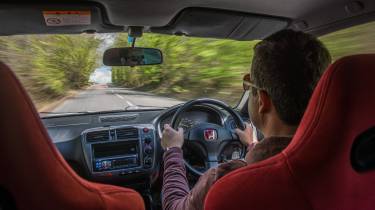
- Pared-back outside and in, with lovely details
- Dials, wheel, seats and shifter are textbook Type R – special
- Fake carbonfibre trim – forward-looking for the late 1990s
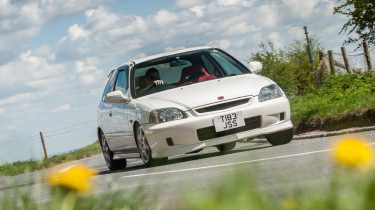
There’s a pared-back simplicity to the EK9 that’s hugely appealing. Yes, the dazzling Championship White paint makes a statement, not to mention sets the Type R apart from your common or garden, granny-spec Civic, but the essential purity of the shape and the lack of fuss is refreshing for such a high-performance car.
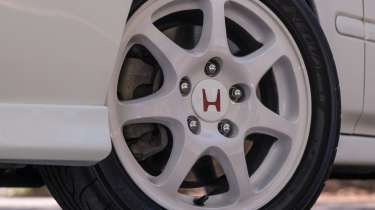
With small (15-inch) wheels shod with modest rubber, a single exhaust pipe, a subtle rear wing, no diffuser and a bare minimum of intakes, it’s the antithesis of its new, wing-festooned descendent. It’s tiny, too, looking like an eight-tenths scale model in modern traffic.
The EK9 is a little more extrovert inside, thanks to a pair of blood-red Recaros and matching scarlet door card inserts, which contrast brilliantly against the otherwise black interior. The dash and instruments are clear and simple. There’s a smattering of fake carbonfibre trim, but it’s not offensive. Besides, the lovely, genuine titanium gearknob more than compensates for any well-intentioned fakery, although unscrupulous individuals have ensured that not all EK9s have one…
Another EK9 signature is the tacho, with a dial that winds all the way round to a heady 10,000rpm. The bright yellow needle and chunky white-on-black typeface have a race car’s simplicity, while the hatched red zone marking the red line and beyond offers an explicit hint of the hardcore excitement to come. The Recaros are pretty much perfect; plump enough to offer genuine comfort, but supportive enough to hold you snugly in place behind the simple, fat-rimmed steering wheel.
Prices and buying guide
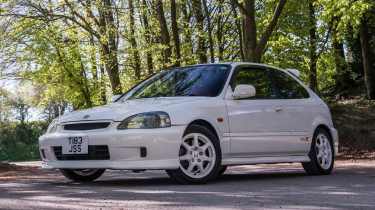
The Far East might not be the cultural or spiritual home of the hot hatch, but the EK9 deserves to be considered amongst the best and most exciting of the breed; a connoisseurs’ car, rightly revered by those lucky enough to have driven it, but largely ignored, overlooked or underestimated by the majority who haven’t.
There’s a lot of snobbery that surrounds classic, collectible hot hatchbacks. A lot of hype, too. I love 205s and 106s and 5 GT Turbos, but great though they are, in pure engineering terms this EK9 is in a different league. Yes, its dedication to VTEC means it’s fundamentally flawed unless you can cane its socks off, but that single-mindedness is also where its brilliance lies. That there are steely strands of NSX in its attitude, delivery and understated style makes even the £15,000 value of the poorest examples a temptation. The very best examples are worth north of £25,000.
Given the EK9 Type R was never officially imported to the UK, there are few to pick from. That, combined with the usual plagues for old Hondas – rust expedited by our damp climate and salty winter roads and an occasional hunger for oil not all owners attended to – numbers are thinner than ever.
Any car you’re inspecting, look out for frills in the arches and underneath, as well as puffs of blue smoke as indicators that some serious care might be required. That said, you’re unlikely to find bad ones now, those left are cars that have been well looked after, hence the higher price range.
Specs
| Engine | In-line 4-cyl, 1595cc |
|---|---|
| Power | 182bhp @ 8200rpm |
| Torque | 118lb ft @ 7500rpm |
| Weight | 1040kg (178bhp/ton) |
| 0-62mph | 5.7sec (tested) |
| Top speed | 135mph (est) |
| Price now | £15,000+ |