Volkswagen Golf Mk8.5 review – still the hatchback benchmark?
The Mk8.5 Volkswagen Golf is a better offering than the original, but it’s still not quite the no-brainer the model once was
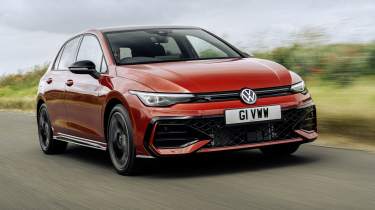
The Volkswagen Golf’s long-standing position as the go-to hatch took a hit with the launch of the Mk8, with an increase in price and the adoption of frustrating interior controls making it less appealing than its predecessors. Volkswagen made efforts to improve matters with the mid-life Mk8.5 update a couple of years ago, bringing fresh powertrains, a refreshed design and updated interior controls to the table. We get behind the wheel to find out if it retains its long-standing hatchback benchmark status.
As always, a variety of hot GTI and R variants stand at the top of the range, but the ordinary hatchback and estate lineup has plenty of draw thanks to the addition of a plug-in hybrid variant, sitting alongside a mild-hybrid eTSI option and a pure-combustion petrol and diesel. There’s still no all-electric Golf variant with the ID.3 having filled that spot (for now), but it seems a Golf EV certainly isn’t out of the question for the future.
> Volkswagen Golf GTI Edition 50 review – finally a match for Honda’s Civic Type R?
Engine, gearbox and technical highlights
- Broad range of powertrains offer good flexibility
- Models with manual gearboxes and diesel engines are still available
- Range-topping EA888 still lacks some character
More reviews
Group tests
- VW Golf R v Cupra Leon 333 – the family feud with an unexpected winner
- Volkswagen Golf GTI Clubsport v Cupra Leon 300 – what's the best mainstream hot hatch?
In-depth reviews
- Volkswagen Golf Mk8.5 review – still the hatchback benchmark?
- Volkswagen Golf R (Mk8.5) review – a better hot hatch but not the best
- Used Volkswagen Golf GTI (Mk5, 2004 - 2009) review – one of the best VWs of the last 30 years
Reviews
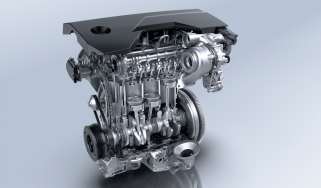
The standard Volkswagen Golf range now begins with a 1.5-litre turbocharged four-cylinder petrol in a 114bhp state of tune, paired with a manual transmission as standard in both Life and Match trim. If you’re looking for more poke from a pure-combustion powertrain, you can opt for the same 1.5-litre in a higher 148bhp tune, available with a manual in Match, Style and R-Line trims. While a 2-litre petrol is no longer an option in the ordinary Golf range, the 2-litre TDI diesel is still available in 113bhp manual and 148bhp automatic forms in Match and R-Line trims respectively.
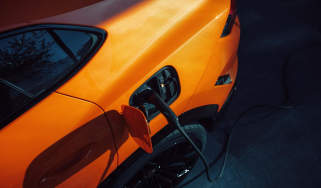
To boost fuel economy, Volkswagen offers a sole mild-hybrid eTSI option with a 148bhp 1.5-litre petrol paired with a seven-speed DSG automatic. A move up the range to Style trim will see the 201bhp plug-in hybrid come into play, which is capable of up to 88 miles (WLTP combined) of pure-electric running. Move up to R-Line and this option is taken away, with only the 148bhp pure-combustion petrol, diesel and eTSI options available.
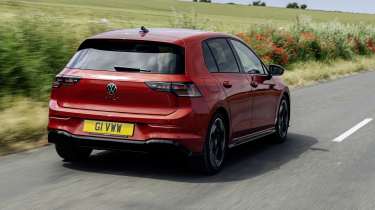
The plug-in hybrid GTE tops the standard range with both the highest price (by a considerable margin) and output. At its core is the same 1.5-litre petrol you’ll find in the entry-level car, but 48V electric assistance boosts output to 268bhp for the quickest acceleration of the lot – it’s also said to achieve 81 miles (WLTP combined) of pure electric running on a charge, making it a very appealing offering for city drivers.
At the top of the range, you’ll find the GTI, GTI Clubsport, GTI Edition 50 and R, all pairing the 2-litre turbocharged EA888 four-cylinder with a dual-clutch transmission. The GTI, GTI Clubsport and GTI Edition 50 send 261bhp, 296bhp and 321bhp to the front wheels respectively, with the all-wheel drive R topping the range with a 328bhp output, matching the previous R 20 Years.
Performance, ride and handling
- Dynamics are adequate rather than outstanding
- Odd brake feel in some hybrid models
- Steering lacks feel, but this is a theme across the segment
If performance isn’t the goal, the entry-level 114bhp manual covers the 0-62mph sprint in a leisurely 9.9sec, with the 2-litre diesel manual the slowest of the lineup with a 10.2sec quoted time. Oddly, the quickest pure-combustion offering on paper from standstill to 62mph is diesel, but in 148bhp DSG-trim with an 8sec time – the next quickest in the range takes an additional few tenths. The GTE is the most potent by quite a way, taking just 6.6sec to reach 62mph. Top speed stands at around 124mph for entry-level models, rising to 143mph in the Golf GTE range-topper.
On the road, the 114bhp eTSI automatic feels a tad underpowered, with the engine having to do an awful lot of work to bring it up to the national speed limit – our particular test car also held onto gears for much longer than felt necessary, only adding to the sense of overstress in the powertrain. For most, this still won’t be a dealbreaker, but if you’re keen on reaching the speed limit in a timely manner, this could become tiring. Opt for a manual and this engine feels less strained, as while it's still lacking in torque, having full control over revs and shifting helps mask its lack of power – this isn’t to say the manual shift itself is good, as it’s notchy and cumbersome.
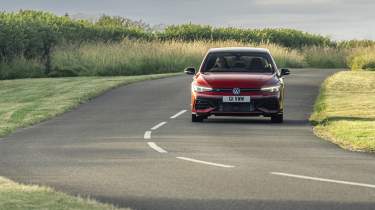
The 148bhp eTSI option feels much more up to the task, with enough pull to make brisk progress and no sense that it’s having to work overtime. While it hardly inspires a spirited drive, there’s a much better sense of connection between your right foot and the powertrain in this spec, though it can sound a tad unrefined in the cabin at higher revs. The transmission in this tune is sharp on the way up and down, making use of the paddles much more appealing. Opt for R-Line and you also get the option of driving modes, unlike the rest, which change throttle maps and automatic shift points for better response.
For efficiency purposes, all Golf eTSI powertrains effectively disengage the drive unit when coasting, which is great in theory, but feels slightly disconcerting on first use. The complete lack of engine braking is something that takes some time to get used to, as even EVs provide some element of off-throttle deceleration through regenerative braking.
The range-topping GTI and R models are just as quick as you’d hope, with more than enough performance for any real-world drive. Sound isn’t quite as engaging as it has been in some of our favourite hot hatches, but updates to the in-cabin sound have made it more authentic than before. In the GTI Clubsport, GTI Edition 50 and R, trick ‘anti-lag’ turbo tech helps improve response, which contributes to quicker corner exits on the road. On paper, the standard GTI is capable of a 5.9sec 0-62mph time, with its more powerful front-drive GTI Clubsport and GTI Edition 50 relatives at 5.6sec and 5.3sec respectively. The R makes the most of its increased output and all-wheel drive with a 4.6sec 0-62mph time. Top speed stands at 155mph across these three range-topping models, but can be lifted to 167mph with optional performance packages.
Dynamics are adequate rather than outstanding. The entry-level eTSI models are comfortable on most roads, but a slow spring rate and chunky sidewall (in certain specifications) does allow for more body roll than we’d like for a more spirited drive. While nothing to complain about on well paved roads, tougher tarmac can uncover a slightly unsophisticated secondary ride, with lateral movements taking longer to settle than we’d like.
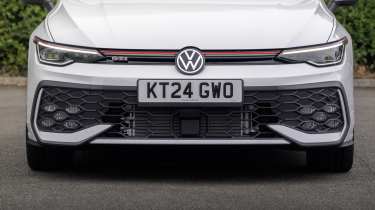
Opt for the R-line with lower profile 225-section tyres and you regain some composure, though a slow spring rate remains, with body control lacking – this also makes steering inputs feel less direct than they would otherwise, with some of that initial input translating to roll as opposed to direction change. Learn to work with the weight transfer and you can carry some good speed on a more challenging B-road, but the Mk8.5 Golf is hardly brimming with feedback for a thrilling drive in any of its standard forms.
The steering has virtually no feedback, as you’d expect from any ordinary car in 2026, but the Golf does have more off-centre resistance than most of its rivals, giving you a greater sense of connection with the front wheels. Steering heft and response are best in the R-Line, but you’ll need to move up the ranks further to the GTI and R for more satisfying steering.
Likely a byproduct of the blend of regenerative braking and friction brakes, eTSI models have unusual brake feel in our experience, with a spongey, resistant feel – we also felt a ‘step’ in the pedal on a few occasions, which adds a dent to the Golf’s solid overall feel. While short, pedal feel is more linear and natural in 150 trim and even better in the R-line, with more than enough stopping power available for most scenarios.
MPG and running costs
- The most efficient models return quoted figures in the real world
- Performance EA888 models see sub-40mpg averages with ease
- Electrified offerings provide great economy
Opt for an eTSI model and the Mk8.5 Volkswagen Golf is just as efficient as you’d expect. Now available only in the higher 148bhp state of tune, the 1.5-litre eTSI with the seven-speed DSG achieves a quoted 54.8mpg on the WLTP combined cycle, with our test returning similar figures. Should you be looking for a manual, the base-level 114bhp six-speed car is said to achieve 51.2mpg, with the more powerful 148bhp pure-combustion model standing at 50.4mpg.
Move up the range to eHybrid models and the electric drive helps extract some ludicrous on-paper efficiency, with the WLTP combined figure standing at 252mpg and 212mpg for the 1.5-litre eHybrid and 268bhp GTE respectively. The two-litre diesel 114bhp manual and 148bhp DSG models are said to achieve 62.8 and 60.1mpg.
Opt for the EA888-powered GTI, GTI Clubsport and R and you’re unlikely to see much more than 40mpg on a long run. Increase the pace and average mpg figures in the high teens aren’t hard to achieve.
Interior and tech
- Some niggles have been rectified with the Mk8.5 facelift
- Many of them still remain…
- Central infotainment display is large, sharp and snappy to use
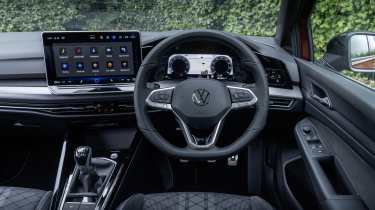
The vast majority of the criticism for the Mk8 Golf was directed squarely at its touch-sensitive HMI and awkward interior ergonomics. In response to this, Volkswagen worked hard to improve the Mk8.5 in these key areas, bringing physical steering wheel buttons back to all variants except the R, illuminated the touch sliders beneath the central display and improved infotainment response.
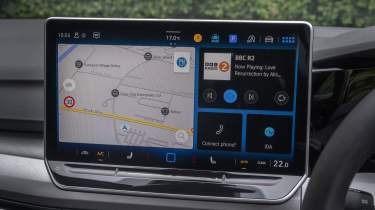
The result is a HMI that is much more pleasant to use, with accidental button activation and blind touch slider use a thing of the past. It’s not perfect, though. Those central touch sliders are still far from intuitive to use, with it difficult to tell which slider does what at a glance. While improved, the new UI for the 12.9-inch central display also has its niggles, with only a select few climate control functions remaining on the screen at all times – in our use, fan controls were always at least a click away, with heated seat controls seemingly taking priority.
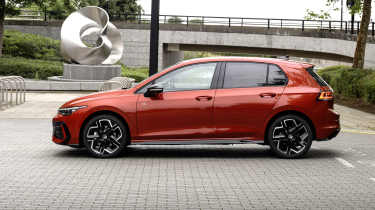
Thankfully that’s where the negatives end, with overall interior design pleasant. In the car we tested, a light interior colourway and full-length sunroof made for an airy, premium feel, with the use of fabric a refreshing sight – jump up a trim level and Alcantara elements bring an element of focus. Seat design is a little basic in lower trim levels, but move up to the R-Line and this is less of an issue, with more supportive bolsters, integrated headrests and (slightly tacky) faux carbonfibre trim included. The R-Line also swaps aluminium trim for gloss black, which adds a premium touch (before anyone’s applied fingerprints and scratches to it, at least).
The software for the central display is one of the snappiest in-car systems on the market, with immediate response and subtle audible feedback on button presses making it a pleasure to navigate. The layout of menus for vital car controls isn’t quite as intuitive as in the likes of the now-discontinued Ford Focus, for example, but the use of a customisable quick access panel is a welcome addition. Apple CarPlay is also well integrated, making use of the full display, unlike most cars. The digital dash doesn’t quite match this, which is very small in dimensions and has an unsightly plastic border as a result.
Overall ergonomics are good, with a sliding armrest making it easier to adapt the cabin to suit the driver, a thin-rimmed steering wheel always nice to see, and good visibility all-round not a given in 2026. Volkswagen says it worked on improving material quality throughout with the Mk8.5 upgrade, too, and while hard plastics are still present, they're mostly limited to the lower portions of the cabin – soft touch materials feature on the dash and virtually any easily accessible area. A few elements such as the rear air vents, select components in the boot and transmission tunnel are still lacking in quality, but there has been a noticeable improvement nonetheless.
As a result, refinement is strong overall, with limited powertrain noise in the cabin and few rattles and squeaks. A-pillar wind noise and tyre road in the R-Line was on the high side in our test, but this could be limited to our particular test car.
Price, specs and rivals
The Volkswagen Golf starts from £28,895 for the entry-level Life trim, rising through the standard range to £32,215 for the R-Line. Opt for the more potent plug-in hybrid GTE and price jumps to £40,140, just behind the £41,810 GTI. At the very top of the range is the GTI Edition 50 and R at £47,995 and £46,850 respectively, with the R Black Edition adding more standard kit (and black trim) for £48,170.
Stack these numbers up against its rivals and the Golf fares well. The Mazda 3 and Vauxhall Astra (£25,280 and £26,125) are the only rivals that start at a lower price. The Ford Focus begins at a marginally higher £29,560 price point if you can still find one pre-registered, with the Toyota Corolla at £30,795 and hybrid-only Honda Civic (non-Type R) costing from £32,445. Move up to some of the more premium brands and you’ll pay more still, from £32,625 for the BMW 1-series and £31,850 for the Mercedes-Benz A-class – the Golf’s premium relative, the Audi A3 costs less than both at £30,880.