Porsche Panamera review – sports car qualities in a luxury super saloon
The Porsche Panamera has adapted to a new era, with variants offering alternatives to everything from BMW’s M5 to the Mercedes S-class
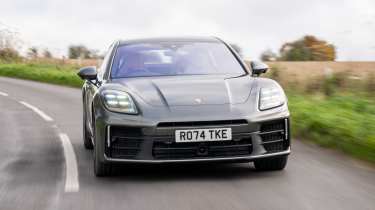
The third-generation Porsche Panamera is, in hindsight, an oddly prescient model for what we can expect from Porsche going forward. For here is a large, powerful, dynamic and luxurious sports saloon, of which petrol and hybrid variants are sold to offer versatility (and something people will actually buy) alongside its electric Taycan saloon.
This is exactly how the marque is now approaching the future of its full-sized SUV, with the all-new Cayenne Electric sold alongside updated combustion and hybrid models well into the 2030s.
Indeed, for those sceptical or burned by the Taycan, the Panamera continues to be a reassuringly old-school saloon. It’s the do-it-all Porsche, some variants being the ultimate sports saloon, others majoring on luxury and others bringing supercar-slaying performance to the fore. There’s a Panamera you might consider instead of an S-class, but another you might have instead of a BMW M5. As you might expect, some variants tickle our fancy more than others.
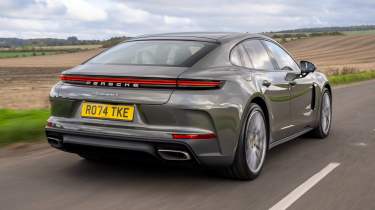
The third generation car features visual changes versus the previous Panamera, with fresh headlights sitting within front wings that are more pronounced in shape with a higher uppermost point. Sitting from behind the wheel, there’s a more distinctive view down the bonnet than before. There's alsoan upper central intake above the numberplate that's a new feature of the nose. The interior has been overhauled, too.
More reviews
But that’s nothing compared to the chassis, which was all new and designed in conjunction with Bentley who built the current generation Continental GT and Flying Spur off the same platform.
Despite all that has and is going on in Porsche’s world the Panamera remains a constant for those looking for a car that isn’t a regular three-box saloon - there’s no more Sport Turimso ‘estate’ we’re afraid. Regardless of its powertrain and specification each model drives like it's been engineered by a team of people who care how a car drives regardless of what it’s been designed to do.
Model range
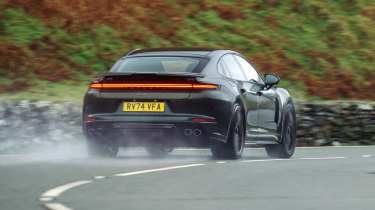
Panamera life begins with the 348bhp, 369lb ft 2.9-litre V6 rear-wheel-drive variant and all-wheel-drive Panamera 4 derivatives. Hybrid models follow with the 464bhp V6 E-Hybrid, which you can only have with four-wheel drive. Since its launch in 2023 Porsche has added the 536bhp 4 S E-Hybrid and the Panamera GTS, with a 493bhp twin-turbo V8, the only non-hybridised eight-cylinder model in the Panamera line-up.
The Panamera Turbo E-Hybrid V8 is monstrously powerful, with 671bhp, 684lb ft. But even that’s out muscled by the more potent Turbo S E-Hybrid that packs a BMW M5 rivalling 771bhp and a Pagani Huayra-matching 737lb ft of torque.
If it was our money we’d pick the GTS as the sweet spot in the line-up. If it was our company’s money and we wanted to give less of it to HMRC we’d pick the V6 engined 4 S E-Hybrid.
Engine, gearbox and technical highlights
- Mix of V6, V8 and hybrid powertrains
- Amazing active ride system optional on hybrid models
- Power outputs between 348bhp and 771bhp
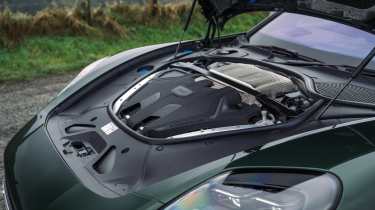
The 4-litre V8 fitted to both Turbo and Turbo S E-Hybrid models is cleaner and more powerful than before, with higher injection pressure, new pistons (in deference to a higher compression ratio), new single-scroll turbos, and now with cylinder deactivation, well, deactivated: Porsche’s engineers found customers only benefitted from it in a relatively narrow field of circumstances. Its replacement, a finer valve-lift control, is better for overall efficiency across all driving scenarios apparently. Should you be curious, this evolution of the V8 made its debut in the current Cayenne.
A new eight-speed PDK gearbox integrates the hybrid electric motor completely into its casing, helping to enable that monster torque output. In electric-only mode, it’s now possible to drive at up to 87mph over longer distances than before due to improved thermal management within the complex powertrain.
As with many VW Group brands, the V8 hybrid powertrains fitted to the Turbo E-Hybrid and Turbo S E-Hybrid are shared wholesale with other family members. The latest Bentley Continental GT and Flying Spur share their engine, gearbox, battery and electric motors with the Turbo E-Hybrid, while the Speed models share with the Turbo S E-Hybrid.
All Panamera models ride on sophisticated two-chamber (the previous generation three-chamber system was deemed no longer necessary) air suspension as standard, with hybrid models also available with a new Active Ride system, arguably the headline technology of this latest Panamera range. Made possible by its 400V electronic architecture, the system is also available across the Taycan range. In Panameras, it adds around £7000 to the list price.
It works by each damper being connected to an electrically driven hydraulic pump, and the system has the capability to keep the car almost entirely flat while cornering or dealing with bumps; in fact in certain circumstances the suspension can ‘overcompensate’ for weight transfer, with the ability to carve into corners in a manner akin to a motorcycle. In an extreme situation, it can exert as much as 1000kg of force at each corner, though Porsche’s engineers say it would rarely exceed 200kg or so in most driving scenarios.
The Active Ride system has one more party piece: ‘Comfort Entry’ raises the car by 55mm on its air springs to help you climb in or out smoothly, and it sinks back to its regular ride height once you close the door. Audi’s A8 uses the same technology
The optional chassis tech is one of many technical highlights in this thorough Panamera overhaul. Although it doesn’t look dramatically different from the Mk2, and features some carryover elements – the doors, for example – roughly 70 per cent of its components are all new. It’s far more than a facelift and justifies being considered a new generation in its own right.
The standard air suspension uses conventional anti-roll bars. Like the active system, it benefits from two-valve adaptive dampers, giving it the ability to adjust rebound and compression independently. The air springs have two chambers whereas models with the Active Ride system fitted use a single, larger chamber.
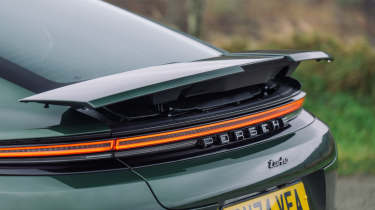
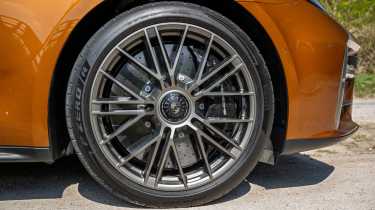
The updated suspension along with increased sound-deadening (Porsche has been keen to improve rear-seat refinement, pointing microphones at all angles in the rear of the car during development to work out ways to cut road and tyre noise) mean it’s not a lighter car than before. There’s also rear-axle steering, a £1540 option on all but the Turbo S. It can turn the rear wheels at up to 2.8 degrees in opposition to the fronts at lower speeds, improving agility and manoeuvrability, while turning in concert at higher speeds, improving stability.
There’s no longer an estate-style Sport Turismo body type. Insiders hint that the decision to drop it was a contentious one within the company but, in the cold light of day, it simply wasn’t a big enough seller to justify another generation, especially when taking into account the work that has gone into this generation of Panamera.
Performance and 0-62mph
Supercar power outputs make for supercar-rivalling performance figures. The Panamera Turbo E-Hybrid is good for 0-62mph in 3.2sec, the Turbo S, with its full-bodied 100bhp, 53lb ft boost, can make the sprint in 2.9sec, albeit in launch mode and in dry conditions. 196mph is the Turbo’s maximum, while the Turbo S is a bonafide 200mph Autobahn crusher, with a top speed of 202mph. Even the Panamera 4 S E-Hybrid is quick, hitting 62mph in 3.7sec, with the entry level rear-drive Panamera covering the sprint in 5.3sec. No Panamera could be accused of being a slouch.
When running in electric mode the hybrid models respond equally crisply, although the 4 S E-hybrid has an unexpected dead spot to initial throttle inputs and takes a second longer to respond than you’re perhaps expecting. On the move hybrid mode makes for a seamless way of driving in urban areas, its silence on electric-only power adding to the Panamera’s already highly refined set-up.
| Panamera | Panamera 4 | Panamera 4 E-Hybrid | Panamera 4 S E-Hybrid | Panamera GTS | Panamera Turbo E-Hybrid | Panamera Turbo S E-Hybrid | |
|---|---|---|---|---|---|---|---|
| Power | 348bhp | 348bhp | 464bhp | 536bhp | 493bhp | 671bhp | 771bhp |
| Torque | 369lb ft | 369lb ft | 516lb ft | 553lb ft | 487lb ft | 684lb ft | 737lb |
| 0-62mph | 5.3sec | 5sec | 4.1sec | 3.7sec | 3.8sec | 3.2sec | 2.9sec |
| Top speed | 169mph | 168mph | 174mph | 180mph | 188mph | 196mph | 202mph |
Driving the Porsche Panamera
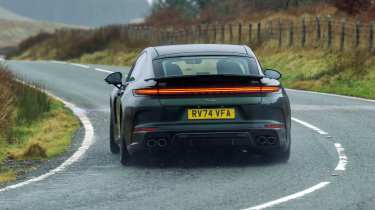
- Active ride tech is fascinating, if not totally engaging
- Typically Porsche dynamic feeling paired with outstanding refinement
- GTS appeals the most to drivers, trading extra power for less weight
Our first experience in the third-generation Porsche Panamera was on neither road nor race circuit – it’s on a wooden platform. Roughly 50 metres long, it’s interspersed with up-and-down ramps at staggered intervals to upset the car as it drives over them; the sort of bumps that’d really make your and your passengers’ heads swing uncomfortably if you ran over them on the road. A powerful demonstration of the capabilities of Active Ride.
Driving along the platform at 50kph (31mph). And… the Panamera is smooth. Very smooth. There’s a bit of a jiggle through the car and a muted thump as the wheels wallop against the ramps, but it’s a distant sensation. It’s actually more dramatic to watch the process from outside the car, each wheel moving up and down in its arch as the Panamera runs down the knobbly runway while its body stays uncannily still, especially compared with an example with the standard suspension fitted, which is shaken around as you’d expect (though it’s still smoother than an average car).
Around a wet Monteblanco circuit, the Panamera Turbo S E-Hybrid’s all-wheel drive and Michelin Pilot Sport S 5 tyres find plenty of traction, the handling balance reasonably predictable in the fast corners, though you are conscious there’s a lot of momentum at work (the official kerb weight is 2360kg). Brake pedal feel on ceramic brakes – a £7k-plus option on the Turbo but standard on the Turbo S – is very good on-track but feels a little inconsistent at lower speeds, as is sometimes the case with hybrids.
As for the Active Ride suspension, in Sport and Sport Plus drive modes the system does not overcompensate (as it were) for the body’s movements: Porsche’s engineers felt drivers might find a total lack of body roll or pitch disconcerting when driving quickly. So there is conventional diving under braking, squatting under power and roll through the corners, albeit tightly contained and controlled. Unsurprisingly, the Panamera handles the kerbs smoothly, too.
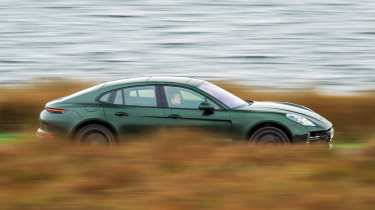
It’s in Comfort mode where it can counteract the body’s movements, sitting the rear up to counteract squat under acceleration and so on. Each corner of the suspension operates independently and the system allows the rear anti-roll bars to be deleted entirely (the new 400v system supersedes the 48V active stabilisers on the previous Panam).
The body remains serenely flat while you throw the car left and right. It doesn’t feel unnatural, however; you sense that even in this mode, Porsche has deliberately allowed a certain level of body movement to retain some level of feedback as you’d expect. During emergency braking and avoidance manoeuvres carried out back-to-back in two different models - one with and one without Active Ride fitted - As a driver (and particularly as a passenger) you’re thrown around far more in the standard-suspension car and it’s easier to plot a route in an extreme avoidance-style scenario in the active car.
The V6 isn’t as brutally fast as the V8 hybrids, but it’s certainly quick enough, and it’s a smooth engine too. The optional sports exhaust makes a fairly noticeable burbly rumble when you accelerate, but overall it’s a quiet, refined car, as per its remit. Body control in both examples is still excellent: you’re very aware, straight away, that you’re driving a large car, but you soon feel comfortable with its dimensions. In fact, the quicker you go, the tighter and more adept they feel. The V6-engined Panamera and Panamera 4 have quoted kerb weights of 1885kg and 1920kg respectively, but they handle their considerable bulk beautifully.
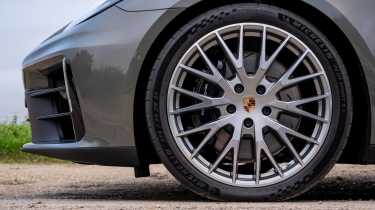
At low speeds, ride quality is excellent; at higher speeds, on the optional 21-inch wheels fitted to the two-wheel-drive Panamera, there’s a bit of surface patter and the secondary ride isn’t quite as buttery-smooth, but it’s still a very comfortable car. The Panamera 4 is on the smaller, standard 20-inch wheels and rides pliantly. At regular road speeds there’s not a dramatic difference in dry-weather cornering between the two, with a little more steering heft in the front-driveshaft-equipped car.
What’s the Porsche Panamera like to drive?
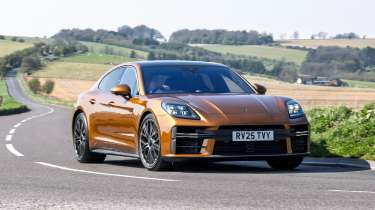
Wintery pockmarked UK roads are a brutal test for the fastest, most capable, most expensive Panamera variant, the Turbo S E-Hybrid. Here, the Active Ride system in the comfort setting makes impressive light work of most of the worst we can throw at it.

Serious high-frequency impacts such as potholes and drain covers do communicate through at speed, although the standard 21-inch wheels can take some responsibility for this. Then by contrast, at lower speeds over things like speed humps, the wheels articulate into the arches with minimal body disturbance, almost like a trophy truck.
It’s spooky, sublimely refined, not Rolls-Royce or Bentley levels of absolute isolation and serenity but of course, the Porsche offers the kind of body control and precision you simply can’t expect of the stately English limousines. They don't offer the same brightness, response and deft sense of loading in the steering either.
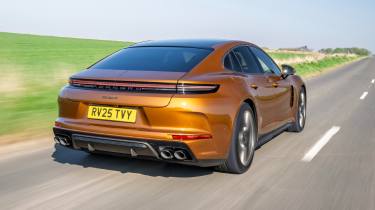
So precisely does Active Ride manage the Panamera Turbo S E-Hybrid’s weight, so agile does the rear-steering make it that you do sometimes find yourself in a slightly unnerving uncanny valley. What effects the laws of physics should be having on 2.4-tons of blunderbus, are most felt in your stomach instead.
You know the weight’s there and the capability astounds you but there’s a slightly unnatural sensation; Porsche’s engineers tried to avoid it by deliberately stopping short of tuning out all roll. You also know, if not feel, that somewhere out there, below you, the tyres are working overtime to latch onto the road surface as the kind of mass you’d usually associate with a large luxury SUV works to break them free.
If we’re being honest, eight tenths of the performance of the 771bhp, 737lb ft the Turbo S E-Hybrid offers would be adequate almost all of the time. Save for showing your mates the dramatic launch control, most other Panameras have all the motorway on-ramp twist you could possibly need.
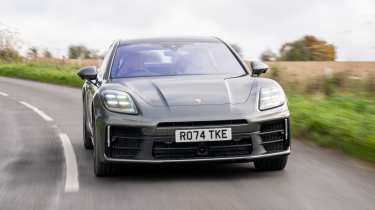
If a Panamera is your do-it-all choice of car, you don’t need the electric capability and you’re a keen driver, the GTS is the no-brainer. It’s never more distinguished from its range mates than now. As the only V8 without hybrid assistance, it pairs the potent performer with a 300kg drop in weight. It ‘makes do’ with the standard air suspension, albeit 10mm lower and with chunkier anti-roll bars and the Porsche Torque Vectoring Plus differential.
If you’re looking at the V6-engined Panameras, the 4 S E-hybrid is the way to go, the combined 650Nm of torque adding the guts to the non-hybrid’s 550Nm. Being the smaller-engined family member doesn’t mean the six-cylinder-engined models are any less impressive as a means to cover ground swiftly and with a level of engagement and reward that requires M, RS or AMG badges on lesser rivals.
There’s a confidence in the Panamera that’s always been since its launch and it remains today with additional layers of refinement and sense of being in a bespoke car rather than one engineered to be a volume seller. It flows with a calming precision, reacts keenly to pot hole avoidance jinks and should you find yourself on a road with a handful of tantalising apexes the V6 models still turn in crisply and move through a corner with the same linear DNA as the brand’s sports cars.
Active Ride can struggle when you push on in Comfort mode (the only mode you can activate it in) and can make for unsettling moments under heavy braking and quick transition as it fights the car’s natural physics. Then again, if you’re pushing that hard up the drive mode to Sport. It’s the car Jaguar should have made.
A Panamera isn’t a car for which you’d set an early alarm and create drives that will stay in your memory forever, but it is an enjoyable car to steer. Steering and brake feel are both better than you’d typically encounter in a luxury car, and you can drive the Panamera with precision.
The strengths of the previous-generations remain intact, and in the mid-2020s hinterland between pure combustion, hybrid and pure-electric power, Porsche’s Panamera remains a car with a sprawling set of attributes that are hard to ignore. It’s the car Jaguar should have made.
Interior and tech
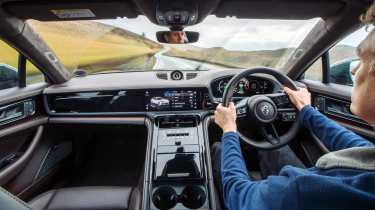
- Button cull hasn’t robbed it of all tactility
- Comfort and refinement are impressive
- Sportier, hemmed-in feel than most limousines and execs
Visually, one of the biggest changes is the much higher front wings, giving a more classical ‘sports car’ style view down the bonnet from the driver’s seat.
The interior has been made slightly less trad-sporty by relocating the gear selector to the dashboard, à la Taycan, which has freed up space for a new centre console that blends digital displays with physical switches (thankfully) for the air-con system (which operates through a new, louvre-free vent system in the dashboard).
It’s the only backward step, with the planks of cheap-looking piano black plastic ruining an ergonomically brilliant interior. You can add different materials such as carbon fibre and some beautiful open-pore wood to some of the trim, but unfortunately the centre console remains an uninspiring nod to the beginning of the Century and looks out of place in a car that’s aimed above more volume alternatives.
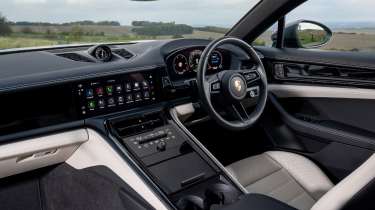
A new 12.6-inch curved digital instrument panel is joined by a 10.9-inch display for passengers. Shutter tech means you can’t see the passenger screen from the driver’s seat, just a blank glossy surface with the odd fingerprint. There are a few surprisingly scratchy plastics lower down in the cabin, on the B-pillar and sill, but overall the fit, finish and sense of quality are as impressive as you’d expect of a luxury Porsche.
If you're an audiophile the Burmester stereo could be a worthwhile option, if you don't mind parting with an extra £4600 that is. The best seats are the 18-way adjustable items, though they'll set you back £2336, you can also have three seats in the back for £719, or adjustable individual chairs for £1962.
Porsche’s legwork to improve refinement is noticeable. This is a quiet, comfortable, serene car in which to demolish any journey. Though if space and an airy feel in the back are essentials, more traditional limousines like Mercedes’ S-class will serve your needs better.
MPG and running costs
- Hybrids claim electric range of 53-60 miles
- Realistic range is 35-50 miles
- Hybrids feature 25.9kWh battery
If efficiency is high on your list of priorities, then the question of which Panamera to get isn’t as straightforward as you’d imagine. The most important consideration is the type of driving you do. Any of the four plug-in hybrid models are best suited to largely urban driving. The engine for the most part won't need to be roused if you’re able to charge and are doing fewer than 50 miles daily.
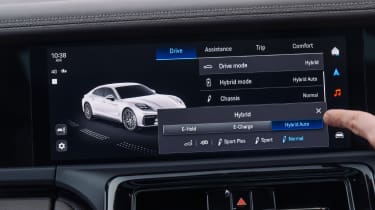
The 25.9kWh battery (gross) can be fully charged at an 11kW charger in two hours and 42 minutes from zero. The car can also charge itself if you put it in E-Charge mode, or retain what battery power it has when in E-Hold mode. Auto will leave the car to juggle the powertrain, though this can lead it to just use the battery until it's empty, even if conditions aren't optimal for using electric power (a motorway for example).
The weighted combined CO2 emissions figures for the PHEVs have risen since the Euro-6e testing change, meaning first registration fees have also increased. The government has, however, implemented an ‘easement’ for company car buyers, classifying all PHEVs bought on the scheme as below 50g/km for the purposes of not lumping those buyers with unexpected extra costs.
If relying on purely combustion power a base Panamera has a combined MPG figure of 27.2-29.2mpg. On the opposite end of the scale, the Turbo S E-Hybrid managed in the region of 20mpg at a fast cruise with the battery depleted or charging.
Prices, specs and rivals
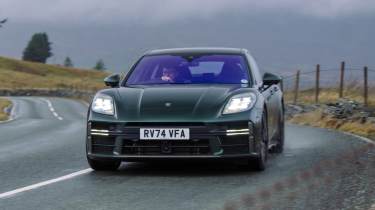
An elephant in the room with the Panamera is price. For when the third-generation car went on sale the range began below £80,000, but since then, prices have risen by close to £10,000 across the board. Prices now start at £89,400 and £92,400 for the base 2.9-litre V6 rear-wheel-drive Panamera and all-wheel-drive Panamera 4 derivatives.
Hybrid models kick off with the V6 Panamera 4 E-Hybrid at £99,100 (up from £91,000 at launch) and has been joined by the 4S E-Hybrid for £110,200 and the Panamera GTS, starting from £131,700. It might be expensive, some £15,000 more than a BMW M5, but the 493bhp V8 is the driver’s choice of the range. The monster Panamera Turbo E-Hybrid V8 now starts from £151,500, up from £141,400 at launch. Then there’s the even more potent Turbo S E-Hybrid variant for a whopping £175,100.
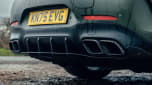
The Turbo S E-Hybrid partially justifies its steep price with a number of expensive features as standard. These include rear-axle steering, Porsche Torque Vectoring Plus, carbon ceramic brakes and Active Ride, which would add £1540, £1283, £8020 and £7182 to the price of Panamera Turbo E-Hybrid, for example. Our Turbo S E-Hybrid test car did feature a few other add-ons to bring its price to very nearly £200,000 – a sports exhaust you would imagine would be standard on the flagship, likewise four-zone climate control or the Burmester stereo.
The Panamera has always been an unusual car in the limo sphere, being focused as much on the driver as its passengers. Softer, cushier, more traditional luxury competitors did include the Audi S8 (now off sale) and the new Mercedes S-Class. On the other hand, a Panamera 4 E-Hybrid could well be cross-shopped on price (if not performance) with the Mercedes-AMG E53. If you’re looking for a thrilling sports saloon and the heavy hybridity of a BMW M5 doesn’t appeal, the Panamera GTS is a worthy alternative, if you don’t mind paying more for less power.
Porsche Panamera specs
| Porsche Panamera (Basic) | Porsche Panamera GTS (Our choice) | Panamera Turbo S E-Hybrid (Fastest) | |
|---|---|---|---|
| Engine | V6, 2894cc | V8, 3996cc, twin-turbo | V8, 3996cc, twin-turbo, plus electric motor |
| Power | 348bhp | 493bhp | 771bhp |
| Torque | 369lb ft | 487lb ft | 737lb ft |
| Weight | 2360kg (289bhp/ton) | 2065kg (243bhp/ton) | 2365kg (331bhp/ton) |
| 0-62mph | 5.3sec | 3.8sec | 3.2sec |
| Top speed | 169mph | 188mph | 196mph |
| Basic price | £89,400 | £131,700 | £175,100 |