BMW M2 Competition (2018-2020) review – the sweet spot F87 M2
Not as ballistic as the M2 CS but the M2 Competition is a brilliant debug of the original and great value
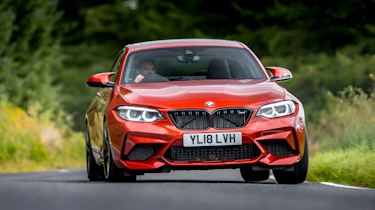
The ingredients that make an iconic BMW M car are difficult to precisely define, but the M2 Competition encapsulates most of them. With significant revisions that improved it compared to the first M2, a delicious full ‘M’ engine and involving dynamics it’s certainly a car that defines the breed. That they can now be had for under £30k only compounds our interest.
The BMW M2 was a car that came so close to greatness. With its pugnacious looks, compact dimensions and biddable rear-drive handling it had all the key ingredients to fill that 1M-sized hole in the BMW line-up. Yet while it had the measure of more traditional hatchback rivals such as the Audi RS3 and Mercedes-AMG A45, the M2 never really caught the imagination like it should. Some of the shortfall could be traced to the slightly ragged on-limit handling, the rest to an engine that was effective enough but lacked the fizz expected of a top-tier M car. Happily, both of these areas were addressed in the M2 Competition of 2018.
Engine, gearbox and performance
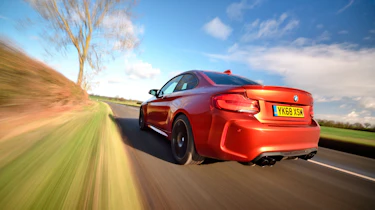
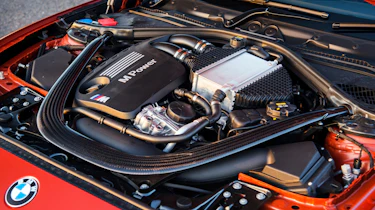
The Competition featured more of the good stuff. There’s a ‘real’ M engine under the bonnet, a twin-turbocharged, 2979cc, 404bhp in-line six-cylinder S55 that was later upgraded to 444bhp for the CS.
The engine features a ‘closed deck’ block, lightened crankshaft, enhanced cooling system, strengthened pistons and all. There was a new exhaust system too, complete with de rigueur active bypass valves for a more bombastic soundtrack. Despite this some owners upgrading from an M2 to the Competition model did mourn the purer sound of the earlier car as while the Comp was definitely louder, it was also less cultured.
More reviews
The Competition’s engine puts out 406lb ft from as little 2350rpm, giving it an elastic flexibility in all gears. Traction feels strong and the M engine gives every impression of being able to get close to its performance claims, in the dry at least.
There were two gearboxes available on the M2 Competition: a six-speed manual and a seven-speed dual-clutch transmission. The DCT (dual-clutch transmission) equipped M2 Competition officially dashes from 0-62mph in just 4.2sec, putting it 0.2sec faster in a straight line than the manual car. Top speed, as you’d expect, is limited to 155mph. However the M Driver’s Pack raised that to 174mph.
In fairness those performance figures weren’t streets ahead of the original M2, but what changed was the way the Comp delivered the goods – and it was very much a change for the better. The engine pulled from low down with the same lag-free muscle of the old unit, but it now had a hunger for revs, eagerly spinning around to 7500rpm redline with a lovely mechanical growl and just a hint of turbo whistle.
The manual was undoubtedly the purist’s choice but the vast majority of buyers went for the seven-speed ‘box. Despite its occasionally notchy shift action, the six-speed self-shifter delivered a welcome extra layer of driver interaction.
The DCT was fast and effective, but it could sometimes thud home ratios, upsetting the car’s composure and tended to be a little clunky when manoeuvring at low speeds. There was a new rev-match system for downshifts on the manual, but it could be disabled by either switching off the ESP or by rummaging through the various driver settings.
Ride and handling
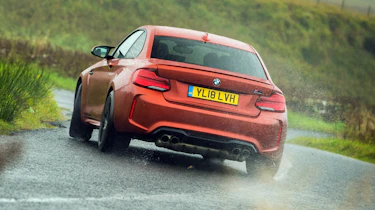
While the M2 Competition’s underpinnings were very similar to the M2’s, both cars already having been treated to the M4’s front and rear suspension assemblies, the Competition received some additional M4 goodness. The bigger car handed over its carbonfibre front strut brace and bulkhead brace, increasing rigidity and therefore delivering more precise and accurate steering.
Elsewhere, the multi-link rear axle received ball joints in place of the old car’s rubber bushes, while both the electronically controlled rear differential and the MDM stability control were treated to some digital development to cope the car’s greater agility.
The springs and dampers were brought over unchanged from the previous model. Like the M2 there was no option to upgrade to adaptive dampers, BMW again wanting to keep some differentiation between the baby M car and the M3/M4.
In another move to keep the models separated, the M2 wasn’t available with the carbon ceramic brakes that were an option on the bigger M cars but made do instead with more or less the same stoppers as the M2 was equipped with – 380mm front discs and four-piston calipers. Many owners found these to be a little marginal, especially if used on track, and there was a £1350 BMW M Performance upgrade which featured larger 400mm front discs with six-piston calipers.
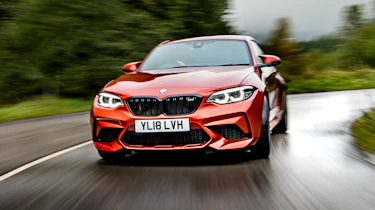
On track you notice the improvements made to the M2 Competition almost immediately. For starters, the body strengthening did the trick. The already meaty steering feels more precise, the front end responding crisply to your instructions.
Traction is strong out of the slower corners, while through the faster turns there’s beautiful balance, the subtle stabilising understeer easily neutralised with a stab of the throttle. Switching off the stability control reveals a car that can be steered as effectively with your right foot as it can with the steering, the stiffer rear axle and tweaked diff delivering a more faithful and progressive breakaway.
On the road there’s the same underlying firmness as in the original M2, with a jiggle in rhythm with the road at low to medium speeds. Yet pick up the pace and this tautness is your ally, helping to keep the Competition’s cornering stance flat and tightly controlling body movements – only over a short but wickedly bumpy stretch does the short wheelbase M2 get unruly.
At saner speeds there’s virtually no front end slip, which gives you confidence to commit from the moment you turn the wheel. Yet there’s still plenty of scope for it to show its playful side, the combination of stump-pulling torque, sharp throttle and newfound precision in the rear axle allowing you either to revel in strong traction or to gently rotate the car at corner exit.
evo Car of the Year 2018 result – Richard Meaden
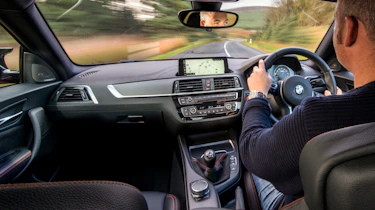
‘There’s something inherently appealing about the M2 Competition. Just like the original 1-series M Coupe it’s partly to do with its compactness, the kind which makes this particular M-car a proper clenched fist of a machine. Then there’s the kudos of the ‘Competition’ enhancements, subtly adorning said clenched fist with a knuckle duster.
'But there’s more to it than packaging and focus. Collectively what we all loved about the M2 Comp was that it gets back to what BMW and M-cars always used to be about. No, its not a simple, analogue car in the mould of an E46 M3, but it goes about its business with a similar verve and enthusiasm, winning you over easily on roads where the bigger present-day M3 and M4 can feel a bit bulky, contrived and heavy-handed.
‘Turbocharging has robbed us of M’s sparkling naturally aspirated straight-six motors, but there’s plenty of fizz about the M2’s 404bhp twin-turbo engine. And it’s all the better for being mated to a sweet manual ’box. Meanwhile retuned steering and a more rigid structure bring control and cohesion where the earlier M2 was prickly and felt out of sorts.
‘Why didn’t it do better? Because 2018 was a truly exceptional year and, whilst brilliant, the M2 Competition isn’t a truly exceptional car. At least not in this exalted company – the likes of McLaren’s 600LT, Porsche’s 911 GT2 RS and Alpine’s A110. Yet it shines brightly enough for fifth place, offering a unique combination of performance, price point and four-seat practicality. An M-car that’s very easy to love.’
Long-term test: 7515 miles in a BMW M2 Competition – Ian Eveleigh
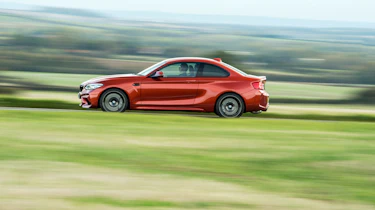
'Eight months with a compact, 404bhp M-car. It’s a no-brainer, right? You’re going to have a good time. Well, when our M2 Competition arrived, I was far from sure.
'Concern number one was that I’ve never really been that enamoured with the F8X M3/M4, and in particular its turbocharged engine, which made its way into the revised M2. Concern number two was that the first M2 was something of a hit-and-miss machine, and while the initial tests suggested this revised Competition variant had addressed many of the original’s shortcomings, could long-term exposure on a wider range of roads once again expose a chassis that struggles just when you need it to pull together? Time would tell.
'Things got off to a good start, chiefly because our M2 had a manual gearbox, not the DCT option. The manual shift immediately endowed the ‘S55’ engine with more character than I recalled from the various current-gen M3s and 4s I’d driven – all of them DCTs – principally because it seemed more natural to hold individual gears over a greater stretch of the rev range rather than flicking them away with the twitch of a finger. In combination with a 40bhp reduction in power, and the identical 406lb ft peak torque figure arriving 500rpm later, at 2350rpm, the spiky delivery that can be tiresome in the next model up the M-car ladder was also suitably tamed.

'Our relationship soon started to blossom, but then winter arrived and things took a step backwards. On cold, wet roads, I found the M2’s front end frustratingly difficult to read, so my pace was often inordinately tempered by not knowing how much grip I had in reserve. Others on the evo team found they could work around it, but I could never get comfortable taking that leap of faith.
'So spring couldn’t come soon enough. With milder temperatures and dry surfaces, front-end grip levels were obvious and plentiful again, while the rear end did a remarkably good job of getting all of that torque to the tarmac via 265/35 ZR19 Michelin Pilot Super Sports. The twin-turbo straight-six was now fully run-in, too, and fed on 99 RON its performance packed a hefty punch. Stretching each of the lower gears out to the 7500rpm red line, not once did I think the M2 needed its bigger brothers’ extra horsepower. In fact, at one point I actually checked the Knowledge to make sure the Competition’s power figure wasn’t higher than I remembered…
'It was around this time that I really began to bond with the M2. In fact, that’s understating it; it really felt more like a mild addiction. I lost count of the number of times I drove my favourite sections of the B660 just for the sake of it. The M2’s size suited said road so well, being compact enough to not feel like you were threading it through the eye of a needle as you avoided the ragged tarmac edge to your left and the catseyes and occasional oncoming traffic to your right. And though you could be shaken up and down quite vigorously at times, crucially this happened not because the car was pogoing on the edge of control, as was often the case with the original M2, but because the taut-riding Comp was moving in close sync with the road beneath, keeping itself in check.
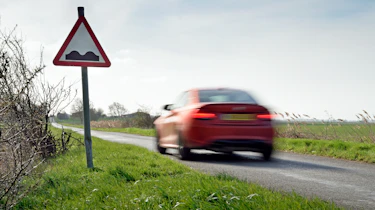
'So those were the fun times; what about the day-to-day? It certainly wasn’t one of those cars that mollycoddled you on regular journeys: with its manual gearshift, manual handbrake, no blind spot warnings, no radar for the cruise control, no adaptive dampers, etc, you were encouraged to remain involved and alert. But it also had all the good nice-to-haves: reliable satnav, a reversing camera (optional), a decent 12-speaker Harman Kardon sound system, and amazingly bright adaptive headlights (those last two being part of the £1800 ‘Plus Pack’).
'Passengers would complain about the harsh ride around town, and accessing the rear seats could be a pain, because the seatbacks insisted on bouncing back to their upright position quite forcefully unless you kept pushing them forward, and because waiting for the (optional) electrically powered seat base to whir slowly forwards was a bore.
'The M2’s mpg generally hovered around the mid-20s, which seemed acceptable given how often its performance was enjoyed. There wasn’t a single glitch, blip, knock or rattle to report, and when the car left us with 8600 miles on the clock, its first service was still over 10,000 miles away. And there was around 7mm of tread left on the front tyres, 4mm on the rear.
'The M2 Competition may have taken its time to fully worm its way into my affections, but when it eventually did, I was hooked. Its departure at the start of the summer – when to my mind its abilities are shown at their best – seemed impossibly cruel. I truly miss it.'
What to pay and buying guide
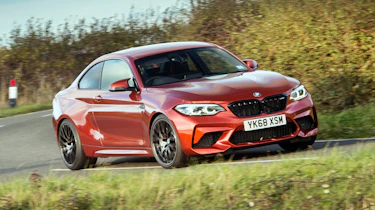
When it was new the M2 Comp was a whisker under £50k and the good news is that you can now bag one for around half that. At £25k you’ll be looking at an early car with high miles but stretch a little more and £30k will get a 2019-onwards example with reasonable mileage. Top whack for an M2 Competition is around the £40k mark which will see you in a 2020 machine with low miles and plenty of options. You can start your search on Carwow.
Cars at BMW main dealers start at about £32k and do offer peace of mind as they’ll come with 12 months approved used car warranty which will cover any major failures. If you’re after a manual example then you might have a little bit more trouble finding one as the seven-speed DCT ‘box outsold the six-speed manual by quite some margin. As a result the manual cars carry quite a price premium, as much as £5000.
Overall the M2 Competition has a decent reliability record but there are a couple of issues that can crop up. Electrical glitches aren’t unknown with the iDrive occasionally failing to respond to inputs or randomly operating of its own accord. The rear indicators can also play up which is a common BMW 2-series problem. The cabin can also succumb to a few squeaks and rattles with the worst generally coming from the glovebox area.
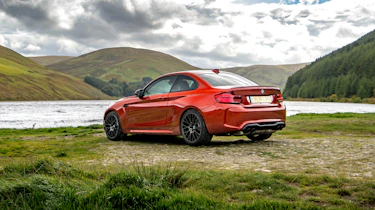
Differential seals, particularly the input seal and the sensor, can be prone to leaks and coolant radiators at the front can be punctured by the plastic wheel arch liners. Bodily there shouldn’t be too many concerns, but do check behind the front and rear wheels for paintwork rash as those 9- and 10-inch wide wheels do spray up plenty of debris which can completely wear through the paint.
Some owners fit arch guards just behind the wheels to prevent this. It’s also worth checking the wheels aren’t damaged, that the tyres are in fine fettle and that the discs aren’t lipped.
Mechanically the main potential weak point in line with some other N55 and S55 engines is the spectre of spun crankshaft hubs. It’s not desperately common and tuned cars are more liable to the fault but if it happens the best-case scenario is that the engine will need retiming while the worst is that the pistons will hit the valves. Our advice would be to arm yourself with a BMW warranty or to invest in one of the aftermarket fixes that address the problem.
BMW M2 Competition specs
| BMW M2 Competition | |
|---|---|
| Engine | In-line 6-cyl, 2979cc, twin-turbo |
| Power | 404bhp @ 5250-7000rpm |
| Torque | 406lb ft @ 2350-5200rpm |
| Transmission | Six-speed manual/seven-speed DCT, RWD, LSD |
| Weight | 1550kg (265bhp per ton) |
| 0-62mph | 4.4sec |
| Top speed | 155mph (limited) |
| Price new | £49,805 |
| Price now | From £25k |