Volkswagen Golf R (Mk8.5) review – a better hot hatch but not the best
VW were quick to rush the Mk8 Golf into its second phase, but even the Mk8.5 Golf R is underwhelming compared to its distant predecessors
evo Verdict
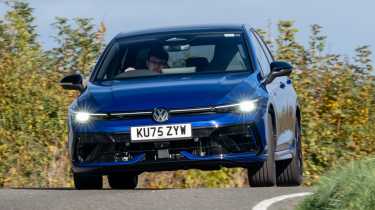
The Volkswagen Golf R has become the everyday hot hatch icon of our times. In a new car market where lease and PCP dominate, its mix of value for monthly expenditure and extreme real-world performance have made it an unstoppable force. The Mk8 fell a little way short of a success compared to its predecessor, but VW has worked hard to refine the Mk8.5. It claws back some ground, even if it’s not yet the best Golf R there’s ever been.
Volkswagen R began with the Mk4 and Mk5 Golf R32s in the 2000s, grew into the four-cylinder Mk6 R but reached its zenith in the Mk7 of the 2010s. It’s fair to say that the pressure was on to reinvent the Golf R in line with the Mk8 Golf, without messing too much with the proven recipe. The endeavor was, it seems, a little way short of a success, the Mk8 Golf R underwhelming on almost all fronts by comparison to the evergreen Mk7. Now, VW has updated it, attempting to inject more life into it while rationalising what was a perilously frustrating user interface.
To keep itself clear of its Golf GTI Clubsport stablemate, the Golf R remains the only model to utilise all-wheel drive. On top of this, the Mk8 also brought with it a torque-vectoring rear differential with which it has had varying degrees of success. With the Mk8.5, the anti-lag turbo tech of the 20 Years is now standard, along with the anniversary special’s power bump to 328bhp.
More reviews
Group tests
- VW Golf R v Cupra Leon 333 – the family feud with an unexpected winner
- Volkswagen Golf GTI Clubsport v Cupra Leon 300 – what's the best mainstream hot hatch?
In-depth reviews
- Volkswagen Golf Mk8.5 review – still the hatchback benchmark?
- Volkswagen Golf R (Mk8.5) review – a better hot hatch but not the best
- Used Volkswagen Golf GTI (Mk5, 2004 - 2009) review – one of the best VWs of the last 30 years
Reviews
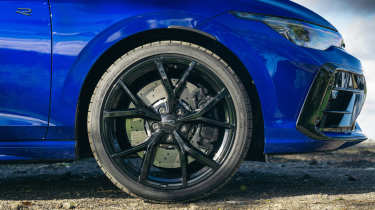
There are now two forms of Golf R available: base and Black Edition. Their technical make-up is identical, with the changes to the Black Edition fundamentally visual. The black trim and wheels wouldn’t be our first choice.
Engine, gearbox and technical highlights
- Ubiquitous EA888 is effective
- Torque vectoring differential on the rear axle
- DSG and five-door only
Three-doors and manuals died with the arrival of the Mk8 and there’s no change on that front for the latest Mk8.5 facelift. The twin-clutch DSG transmission features seven gears, and its near instantaneous shifts contribute to effortless performance, even if the turbocharger and transmission feel like they need longer to wake up than they once did – something that could well be due to the gas particulate filter fitted to all Mk8 Golfs.

There’s software at play that further sharpens the transmission and augments a sort of anti-lag function, coming from the Golf R 20 Years, that’s now standard. The system keeps the turbo spinning through a partially opened throttle under heavy braking to reduce the spool time when you jump back on the accelerator.
Like the Mk8 GTI Clubsport, the R features a host of detail changes to its tried and tested layout of MacPherson front struts and a multi-link rear axle, with improved bearings and joints throughout and stiffer spring rates than on the old car. There are no chassis set-up differences between any of the three subvariants.
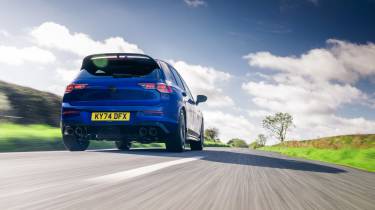
The standard dampers are passive, but VW’s adaptive units are a £735 option (and a must-have in our view). The base car’s standard wheel size is once again 18 inches. The rears are fed power via a torque vectoring rear differential that can send up to 100 per cent of drive to the outer rear wheel during cornering.
The R offers Comfort, Sport, Race and Individual driver modes, accessed via either a button on the dash or on the steering wheel. Special, where all the car’s systems are configured for the Nürburgring Nordschleife, and Drift, with obvious consequences, that were extras before, are now standard. The front brake discs are larger than those of the old seventh-generation model at 357mm, and gripped by lighter calipers.
Power, torque and 0-62mph time
While the Mk8 Golf R launched in 2021 with 316bhp and 310bhp. For the update, the 2-litre EA888 Evo 4 four-cylinder turbo has been uprated to 328bhp from 5600-6500rpm (matching the 20 years edition of 2022), while the 310lb ft from 2100-5500rpm torque figure remains.
The Golf R is almost surgically accelerative, now said to hit 62mph from standstill in 4.6sec, a tenth quicker than before and ahead of its Mercedes-AMG A35 hatch rival. The R’s standard top speed is 155mph but opt for the Performance package and this is lifted to 167mph, a figure that it will hit with surprising ease on the autobahn. These figures translate into one of the most usably quick cars on sale for under £100,000.
Performance, ride and handling
- Engine is performant if a little soulless
- Dynamics are stable and responsive if not stimulating
- Dynamic Chassis Control an essential option
In all rational sense the Golf R is a quick car, but it does feel somewhat blunted by its 1548kg kerb weight, which is c/100kg more than the larger, but admittedly front-wheel-drive Honda Civic Type R. When we put it on our scales, the Golf R 20 Years actually sat underneath the quoted weight at 1529kg, but for a four-cylinder hot hatchback it’s still a big enough figure to cause some problems.
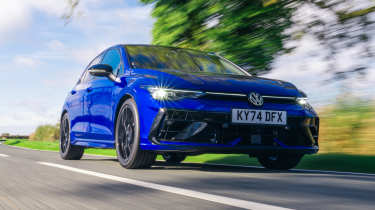
Thanks to the heady combination of a high-torque turbocharged engine, 4Motion all-wheel drive and a dual-clutch transmission, the new R feels just as quick as before, with impressive pull both from a standstill and on the move, thanks to its anti-lag turbo tech. Play with its numerous drive modes and there is a noticeable improvement in response from the chassis to the powertrain, when opting for sportier calibrations.
The ability to decouple the transmission mode from the engine mode is also a big plus, and if you do decide to take over there is a new set of paddles behind the steering wheel to give you control. It’s one of the few, but much appreciated, improvements the Mk8 introduced. Sadly, the latest Mk8.5 does not get the snappy transmission mapping of the 20 Years edition.
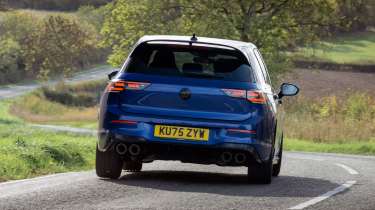
The Golf R is a car with an awful lot of software commanding your attention from the moment you slide into its bucket seat. It is possible to simply press the ‘start’ button and drive, as long as you don’t mind the haphazard and unsettling intervention of the Lane Assist function, which has to be switched off every single time the ignition is turned on.

To adjust the ESP setting you’ll need to delve into the central display, look for ‘brakes’ within the assist screen and confirm your choice. Having spent lots of collective time in the latest Golf R in all of its guises, we have found a shortcut to the ESP’s lesser setting – a flick down from the top of the screen will show a further sub-menu that you can then add an ESP shortcut to. There’s still a need to confirm the selection, and you’ll need to haphazardly flick up again to rid the screen of it again, but it’s a useful tool. This is the sort of useful consumer advice you’ll only find on evo. If you really want to set the car up for enthusiast driving, it’ll take pressing buttons for at least 30 seconds after ignition to get there.
Anyway, with Lane Assist disabled and Comfort driving mode selected, the Golf R feels more or less like a TSI-engined Golf R-Line. It is completely undemanding: quiet, refined, well-riding even on the optional 19-inch wheels, coasting at times to save fuel, and perfectly set up for local trips or long motorway drives.
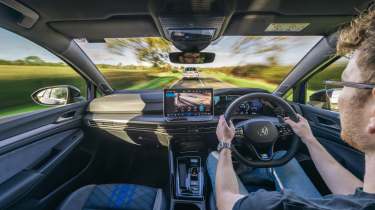
Objectively these are all good things, qualities that will make the R an effortless companion, especially for those who are only interested in owning the best, most expensive Golf, but aren’t really interested in hot hatchbacks per se. The previous model was always good at covering off this market, something that’s unchanged in the new R. The problem occurs if you want your hot Golf to be exciting when the road gets interesting. For all its glossy persona and capability, you can drive for miles and miles and wonder what all the fuss is about.
That is until you dare delve back into the driver modes. Get busy with the different elements in Individual mode and the Golf R’s more aggressive side starts to reveal itself. The powertrain, optional adaptive dampers and steering ratio all immediately wake up, washing off some of the polish that all these elements portray when just ambling about, but unlike its predecessor what’s revealed underneath doesn’t exactly feel up to scratch.
Despite added weight to the steering, the Golf R feels looser and less precise around the straight-ahead than it really ought to. Start leaning on the chassis and the front end is immediately put under pressure, the dampers’ struggle to maintain complete control of the front wheels fed back to you via kickback through the steering wheel. Introduce some challenging cambers or bumps and it doesn’t take much to find the bump-stops.
This is all the more disappointing when you learn that, like the GTI Clubsport, the R’s front end actually has some pretty serious geometry, with an aggressive amount of negative camber, while the subframe is reinforced and the progressive steering rack is bespoke.
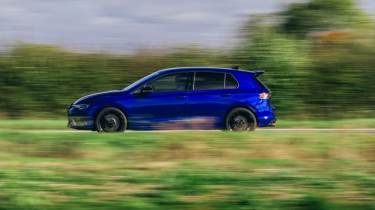
The trick differential system is still difficult to fully take advantage of on the road, with the rotation you’re looking for often turning to mild front-end push. Brake very hard into a tight corner and you can get the tail swinging to help turn-in, and once in the corner it’s possible to get on the power very, very early – sometimes this simply fires you out of the corner in a satisfying manner.
But in some circumstances it results in dramatic power oversteer, thanks to the torque vectoring rear differential, and try to maintain yaw and it almost feels like the tyres are being dragged in underneath themselves, sometimes manifesting in a sort of lateral hop like you’re in an AMG from the early noughties.
Ironically, a modern A45 S AMG will do the same oversteer motion, and very occasionally the GR Yaris, but there’s something about the way the R relinquishes grip and then drives forward with all four wheels scrabbling away that feels a little less resolved.
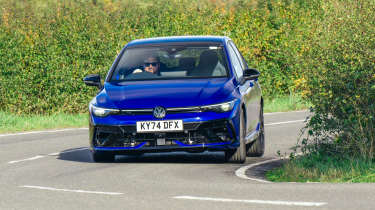
The engine also isn’t without fault. At lower revs it feels constrained by the car’s weight, but once over 4500rpm the mass is less of an issue and the R does pick up speed. As mentioned, the larger paddles behind the wheel are a big improvement as well, although they’re still a bit of a stretch to reach.
The latest Golf R’s overall driving experience still feels undernourished in a way the old Mk7’s didn’t. The basics are there, but the dynamic capability that resided below the polish is gone, replaced with something that’s more ham-fisted and broadly less capable.
To many Golf R buyers, this last ten per cent won’t matter. But to us, for what was always a very desirable car that had the dynamic chops to back it up, it’s returned to the Mk6 syndrome of not actually being that great to drive, which makes the Mk8’s price tag even harder to accept. If you’re looking for a lithe, playful hatch for everyday road speeds, the R wouldn’t be our pick, but if stability and overall pace is the goal you can’t go too far wrong.
MPG and running costs
- EA888 is frugal until you use its performance
- Expensive to first register
- Expensive car supplement adds to initial yearly VED costs
There’s plenty of emphasis on fuel and emission saving in the Golf R with its particulate filters, eco modes and dual-clutch ’box, yet like all these New-Age high-performance fours, hard use will see MPG figures drop way down from those claimed. VW quotes an official rating of 36.2mpg, but this will easily drop to the mid-20s when pushing hard.
In contrast, a gentle motorway cruise will see the R comfortably crack 40mpg, the variation in fuel usage a clear signal of how much development and technology has been integrated into the venerable EA888.
Your biggest friend when it comes to running costs is the Golf R’s rock-solid residuals, often making the R cheaper to buy on a lease or PCP finance option than more affordable rivals of a similar demeanour. The threat to this is all the options, which will never retain as much value percentage-wise as the car itself. Worth remembering is that a Golf R is an expensive car to register (£3300) and tax (£195 plus £425 expensive car supplement for the first five years).
Most UK Golf Rs on the 19-inch wheel run on 235/35 R19 Bridgestone S005 rubber, which will set you back a not unreasonable £122 each at current prices.
Interior and tech

- Improved ergonomics aren’t perfect
- Backlit temperature controls good, haptic wheel controls bad
- Material quality mixed, but it’s stylish
Slide behind the wheel and into its well bolstered seats, and the seating position is the first thing that comes to mind – it’s far from the worst offender on the market, but it sits you too high in the cabin giving that ‘sat on rather than in’ feeling. Multiple interior finishes can be specified for the interior, but the cars we tried featured R-specific faux-carbonfibre fabric on the seats, which is now looking a bit naff a decade on from when it was first introduced; we much prefer the grey Alcantara and chequered fabric option.
The steering wheel is where most of the criticism was directed with the original Mk8, with the touch pad controls far too sensitive, leading to accidental activations. While the rest of the Mk8.5 Golf range has now reverted back to physical buttons, the R makes do with the same touch pads, only with the sensitivity recalibrated in an effort to resolve the issue. Volkswagen says it didn’t opt for physical controls as it wanted to retain the dedicated R button, which would have required the costly creation of new physical controls.
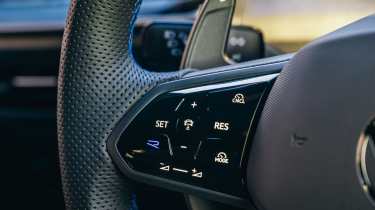
Despite the updates, the same problem remains. Our first drive in the R on track saw us accidentally activate a 39mph speed limiter (not ideal on the high speed Lausitzring), with the heated steering wheel is also easily activated when all you want to do is turn a corner.
Thankfully, the touch sliders beneath the improved 12.9-inch central infotainment display are now backlit, but the HMI still has plenty of room for improvement. There’s still a lack of common sense to the system, hiding critical functions like climate controls within menus that still have us pining for manual rotary controls.
Move away from the technology though, and the R is a comfortable place to be on the whole. The steering wheel has a relatively thin rim, a rarity in today’s market, with the R-exclusive extended paddles making shifting a much more pleasant experience than in the GTI models.
Prices, specs and rivals
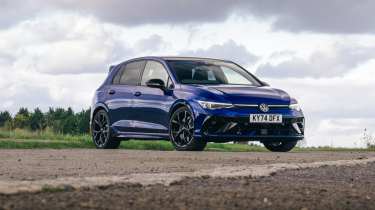
There are now two forms of Golf R available: base and Black Edition. Their technical make-up is identical, with the changes to the Black Edition fundamentally visual. The black trim and wheels wouldn’t be our first choice. Base starts from £46,810, while the Black Edition rises to £47,050 OTR.
Where once the Golf R was pricier than its closest rivals, the Audi S3 and BMW M135, it now splits them. The Audi starts from a sturdy £48,900 while the newly-refreshed BMW comes in under the VW, available now from £45,550. The recently updated Mercedes-AMG A35 is the Golf's strongest competitior but has gone up in price, now starting at £47,610.
Despite its flagship status within the Golf range and a base price north of £46k, the latest R is rather underspecified when it comes to standard kit. The ‘Warmenau’ wheels are a £1120 option you might want to avoid for the sake of ride comfort. You’ll want to add the DCC adjustable adaptive dampers, for £735.
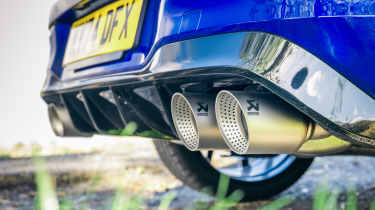
A bit more aggression from the Golf R’s vocals can come courtesy of the Akrapovič R Performance exhaust with a titanium muffler, but that’s a £3,395 option. Want a decent stereo? That’s an extra £665. The £2510 for leather upholstery is a lot for what essentially comes as standard on almost all rivals. The crux of the long options list is that to reach the point where a Golf R feels well-specced, you’ll be looking at well over £50k…
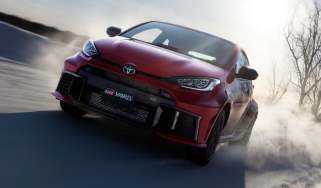
The herd has thinned in the wider hot hatch world in recent years, with the departure of the Ford Fiesta ST, Hyundai i30N, Renault Sport Megane and Honda Civic Type R. But there are still a few great choices. Whether it’s the dynamism of the freshly updated Toyota GR Yaris or the more fun you’ll get out of a Cupra Leon.