Aston Martin V8 Zagato review – the quirkiest 1980s supercar is also brilliant to drive
In the mid-1980s, Italian design house Zagato put its unique stamp on the V8 Vantage. The result was a quirky, engaging and hugely desirable super-GT
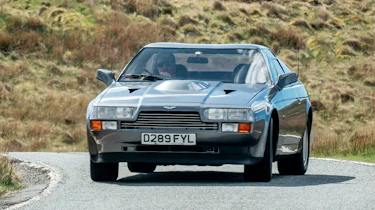
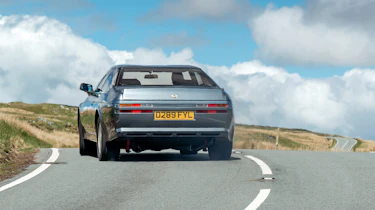
Italian design house Zagato definitely went through a ‘less is more’ period in the ’80s. You could see it in Lancia’s Integrale-based Hyena, and the same sense of sucked-in, condensed, hard-bodied minimalism is evident in Zagato’s 1986 take on the V8 Vantage for long-time client Aston Martin. Pretty it wasn’t (and with the sublime 1960s DB4 GT Zagato in the back catalogue, that was a disappointment to some), but it still looks remarkably modern today, a design devoid of the grand stylistic gestures that can date quickly.
In some respects, the project reprised the lightweight DB4 GT Zagato. Like its classic counterpart, the modern V8 Vantage Zagato was reduced in overall size and clothed with an aluminium body from Italy. As with the DB4, the chassis was shortened and the rear seats removed, the result being a considerably more agile and involving driver’s car. Fans of the Zagato included Aston enthusiast Rowan Atkinson, who bought the first right-hand-drive example and later had it converted into a 482bhp racer. By the end of the ’80s, in the height of the supercar boom, examples were changing hands for as much as £450,000.

In all, 52 examples of the coupe were produced, followed by 37 Volante convertible versions. The initial price of £87,000 positioned the Aston way above Lamborghini’s Countach and Ferrari’s Testarossa flagships, and increased to £95,000 the following year, then continued to rise to £125,000 by 1988 – necessary to offset the crippling cost of shipping rolling chassis from Newport Pagnell to Milan to receive the new bodywork before they were shipped back again to be painted and trimmed. Sounds ambitious, but Aston supposedly had no trouble selling them, and today the Zagato is a very collectable classic that’s also a treat to drive.
Engine and performance
- 170kg weight saving over V8 Vantage thanks to aluminium bodywork and lack of rear seats
- 5.3-litre V8 with 432bhp, driven through dog-leg manual
- Genuine supercar speed, even in today’s context
More reviews
Group tests
- Ravage Alpine A110: France's perfect sports car made even more perfect
- Alpine A390 v Hyundai Ioniq 5 N – are these EV crossovers fun as well as fast?
- Ariel Atom 4R v Ariel Nomad 2 – is grip more fun than slip?
- Ariel Atom 4R v Caterham Seven ‘evo25’: power-to-weight heroes go head-to-head
- Audi Quattro, RS2 and RS3: five-cylinder icons head-to-head
- Who makes the best GT car? Aston Martin v Bentley v Maserati
- BMW 230i M Sport v Volkswagen Golf GTI Clubsport
- Caterham Super Seven 600 v Super Seven 2000
- Ferrari Enzo v LaFerrari – analogue hypercar meets its digital successor
- Great Ferrari hypercars driven: 288 GTO, F40, F50 and Enzo head-to-head
In-depth reviews
- Abarth 600e review – electric hot hatch with surprising character
- Alfa Romeo Junior review – small Italian crossover to rival Ford's Puma
- Alpine A110 R (2023 - 2026) review – the flawed but fantastic Porsche Cayman GT4 alternative
- Alpine A390 review – France's flawed rival to the Porsche Macan
- Alpine A110 review – the sports car Lotus should be building
Long term tests
- How lowering the roof on the Abarth 695C is a threat to my driving licence
- Alpina B10: Alpina B10: end of term report
- Alpina B10
- My £200k Aston Martin DBX707 comes with a built-in shower I didn't ask for
- The subtle trick that makes Audi’s old interior better than a touch screen
- My Audi S8 can’t make me hate it, even if its safety systems are often terrible
- Living with this £40k Caterham Seven even makes the KFC drive-thru memorable
- Caterham Seven evo Edition revealed – bespoke 420R joins the Fast Fleet
- It has a VW Golf R engine, but the Cupra Leon is quietly old-school
- Cupra Ateca VZN Fast Fleet test – four months with Cupra's hot crossover
Reviews
- Abarth 695 (2012-2024) review – why we’ll miss Italy’s Mini Cooper S rival
- Abarth 500e 2023 review
- AC Cobra 289 review – British sports car with an American V8 heart built to fight Ferrari
- AC Cobra 378 Superblower MkIV 2021 review – another V8 Cobra, but with a GM heart this time
- Acura Integra Type S 2024 review – a Honda Civic Type R with added restraint
- Alfa Romeo 33 Stradale 2025 review – a rare Italian jewel beyond compare
- Alfa Romeo Tonale 2023 review – 276bhp Speciale version tested
Its pricing may have been punchy, but the Zag more than backed it up with startling looks and some equally impressive stats. For starters it was genuinely lightweight, tipping the scales some 170kg (or roughly 10 per cent) less than the V8 Vantage upon which it was based. Unlike its DB4 GTZ ancestor, the wheelbase was unchanged, but the front and rear overhangs were greatly reduced. Zagato’s all-aluminium bodywork made further savings, as did the lack of rear seats. To maximise the tangible effect of every kilo saved, the Zagato was powered by what was known internally at Aston Martin as the 580X version of the revered Tadek Marek-designed 5.3-litre quad-cam V8. It was mated to a dog-leg manual gearbox.
This ‘X-Pack’ state of applied race tuning modifications included Cosworth forged lightweight pistons, ported cylinder heads and higher-lift camshafts, plus modified Weber 50 IDF carburettors and a less restrictive exhaust system, to increase power by up to 60bhp compared to the regular V8 Vantage engine for a total of 432bhp. That gave the Zagato an impressive 0-62mph time of 4.8sec, and a 186mph top speed.
Driving the Aston Martin V8 Zagato
- Beautifully responsive and characterful V8
- Friendly front-engined, rear-drive dynamics
- Sharp steering takes some adjustment
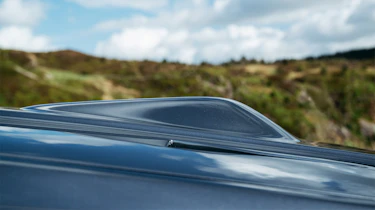
The combination of Zagato’s desire for a less bluff nose and the 580X’s battery of Weber carburettors resulted in one of the most prominent power bulges of all time. Standing prouder than Cameo frontman Larry Blackmon’s ‘Word Up’ codpiece, it is the most memorable of the Zagato’s many eye-catching details.
Despite its sharply tailored Italian suit, the Zagato still seems somewhat upright compared to a typical contemporary supercar. This impression is confirmed by the driving position, which places you relatively high, though the upside is blissfully easy ingress. The interior is quietly stylish, mixing leather and suede but shunning veneers for a down-to-business vibe.
This Zagato – number 17 of the 52 built – is a real hot-rod from the moment you start it up, with crisp throttle response and a sharp, cammy note that’s every bit as exotic and energised as you’d expect from a super-GT. It’s easy to be seduced by the engine – it’s so revvy, so responsive, yet has a big, woofly character.
The idle is throbby, jiggling the car on its springs. Control weights are hefty. Despite power assistance, the steering is very meaty and requires positive inputs. Likewise the gearshift, which has a pronounced H-pattern gate and dogleg first gear. The lever moves easily enough but the cross-gate shifts are rather square-edged and require accurate guidance rather than applying a diagonal force as you do in more modern stick-shift ’boxes.
This car – kindly supplied by Stratton Motor Company – has a sport suspension package that was popular in the day and makes a big difference to how the Zagato feels compared with a completely standard car. It was common to modify Zagatos in period, with RS Williams 7-litre engine upgrades especially popular. More power isn’t really needed, but the suspension package is welcome, even if ride comfort is sharp at low speeds. It settles nicely once above 40mph or so and the car changes direction keenly, though the initial steering response is a bit jumpy.
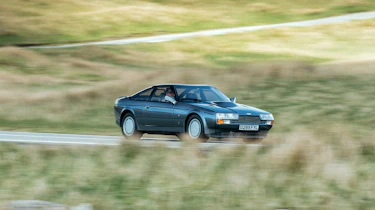
Allowances must be made for the Goodyear Eagle tyres, which are modest in size – 255/50 VR16 on all four corners – and of advancing years. The age-hardened treadblocks offer less outright grip and progression than fresh rubber would, but the Zagato’s sweet balance and playfulness shine through, making it more immediately and conventionally enjoyable than, say, a Countach. You just roll up your sleeves and get stuck in.
In straight-line terms it feels very rapid indeed. Not as explosive as a Porsche 930 Turbo, but sharp and keen with big-league mid-range and fabulous in-gear reach. Period claims of a 186mph top speed placed it amongst the very fastest production cars money could buy. It certainly sounds magnificent under load when the Weber induction noise and V8 bellow are at their peak. It’s also epic off-throttle, when you get a delicious array of authentic pops and crackles that seem to rumble through the whole car.
It’s easy to view the Zagato as the ‘odd man out’ among 1980s supercars, but equally easy to fall for its unusual and exuberant character. The way it combines British pomp and Italian exoticism is highly seductive.
Aston Martin V8 Zagato specs
| Engine | V8, 5340cc |
| Power | 432bhp @ 6500rpm |
| Torque | 400lb ft @ 5000rpm |
| Weight | 1590kg |
| Power-to-weight | 276bhp/ton |
| Tyres as tested | Goodyear Eagle VR50 |
| 0-60mph | 4.8sec |
| Top speed | 186mph |
| Basic price new | £87,000 (1986) |
| In today's money | £267,500 |