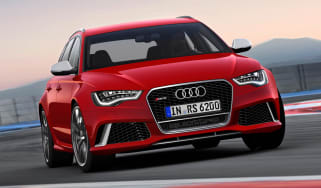
Audi RS6 (C8, 2019 - 2025) review – the fast Audi that caught up to BMW’s M5
The C8 RS6 arrived as the best yet and only got better, right as rivals from BMW M and Mercedes-AMG fell off the boil
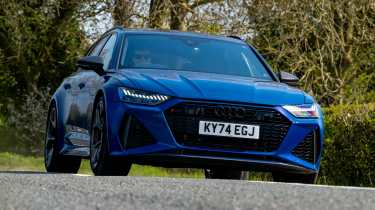
The Audi RS6 has always been beloved by its buyers as a brute force blunderbus with monstrous straight-line grunt, prodigious grip and all-weather performance deployability. What it’s not always been is the most thrilling driver’s car, often falling foul of the still fast but more engaging BMW M5 and the hot rod thriller that was the Mercedes-AMG E63 S.
In its C8 generation, however, the RS6 reached an unexpected zenith, pairing an uprated version of the monstrous 4-litre V8 engine and quattro all-wheel-drive system we’ve come to enjoy and respect with an unlikely sense of agility and dare we say it, fun. It was also a car that improved with each iteration and with options that added genuine benefit rather than simply adding to the cost.
Just as the C8 found its best form with RS6 Performance and ultra-limited RS6 GT variants, Mercedes-AMG has declined to offer a full-fat, V8-powered E-Class to challenge it. For now. While BMW has introduced the first M5 Touring in almost 15 years, its latest M5 is a controversial one, tipping the scales at almost 2.5 tonnes and lacking the resolved dynamics that made previous versions no-brainers over the equivalent Audis. The C8 RS6 ends production at the top of its game but also, as an unlikely class leader, the evo Car of the Year-contesting RS6 GT a glorious final flourish.
More reviews
With such progress also came a hike in price, with the final models starting at £120,195 and climbing to £137,595 for a Performance Vorsprung Carbon Edition. It’s an issue that time, discounts and used values are soothing. The wild RS6 GT might still command £160,000+ (still down on its £177,115 new price) but RS6 Performance models are plentiful under £100k, with the earliest 2020 C8s now available from as little as sixty-thousand.
Engine, gearbox and technical highlights
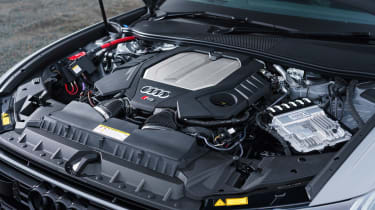
- 4-litre twin-turbo V8 is mild-hybridised
- Rear-steering added to improve stability and agility
- Air springs standard with ‘Dynamic Ride Control’ coil spring and damper set-up optional
Arriving in 2019 Audi’s C8 RS6 carried over a version of the 4-litre twin-turbo hot-vee V8 engine that had been serving in the RS6 since the C7’s introduction in 2012 and numerous VW Group models from Bentley to Porsche and Lamborghini too, with an eight-speed torque-converter automatic transmission sending power to all four wheels via a Torsen centre differential and, on UK models, a standard Sport differential at the rear axle. The centre diff has a 40:60 torque split front-to-rear, but in certain situations can direct up to 70 per cent of the power forwards or as much as 85 per cent to the rear wheels.

The RS6 also includes Audi’s 48V mild-hybrid technology, though it really is fairly mild, less about supplementing drive and more about reducing alternator load and using the big 48V electrical system to handle minor systems instead of drawing all that power from the engine. Another concession to fuel efficiency is cylinder deactivation, which is pretty much imperceptible to the driver and as we’ve discovered on longer trips, relatively effective at calming the RS6’s long-distance fuel consumption.
The other key technology for the C8 RS6, as used in some conventional C8 A6 models (as well as the A7 and A8 of the time) is rear-wheel steering. It has the ability to turn the rear wheels five degrees in the opposite direction to those at the front at low speeds, and up to two degrees in the same direction above 62mph. It’s not a fixed ratio either, with deeply complex electronics determining how far the wheels should steer based on factors such as road speed, cornering load, driver input and more.
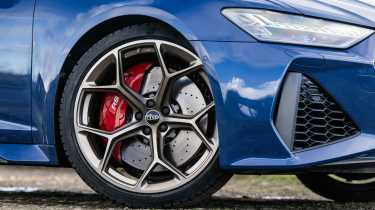
Finally, there’s the suspension set-up, which for this generation of RS6 is a dedicated Audi Sport variation on Audi’s air suspension as standard, with a more conventional coil-sprung and adaptive damper combination, dubbed Dynamic Ride Control, as an option. The damping among other parameters across the steering and powertrain can be varied in their aggression via Drive Select, with RS1 and RS2 modes allowing you to save your preferred individual configurations.
On top of being more powerful and quicker, the RS6 Performance is nominally lighter than the standard RS6 it replaced in 2023. It shirked some sound deadening to the tune of around 8kg to increase the flow of exhaust noise in the cabin to counter the more restrictive particulate filters. Not much difference when the end result is 2090kg, though that’s still almost 400kg lighter than BMW’s current G90 M5.
Power, torque and 0-62mph time
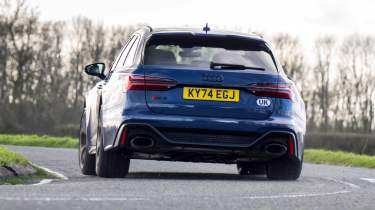
- Standard RS6 has 592bhp, RS6 Performance boosted to 621bhp
- All C8 RS6s will hit 62mph in 3.6sec or less
- Top speed can be as high as 189mph with the right options fitted
It’s difficult to imagine requiring more than the 592bhp and 590lb ft that the C8 Audi RS6 produced from launch in 2019, but the RS6 Performance increased this to 621bhp and 627lb ft four years later, figures the limited-run GT stuck with.
At launch the C8 RS6 was good for 0-62mph ion 3.6sec on the way to a standard top speed of 155mph. You could raise this with fitment of the RS Dynamic Package to 174mph, which also added the all-wheel steering and the quattro sport differential.
Audi RS6 specs
| Audi RS6 Avant (C8) | Audi RS6 Avant Performance (C8) | |
|---|---|---|
| Power | 592bhp @ 6000rpm | 621bhp @ 6000rpm |
| Torque | 590lb ft @ 2050-4500rpm | 627lb ft @ 2300-4500rpm |
| 0-62mph | 3.6sec | 3.4sec |
| Top speed | 155mph | 174mph |
The RS Dynamic Package was standard with Performance models, which could reach 62mph in 3.4sec. Many have recorded sub-3sec runs, which is frankly absurd and rather terrifying and brutal on the transmission. Add RS Dynamic Package Plus and the top speed increases to 189mph and includes carbon ceramic brakes too.
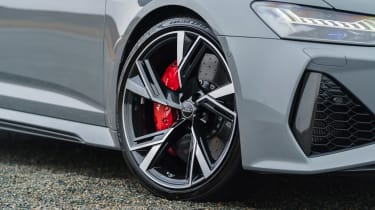
Lighter 22-inch wheels and Continental Sport Contact 7 tyres combine to achieve Audi’s claim that the RS6 Performance can haul itself to a stop from 62mph two metres sooner than the standard RS6.
Performance, ride and handling
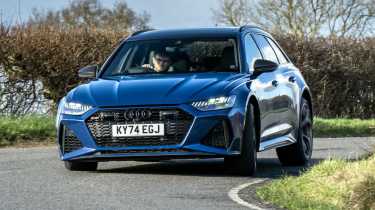
- Rear-steering adds impressive response and agility
- Dynamic Ride Control adds focus but reduces comfort
- Power and performance are mind-blowing
It's not the initial burst of acceleration that impresses, rather the mid-range surge that generates the sense that the RS6 will never stop pulling you closer to the horizon. That it will deliver this kind of performance come rain, snow or sun only adds to the feeling this is more than just a large-hipped A6 Avant.

Its V8 isn’t exactly a modern unit, despite featuring tech such as cylinder deactivation, and there are times when it both feels and sounds a little old school. Not that this is a bad thing, but it lacks the crispness of the BMW M5’s 4.4-litre V8 and the strength of the last-generation Mercedes-AMG E63's V8.
Engine response is slightly delayed by the machinations of the gearbox, which can take a few beats to deliver its power to the wheels off the line and when you ask it to kick down a couple of gears in automatic mode.
Switch to manual, however, and you can make progress nicely, shuffling between traffic and enjoying its mighty torque delivery on the exit of every corner. Shifts are quick enough going up but if your fingers are too trigger happy on the ‘paddles’ on the way down you can find yourself waiting longer than ideal for the desired gear to engage.
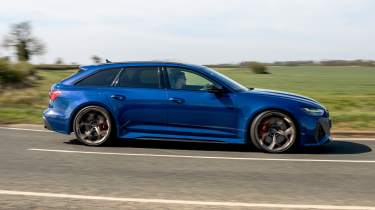
One of the great surprises of the C8 RS6 was that it had both a very liveable ride quality when its Comfort damping mode was selected, yet was still agile and involving enough when you asked it to up its game.
Audi worked hard with its late-2010s to early-2020s generation of S and RS models in areas that don’t just improve objective measures of performance, but subjective ones, too. Stiffer bushings, better matching of suspension to wheel size and weight and the tyre’s performance, along with retuned mapping for the steering all came under scrutiny in the C8 RS6’s development and continued to be evolved after its 2019 launch.
Fitment of rear-wheel steering helped considerably when it comes to the RS6’s dynamics, providing it with an agility that was previously alien to the big Audi when compared against its rivals. It makes for an impressively nimble car for one nearly five metres in length to manoeuvre into tight spaces, and equally agile at speed when you tap into the V8’s thirst for revs. Although some rear seat passengers might find its constant adjustments unsettling, there are times that, despite being 5mm under five metres long, it feels more compact than its smaller non-Competition B9 RS4 sibling.
The C8 RS6 Performance turns in positively, hangs on mid-corner and exits cleanly in a way no car this big or heavy has any right to. Is it as involving as an F90 M5 Competition? No, it lacks the detailed feedback and togetherness that’s inherently engineered into the last-generation BMW M car. It also lacks the purity of the old E63 and the polish of the outgoing Porsche Panamera Sport Turismo. Where the C8 RS6 triumphed is in how it got so much closer to its rivals, dynamically feeling more hooked up and agile than any RS6 bygone.
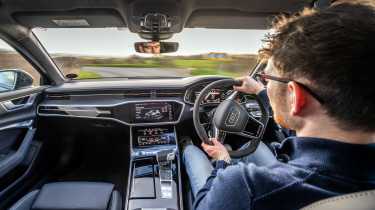
Its steering isn’t what you would call chatty, but there’s a clarity to its response, progression and weighting that makes cornering an intuitive process rather than guesswork of old. Though reduced in weight compared to before, naturally the RS6 Performance can’t mask its mass and under braking and over crests you need to be mindful that there’s a lot of weight to control.
Cars fitted with air springs have more float and less body control, even in their firmer modes, but still plenty of ability. If you’re really serious about cornering your two-tonne monster then you should tick the Dynamic Ride Control box, but for most the air set-up could be an ideal compromise for UK roads.
Where once the RS6 was fast but inert, the C8 RS6, especially in Performance trim, is even faster, but also a car that responds faithfully enough that you feel like a driver rather than an operator.
Driver’s note
‘It doesn’t take many miles to discover that a factory-spec RS6 is a hugely capable car from point to point, with tremendous straight-line pace and a thundering V8 soundtrack. Thanks to its clever air-suspended chassis the RS6 is supremely refined and compliant on the majority of roads, as befits function as a do-it-all estate. Numerous modes help you tailor its adaptive chassis to suit your needs so it can offer a genuinely supple ride, something many of its rivals fail to achieve.’ – Sam Jenkins, evo Senior Staff Writer.
MPG and running costs
Mild-hybrid technology and cylinder deactivation do their best to pull respectable fuel economy figures from an otherwise performance-orientated twin turbocharged V8 engine. They’re not magic though, so a combined figure of up to 22.8mpg is as high as you’re getting officially, and CO2 a minimum of 281g/km, putting it in the highest VED bracket. Although after twelve months and more than 22,000 miles we averaged 23.6mpg over a mix of fast road, motorway and track work.
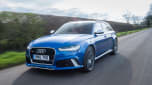
The reality might actually be better though. While the V8 will indeed slurp fuel when you’re using its full potential, we’ve found the RS6 surprisingly frugal on steady runs, regularly achieving a nice round 30mpg on longer, calmer trips. The cylinder deactivation kicks in quite frequently if you keep things steady, and a coasting function in the transmission allows the engine to idle when you decelerate, livening back up instantly when you prod the accelerator.
What you do need to be weary of is punctures. The giant 285-section UHP Continental Sport Contact 7 soft compound on our long-term RS6 Avant Performance seemed to be magnets for deflationary detritus.vEven the standard C8 had 275-section tyres. At over two tons, these along with the giant braking hardware work hard and are expensive to replace.
Interior and tech
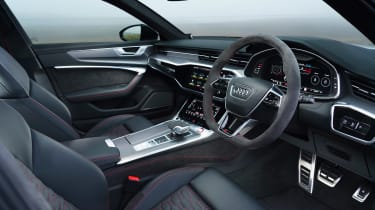
- Twin-screen solution is okay ergonomically…
- … but not as intuitive or as satisfying as proper buttons
- Quality, comfort and practicality are all strong.
The C8 Audi RS6 has a familiar level of material quality, fit and finish and comfort as previous generations. Where the C8 deviates is in its use of haptic touchscreen controls for minor functions. Objectively it works pretty well, the haptic vibrations doing their stuff to let you know when you’ve pressed a ‘button’, and being among the less distracting screen set-ups with large controls for air conditioning or audio functions on the two screens.
Apple CarPlay and Android Auto are included, but be aware that it’s an old HMI system trying to work with the latest technology so don’t be surprised if frequent discontents and a refusal to pair become common.
Subjectively it’s still not as satisfying or distraction-free as proper buttons, and some drivers may simply not get on with the layout, or take longer to get used to it. Worth noting too that the screens do pick up fingerprints, so regular cleaning will be required to keep the cabin looking the way Audi designed it.
Other than that, and a slightly Germanic vibe typical of Audis (don’t expect much in the way of trims colours other than black), there’s little to complain about. The third screen, Audi’s virtual cockpit, is as clear and easy to use as ever. The steering wheel with its dimpled leather feels great, but the Performance’s Alcantara trimmed rimmed feels better still and it’s easy to find a driving position you can sit at for hours, as we did frequently in our long term test car.
Everything you’re likely to touch feels of a high quality and crucially, the RS6 feels very special to be in, and hides its more humble A6 roots far better than BMW’s current M5 hides its humble G90 family connections. And it fits the usual Avant practicality brief too, swallow people, film equipment, animals, furniture, hockey kit or whatever it is you carry around with you.
Prices, specs and rivals
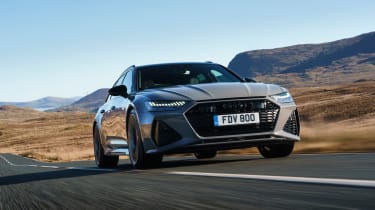
There was a time when this was a hotly-contested segment and on its arrival, the C8 Audi RS6, while enormously improved compared to previous iterations, trailed the F90 BMW M5 and Merc-AMG E63 S in terms of outright thrills, if not as a daily driver. But as the RS6 improved (with the introduction of the Performance model in 2023), its rivals fell away. It departs Audi’s lineup with only a six-cylinder hybrid Mercedes-AMG E53 struggling to fill the big shoes of the old hot-vee V8 engined E63 and the new M5 Touring.
The C8 Audi RS6 departs Audi’s lineup as a very expensive car indeed, with prices towards the end of its run depending on options of between £120,195 and £137,595 The RS6 GT cost from £177,115 when new and values are holding firm(ish). Lesser RS6 and RS6 Performance models are available from £60,000 and the latter from £90,000 at the time of writing (January 2026).
Rear-wheel steering is a rare omission from most models on the market but be sure your chosen example is so-equipped. Likewise, RS Dynamic Pack (Plus if you want a 189mph top speed), if you intend to use as much of your RS6’s performance as possible.
The C8 RS6 is in some ways too young to be showing any real issues, though as always, the best used examples will have bulletproof service and MOT history, with good life in the brakes and quality branded tyres signs of previous owners that were diligent in their roles as caretaker. The central door locking solenoid failed on our long term test car and is a common A6 fault that prevents the driver’s door from unlatching once unlocked.
If the car you are considering looks too good to be true, it probably is. It’s essential that you pay for a specialist to inspect the car before buying and interrogate the history. There was a time when an RS6 fell into the cheap monthly lease pool for some and was driven to attract as many likes and clicks on social media rather than to enjoy it for what it is: one of the very best fast super-estate cars you can own.
| Audi RS6 Performane | BMW M5 Touring | |
|---|---|---|
| Engine | V8, 3996cc, twin-turbo | V8, 4395cc, twin-turbo, plus 145kW e-motor |
| Power | 621bhp @ 6000rpm | 717bhp |
| Torque | 627lb ft @ 2300-4500rpm | 738lb ft |
| Weight | 2075kg (304bhp/ton) | 2475kg (290bhp/ton) |
| 0-62mph | 3.4sec | 3.6sec |
| Top speed | 174mph (189mph optional) | 155mph (190mph optional) |
| Basic price | £120,195 (when new) | £116,095 |