Ferrari F430 Scuderia (2007 - 2009) review – the forgotten hardcore Ferrari?
Ferrari’s sophomore hardcore special blended technology and savagery to winning effect
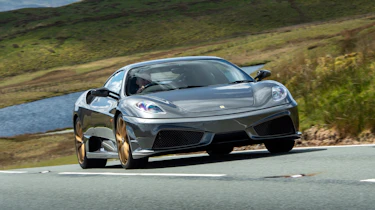
When the 430 Scuderia was launched, its cutting-edge tech made it seem the smooth, digital foil to Porsche’s more analogue 997.1 GT3 RS; the future of performance driving, locked in a tussle with a near-perfect exponent of the past.
The showdown took place during eCoty 2007, and Stuttgart triumphed, just, relegating the Ferrari into second place, yet no one was in any doubt that the Scud was one of the all-time great Ferraris. Even the used market has been slow on the uptake; the 360 Challenge Stradale that preceded it and its successor the 458 Speciale, often valued much higher. Only now is it catching up, and rightly so.
Engine gearbox and performance
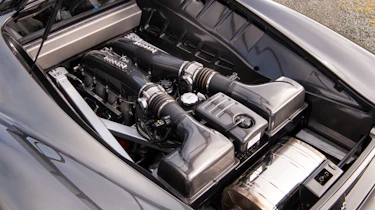
- F1 transmission dropped shift times to 60ms
- E-Diff and F1-Trac stability systems worked in concert with the engine and gearbox
- 4.3-litre V8 good for 503bhp and 347lb ft
There was that screaming F136 Ferrari V8, offering 503bhp and 347lb ft of torque (compared with 483bhp and 343lb ft from the standard F430). That’s thanks to a revised carbonfibre intake system, modified pistons that feature re-profiled crowns, a higher compression ratio (up from 11.3:1 to 11.75:1), and a lightweight sports exhaust system with a single silencer and tailpipes repositioned to keep them out of the revised underbody airflow.
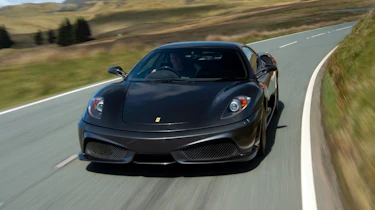
The front spoiler (in a plastic that, while not quite as light as carbonfibre, also wasn’t as expensive to manufacture or replace if you have an ‘off’) features larger vents for the oil radiators, while the edges of the vent apertures are subtly shaped to sweep air down the side of the car.
More reviews
Group tests
- Ravage Alpine A110: France's perfect sports car made even more perfect
- Alpine A390 v Hyundai Ioniq 5 N – are these EV crossovers fun as well as fast?
- Ariel Atom 4R v Ariel Nomad 2 – is grip more fun than slip?
- Ariel Atom 4R v Caterham Seven ‘evo25’: power-to-weight heroes go head-to-head
- Audi Quattro, RS2 and RS3: five-cylinder icons head-to-head
- Who makes the best GT car? Aston Martin v Bentley v Maserati
- BMW 230i M Sport v Volkswagen Golf GTI Clubsport
- Caterham Super Seven 600 v Super Seven 2000
- Ferrari Enzo v LaFerrari – analogue hypercar meets its digital successor
- Great Ferrari hypercars driven: 288 GTO, F40, F50 and Enzo head-to-head
In-depth reviews
- Abarth 600e review – electric hot hatch with surprising character
- Alfa Romeo Junior review – small Italian crossover to rival Ford's Puma
- Alpine A110 R (2023 - 2026) review – the flawed but fantastic Porsche Cayman GT4 alternative
- Alpine A390 review – France's flawed rival to the Porsche Macan
- Alpine A110 review – the sports car Lotus should be building
Long term tests
- How lowering the roof on the Abarth 695C is a threat to my driving licence
- Alpina B10: Alpina B10: end of term report
- Alpina B10
- Aston Martin's 697bhp DBX707 super SUV is now half price, but I can't see why
- The subtle trick that makes Audi’s old interior better than a touch screen
- My Audi S8 can’t make me hate it, even if its safety systems are often terrible
- Living with this £40k Caterham Seven even makes the KFC drive-thru memorable
- Caterham Seven evo Edition revealed – bespoke 420R joins the Fast Fleet
- It has a VW Golf R engine, but the Cupra Leon is quietly old-school
- Cupra Ateca VZN Fast Fleet test – four months with Cupra's hot crossover
Reviews
- Abarth 695 (2012-2024) review – why we’ll miss Italy’s Mini Cooper S rival
- Abarth 500e 2023 review
- AC Cobra 289 review – British sports car with an American V8 heart built to fight Ferrari
- AC Cobra 378 Superblower MkIV 2021 review – another V8 Cobra, but with a GM heart this time
- Acura Integra Type S 2024 review – a Honda Civic Type R with added restraint
- Alfa Romeo 33 Stradale 2025 review – a rare Italian jewel beyond compare
- Alfa Romeo Tonale 2023 review – 276bhp Speciale version tested
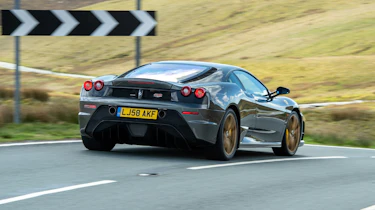
The shape of the central vent also changed to ram air more effectively under the car and improve the ground effect. It works in league with a revised venturi at the rear that has three fins per side instead of two and also incorporates exit vents for the ducts that cool the gearbox and clutch. (The intakes for these ducts, located in the sills, were also enlarged.) Thanks to all these elements – and with a little bit of help from a slightly larger lip spoiler on the tail – the underbody aero package creates 310kg of downforce at 186mph (300kph), 30kg more than the F430 can muster. The rear view of the Scuderia, with all its additional black mesh and fins, has more of a look of the track about it.
The ‘F1 Superfast 2’ version of the single-clutch gearbox was said to cut shift times from 150ms in the standard 430 to just 60ms, in itself comparable to Ferrari’s F1 challenger from just a few seasons before. It would however be the last of Ferrari’s mid-engined models to use the single-clutch F1 transmission, with the 2009 458 Italia adopting a dual-clutch ‘box.
Weight savings were almost a given in this arena by 2007 and so to that end, the 430 Scuderia dropped 100kg compared to the standard 430, down to just 1350kg, thanks to the removal of sound insulation, carpets (yes, with the trademark raw alloy floor panels) and making the stereo optional. Weight distribution was 43:57 front to rear.
The 430 Scuderia also marked the point where Ferrari’s mastery of chassis electronics passed from expert to guru level. By combining the operation of the E-Diff and the F1-Trac set-up with the brain for the engine and gearbox. There was more configurability in the Scuderia, with damper stiffness settings not bound to the traction control position due to what we now know as the ‘bumpy road’ button, an innovation that came courtesy of Schumacher no less. The Scuderia was dropped by 15mm in ride height on its titanium springs.
Driving the Ferrari 430 Scuderia
‘The cockpit was a rather busy mix of Alcantara, gloss-finish carbon and miniature checker plate, plus an unusual webbed fabric for the centres of the comfortable and brilliantly supportive carbon-shelled seats. All the better for keeping you in place while you exploit the handling...
‘There’s a lot of chassis tech at work in the Scuderia, but that doesn’t make it feel in any way contrived or unnatural, and if you work up the confidence to turn everything off, you discover why: the Scuderia handles with real panache. The systems are there for poor conditions, or if you don’t want to test your skills or if you just want a bit of help to make the most of its abilities.
‘While it has a wonderful poise and balance and a sensationally high level of grip on warm, dry roads – just like the Stradale – it does feel different. Its steering rack is faster, the performance of its V8 is substantially stronger, and more nuanced too, the volume of its howl proportional to how hard you’re asking it to work. Same goes for F1-SuperFast2, the final and finest evolution of the automated manual, which matches shift speed to throttle demand.
‘In short, the Scuderia is very able and very fast – even by today’s standards – but best of all it’s dynamically transparent and places all its ability in your hands; it’s just as good as you are.’ – John Barker, evo editor-at-large
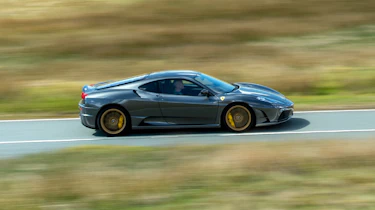
‘The way Ferrari’s SuperFast F1 ’box goes through a flat upshift with a BAP! so loud it rips the air, the way it sounds just like a Formula 1 shift, the way it is as fast as Schuey’s 2004 F1 shift, all combine to make it one of the truly great automotive experiences.
‘The Scuderia is incredibly light on its feet, yet it’s also very easy to drive. The steering is spookily light at times but always accurate, while the massive carbon brakes that make an audible schhh every time you press the pedal are so communicative that you can actually feel the coarse texture on the surface of the discs.
‘Because so much of my lap is quite slow, the P Zero Corsas never get a chance to become hot and sticky, and as a result the 430’s usually unmoveable rear end is entertainingly mobile. Out of the tighter bends it’s frequently flaring up with barks of revs, one or two of the change-up lights in the steering wheel illuminating as you hold the slide out of a corner.’ – Henry Catchpole, evo contributoring editor.
Bedford track test – John Barker
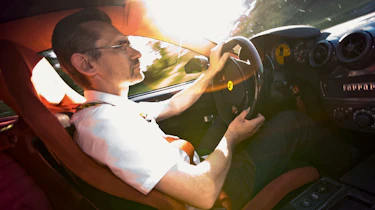
‘There’s a lightness, an athleticism about the Scuderia that you notice right from the off. The steering has good weight but relays clearly that the nose is light, and you quickly appreciate that the key to a fast lap is keeping things tidy.
‘It’s as if you have to guide it along a narrow path, not allowing either understeer or oversteer to get beyond a quarter turn. Imagine a bigger, more potent, more feelsome Lotus Exige and you’re not far off. Even with traction control assisting in Race mode, it pays to feather the throttle out of the Bank hairpin so as not to get the tail out and excite stability control into throttle-cutting action.
‘Perhaps unusually for a 500bhp car, the Scuderia is more awesome into the corners than out of them, the highlight of the lap being the entry to the new Pif-Paf sequence. You brake with confidence from over 110mph and peel in still hard on the brakes, anti-lock resisting triggering, the grip of the Pirellis divided between braking and cornering, while the E-diff and stability control ensure rock-solid composure.
‘As usual, Ferrari has a target, in this instance the big-hitting Porsches that have already been around the recently revised West Circuit: the 523bhp 997 GT2 and the 604bhp Carrera GT, which recorded 1:23.5 and 1:23.3 respectively. The Enzo lapped the old circuit, which was a bit quicker, in 1:21.3sec, so if the Scuderia gets close to that, it’ll be on the money.
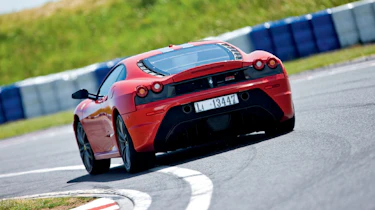
‘The fastest laps are with Race mode selected, though there’s just a couple of tenths in it – 1:22.5 with versus 1:22.7 without. It feels like it would go a bit faster with less understeer, and reducing the front tyre pressures to match the rears (we normally stick with the manufacturer’s recommendations) does the trick.
‘It feels like the rear is taking more of the cornering load, which makes things a bit serious in CT-off in the faster turns (and no quicker overall), but in Race mode the Scuderia seems to balance right on the edge. It’s there in the lap time, too – 1:21.7, which takes its advantage over the Porsches out from around 1sec to over 1.5sec.
‘Allowing for the changes to the circuit, that also puts it on a par with the Enzo we tested on the old layout, and there’s no question that the Enzo, with simple traction control and a purely mechanical limited-slip diff, was looser and much scarier.’
Values and buying guide
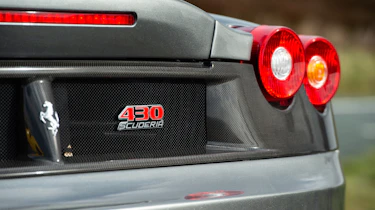
For a few years the 430 Scuderia was the unloved track-honed special among a clutch of high-value darlings. The 360 Challenge Stradale has had a certain value to it for years, that’s skyrocketed over the last 12 months at the time of writing (June 2026). The 458 Speciale that succeeded it meanwhile has critical kudos (our first and until the Revuelto last year, only eCoty contender voted winner unanimously by our judges) and the affections of owners and the market. Finally, though, the 430 is catching up, the Scuderia over the last year jumping from the £150,000 range to over £300,000.
Full Ferrari or specialist service history is a must. You’ll also want a detailed picture of how much life is left in the F1 box’s clutch, and any reputable vendor should be able to produce a printout detailing as much. Also check the tyres. As much as wear, you’ll want to pay attention to age, as these are cars that often spend more time laid up in secluded collections, than they do on track. Check for wear on the thin and enormous 398mm carbon-ceramic brake discs, as well as the health of the calipers themselves. Seized pistons aren’t unheard of when not in regular use.
Specs
| Engine | V8, 4308cc |
|---|---|
| Power | 503bhp @ 8500rpm |
| Torque | 347lb ft @ 5250rpm |
| Weight | 1350kg (378bhp/ton) |
| 0-62mph | 3.6sec |
| Top speed | 198mph |
| Price new | £172,605 |
| Value now | £200,000+ |