Polestar 4 review – a reason to ignore Tesla’s Model Y
The Polestar 4 is a style and performance statement with more appeal than most in its segment, but it lacks the dynamic polish of some rivals and has shocking range
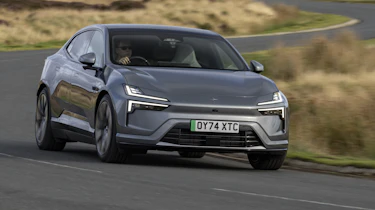
Polestar insists that it remains a niche luxury marque without a focus on high sales volumes, but over the last few years it has introduced no fewer than two crossover-SUVs in the 3 and 4. In so doing, the Swedish marque went from a single-model manufacturer to one with three, and later this year, the 5 will join the lineup as an alternative to the Porsche Taycan. For now, we’re focussing on the car it hopes will become its Tesla Model Y: the Polestar 4.
This is a bold new crossover designed to draw customers away from the likes of the Porsche Macan Electric, Audi Q6 e-tron and aforementioned Tesla Model Y, so it has to be a strong performer to stand a chance. On paper that appears so, with it being the quickest and most powerful model Polestar has ever sold in dual-motor form, and featuring plenty of eye-catching design and interior tech to go with it. In reality the 4 is a decent all-round package, if not exactly a flawless one.
> Tesla Model Y Performance review – a Porsche Macan on a budget?
Like the Polestar 3 it suffers from infuriating software glitches, from the unfathomable buttonless keys not working to open the doors to HMI software that on occasions in the past when testing the cars, simply hasn’t worked. At this price point that's unacceptable. As is the range, which we never got close to the near 370 mile claim, our test car showed nothing more than 270 miles when the battery was charged to 100 percent. Which is a shame, because when you can get into it the Polestar 4 is refined, with high quality materials throughout and more space than its exterior footprint suggests. It’s very reminiscent of BMW’s 5 GT. Take that as you will.
More reviews
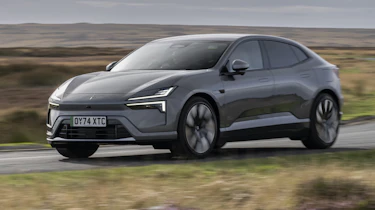
The styling of the Polestar 4 is definitely a USP. It’s a modernist slice of sino-Scandinavian acrylic and could be a storm trooper’s daily driver in white. Where the Polestar 3 is stylish but a little more anonymous, the Polestar 4 has people cricking their necks to get a look. It’s properly sci-fi and easily the most interesting to look at next to a Model Y, Macan and Q6. All four doors being pillarless only adds to the sense of occasion too, though what they gain in style they lose in a slightly rattly door shut sound. It’s just a shame Polestar is allergic to coloured paint and only allows you to select from a drab, uninspiring colour palette.
Powertrain technical highlights
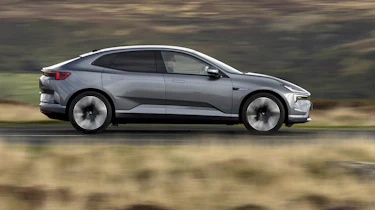
- Up to 536bhp and 506lb-ft with the performance pack
- 400-volt electrical architecture limits charging performance
- 0-62mph in 3.7sec
The Polestar 4’s opening gambit is that it is unequivocally the fastest, most potent Polestar yet (before the 5 arrives). This will be as confusing to buyers as it was to us, since the Polestar 3 is actually the more expensive, more premium model. The 4 rides on Geely’s Sustainable Experience Architecture, which also underpins the Volvo EX30. In fact, the Polestar 4 has more in common with the Lotus Eletre, architecturally, than it does the Polestar 3, which rides on the SPA2 architecture that also underpins the Volvo EX90. Keeping up? The choice to plunder the Geely parts bin was one of convenience for Polestar and is part of what has allowed it to bring multiple new products to market in such a short space of time.
There’s certainly power if you want it. The long range, dual motor model with the Performance Pack delivers a quite dizzying 536bhp and 506lb ft, allowing 0-62mph in. 3.7sec. Those motors are fed by a 94kWh (usable) battery. With all that punch on offer, you’d hope the rest of the package is up to the job of harnessing it. The Polestar 4 is suspended by a four-link set-up at the front and integral link at the rear with ZF’s active dampers and coil springs with the former offering Normal, Nimble or Firm settings. Performance mode means both motors are working all of the time, making the full 536bhp immediately available.
Range and efficiency
This was a point of soreness with our Polestar 4 experience. When not being plumbed for a 3.7sec 0-62mph time, the battery should be able to deliver a claimed 367 miles of WLTP-certified range. If our experience is anything to go by, that's clearly a figure plucked from the range clouds, as we saw no more than 270 miles when the battery was charged to 100 percent – that Polestar Charge subscription to save on public charging might just be worth it. In any case, sacrificing the meaningless performance it offers for range would be a far better option.
The Polestar 4's 400-volt architecture is not the most technologically advanced by comparison to the 800-volt, PPE-based Porsche Macan EV and Audi Q6 e-tron, with only DC charging available up to 200kW, which you’ll need due to the poor range. It's a shame that as yet, the 800-volt upgrade the Polestar 3 is set to get for the 2026 model year has yet to be announced for the Polestar 4.
Performance, ride and handling
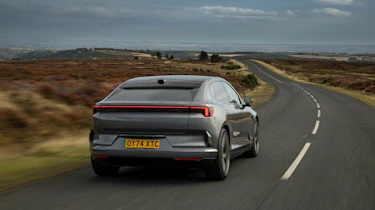
- The performance feels excessive in this platform…
- … especially in lieu of real world range
- Quick and capable but lacking polish compared to rivals
The 4 takes that a little too literally, with the throttle mapping spikey and power delivery hard to modulate at lower speeds. Range mode disconnects the front motor in normal driving but is able to reconnect near-instantly when you call up more power.
Deploying the full 536bhp can be as unnerving as it is thrilling, with the wheels often tramping and juddering in the arches as the tyres try to find purchase. The 4 struggles in this department too, with the traction control flashing away and cutting power much more frequently than with most fast EVs we’ve tried. It’s also the most unnatural car to drive quickly, redolent of early performance SUVs of the 2000s when too much power was fed through a chassis designed to manage high-torque diesel engines not high performance petrol ones.
On the road at pace, Nimble is the happy medium, with Normal not affording the kind of control you’d want for a car as fast as this and Firm doing exactly as advertised, stiffening the road ride almost to the point of intolerability. At low speeds you’ll find yourself apologising to passengers more frequently than you’d like.
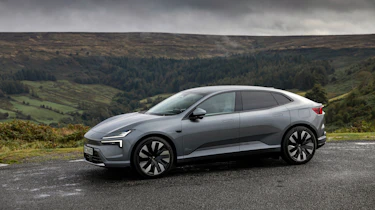
That’s not to say the Nimble setting is ideal, with the big 22-inch forged wheels juddering in the arches over sudden imperfections and the 2,355kg kerb weight making itself known through any direction and elevation changes. Off the back of driving the calmer air-sprung Polestar 3, one can’t help but wonder if air suspension would have elevated the Polestar 4 experience too. Its omission is a function of price management for the Polestar 4, we’re told. The same is likely the case for the Polestar 3’s BorgWarner limited-slip differential that, in spite of it being more powerful, cannot be had on the Polestar 4.
Steering weight is adjustable through light, standard and firm, though the differences between the modes are negligible. Firm is the heaviest setting and perhaps feels the most appropriate for a car that weighs as much as the 4, but even this setting doesn’t provide much heft. Steering feel isn’t just absent, there’s virtually no sense of load throughout the range of motion at all, which can be slightly disconcerting given the pace you can build in an instant.
Opt for the Performance pack and you get potent Brembo four-piston brakes at the front clamping 364mm discs that have little trouble scrubbing the momentum the Polestar 4 is capable of building. The metering of braking power through the pedal’s travel is good and the pedal feel evolves depending on what suspension mode you’re in, with Firm yielding a strangely gravelly texture underfoot. Regeneration is configurable too, with the option also of turning it all the way off. Indeed some at Polestar subscribe to the school of thought that ‘sailing’ instead of using regeneration, is actually more efficient.
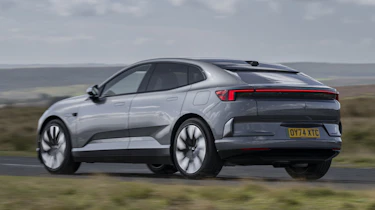
Overall, the Polestar 4’s dynamics just aren’t as sophisticated as some rivals. This is an enormously capable car on the right roads, but as soon as things get tight, a bit too rough under the wheels, the Polestar 4 can trip over itself. That comes as less of a surprise than the fact this car – designed for a broader audience – can be had with as much power and performance in the first place.
> Polestar 3 review – a cheaper alternative to the BMW iX?
For what it is, it does enough with what it has and if anything, what they’ve managed to make this car achieve with a borrowed and adapted platform, excites us for what the bespoke platform, British-developed Polestar 5 and Polestar 6 could be like. Ultimately, Polestar has backed the 4 into a corner by focussing too much on performance and less on what it is actually good at: covering ground effortlessly and with a refinement and quality not seen in its rivals, or even the more expensive Polestar 3. If you buy a Polestar 4 thinking it’s a performance car you’re going to be hugely disappointed.
Interior and tech
- Material quality, fit and finish is good
- UI is unimaginative but intuitive
- Software glitches still pervasive
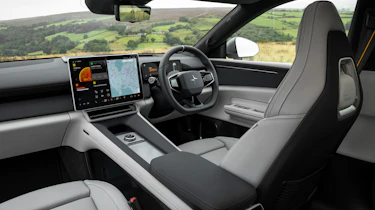
Inside the Polestar 4 is a calm and very Scandinavian place in which to find yourself. Although the small instrument cluster and the huge central screen means you could be sat in any electric car. The materials are to a high standard, the seats some of the most comfortable you’ll sit in (always a Volvo strong point and thankfully carried over here to its sister brand).
The enormous panoramic roof – enabled by there being no back window – adds a concept car-like airiness, as does a clear view out and plenty of space. Our car had sustainable tailored knit trim which was both satisfying to look at and to the touch, though some upper layer panels on the doors did creak when driving.
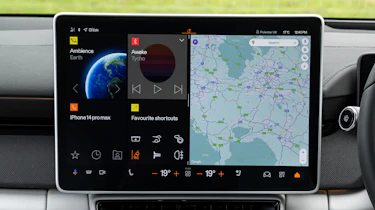
A very Tesla-esque crisp and clear 15.4-inch panoramic screen dominates the dashboard and features a Google-powered Android Automotive OS that’s intuitive and responsive – to the point you don’t feel the immediate urge, as in some cars, to mirror your smartphone. As ever, a few more physical buttons pertinent to the most regularly-used functions would have been nice but the Polestar 4’s UI is certainly not unnavigable despite being unimaginative.
Steering wheel controls have been swapped from the frustrating haptic kind to buttons with more feel, but there is still a distinct lack of physical controls in this cabin, something the 3 gets right. Ergonomics might be off for some drivers, too. The seating position can, for some frames, never feel quite right with you sitting too high and almost floating in the car. Spend longer in the 4 and you’ll find more niggles like this, with the quality of the build (not the materials, they are some of the best you’ll find in any in this class) and thought behind the controls just not quite up to par with some rivals. Tesla’s Model Y is a more polished product in this department.
If you’re concerned about the lack of a rear window, the rear view ‘mirror’ that displays a rear-view camera feed works surprisingly well, both in the day and at night. A problem if it goes wrong? Yes. A bit weird in terms of acclimatising your depth perception? At first, yes. But it’s surprisingly intuitive. It pays off when you’re sitting in the back too – the Polestar 4 feeling like a concept car for rear seat passengers. It’s spacious, airy for it not having a rear window and just a nice place to be. The only slight issue comes when you need to reverse on a cold morning and come to find the camera is covered in condensation and you need to wait for it to clear. Or relying on the proximity sensors.
The 4’s software is still not bulletproof. While we’d rather not have to interact with a display each time we enter a car, this has become the default in this segment, and so you need to do it well. Tesla and more recently, Audi, have figured it out, with snappy, reliable systems, but the Polestar 4 lags behind – it’s not frequent, but menus occasionally crash, inputs fail to register on the first attempt and features like the trick active noise cancellation actually end up creating more noise in the cabin than less. In our test car on certain surfaces, it actually sounded as if it was pumping road noise into the cabin on one side.
The Polestar 4 doesn’t deliver a groundbreaking drive to match its groundbreaking looks, even if it is fast – it probably splits the difference between the Macan and Q6. That’s far from a bad showing and in the real world with the kinds of people these cars are aimed at, the amazing looks, ergonomic design, potent performance and commendable electric range deserve to impress.
Price, specs and rivals
The Polestar 4 has actually dropped in price since it was launched in 2023, with the entry-level 268bhp single-motor model now starting from £55,750, £4240 less than before – the dual-motor all-wheel drive car we tested is much more expensive at £67,000. The new entry-level Tesla Model Y might be basic, but it is available at a much lower £41,990 price point, with even the range-topping Performance costing £5760 less than the Polestar 4 dual-motor at £61,990. Porsche’s electric Macan starts from £68,600, but does offer a more polished package with proper Porsche feel.
Unlike many of its rivals, the Polestar 4 is available with a good number of options, including premium Bridge of Weir leather upholstery for £3100 and the 'Prime Pack' with privacy glass and a stack of additional premium features for £1000. If you’re looking to bring more focus to the range-topper with the Performance Pack, you’ll pay £4000 for the privilege.
All up our car had a sturdy £75,040 price as tested, which is about on the money for where the less powerful Porsche Macan 4S Electric starts. The Audi SQ6 e-tron is both down on power compared to this Polestar and costs considerably more, and while the sub-£60k Kia EV6 GT offers competitive performance for the money, it suffers poor range like the Polestar 4, too.
Polestar 4 (dual motor) specs
| Powertrain | Dual-motor, all-wheel drive |
|---|---|
| Power | 536bhp |
| Torque | 506lb ft |
| Weight | 2355kg |
| Power-to-weight | 228bhp/ton |
| 0-60mph | 3.7sec |
| Range | 367 miles |
| Basic price | £61,990 |
Frequently Asked Questions
The Polestar 4 is a good car, albeit with some flaws. The suspension is not as polished as the Polestar 3’s, or rivals like Porsche’s Macan. The interior tech can sometimes be glitchy and the range isn’t best-in-class. But it is fast, good looking and has a high-quality feel inside.