Best hybrid cars – the electrified performance cars still fuelled by petrol engines
Hybrids are currently the perfect compromise, keeping petrol powered internal combustion engines but with added electric motors to keep emissions - and running costs - down
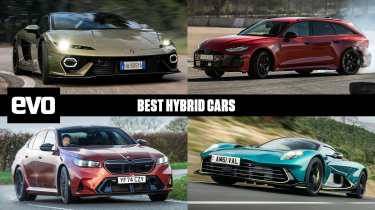
The new car landscape is an incredibly volatile place to be and the power of the consumer has been made abundantly clear. As EV uptake stalls, conversely, the popularity of hybrids has exploded. Manufacturers that were once stubborn in their commitment to all-electric, have been forced to backtrack or diversify their offerings, bolstering their lineups with tax-friendly PHEV stepping stones.
Conversely, manufacturers that had yet to bet it all on batteries are jumping to hybridisation, to heavily reduce their emissions without alienating customers with a preference for petrol power. Hybrids are everywhere with almost no exceptions, from supercars and SUVs to supersaloons. From the Porsche 911 to the BMW M5 and Bentley Continental GT, performance car staples from across the spectrum are, to varying degrees, picking up some form of electrification for 2026. And buyers can feel the benefits right away in their pockets, with favourable Benefit In Kind rates if they're looking for a company car, or a vastly reduced VED first registration fee – both being contingent on official CO2 output figures, that are greatly reduced with significant electrification. Unlikely to be on any company car list are a couple of new additions: Lamborghini's Temerario, Ferrari's F80 and 849 Testarossa and Aston Martin's Valhalla...
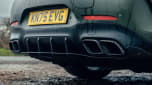
Of course, the so-called holy trinity of hybrid hypercars – the McLaren P1, Ferrari LaFerrari and Porsche 918 Spyder – effectively introduced hybridisation to the world of performance cars over a decade ago. Even in those ultra-exclusive and ultra-focused hypercars, the potential benefits of part-electrification were obvious. Never mind torque fill, the ability to drive on electric power and leave your house in the morning without an anti-social cold start was always going to be a game changer. Not that the buyers of those cars were your average nine-to-five commuters or had neighbours close enough to offend, but the potential utility was clear to see. And so over a decade on, there’s a full-bodied lineup of hybrid premium, performance super and hyperscars on the market and here are some of the very best.
Best hybrid cars 2026
- Audi RS5
- Mercedes-AMG E53
- Ferrari 849 Testarossa
- BMW M5
- Bentley Continental GT Speed
- Ferrari F80
- Lamborghini Temerario
- Aston Martin Valhalla
- McLaren Artura
- Porsche 911 GTS T-Hybrid
- Porsche Panamera Turbo E-Hybrid
- Chevrolet Corvette E-Ray
- Lamborghini Urus SE
- Mercedes-AMG GT 63 S E Performance
- Lamborghini Revuelto
Audi RS5
- Prices from: £92,120
- Pros – More balanced than ever
- Cons – You have seen how much it weighs, haven’t you?
- 4 stars
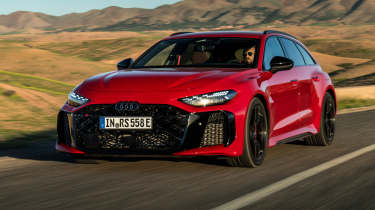
It’s easy to become fixated on the Audi RS5’s 2370kg kerbweight. It is after all a figure you’d associate with a Q7 rather than a much smaller estate car. But that’s the price we’re going to have to pay to keep cars such as the RS5 in our world. To meet ever tightening emissions targets manufacturers need plug in hybrid systems, which means heavy batteries and an electric motor.
For the RS5 it also means the 2.9-litre twin-turbo V6 has had a 50bhp increase over the RS4 it replaces, which when combined with the electric motor delivers 630bhp and 603lb ft. As a result it will reach 62mph in 3.6-seconds and top 177mph.
Beyond the headline power figures and that weight is a rather sophisticated chassis, that includes Audi’s electromechanical torque-vectoring rear-diff, which along with allowing you to rip the rear tyres to shreds in a matter of minutes, but also provides the RS5 with deft precision and a natural feel. As deft and natural as BMW’s M3 Touring? The two are very different beasts that do very different jobs even if the perception suggests a bitter rivalry.
Alternatives to the Audi RS5
Direct plug-in competitors to the new RS5 are few are far between for the moment. The Mercedes-AMG E53 below is bigger for about the same money but lacks the RS5's outright performance focus. A BMW M5 meanwhile is a chunk more expensive. If hybridity is not essential, the BMW M3 Touring is probably the better driver's car.
Mercedes-AMG E53
- Prices from: £93,695
- Pros – Looks like an AMG, drives like an AMG, goes like an AMG…
- Cons – Doesn’t sound like an AMG
- 4 stars
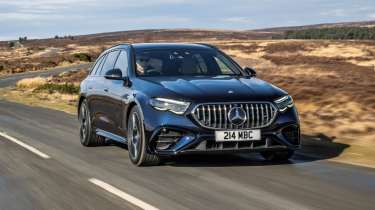
After AMG neutered the C63 by cutting its cylinder count in half and adding a heavy hybrid pack, there were serious concerns that the E53 would deliver the same level of disappointment when following in the tyre tracks of the mighty E63 S. Thankfully, it only lost two-cylinders and the remaining half dozen have been reconfigured in a straight line and the hybrid system doesn’t play such an integral part in the car’s performance make up.
So while it lacks the voice of its eight-cylinder father, it still has a shock-and-awe approach to performance. 433bhp is produced by the 3-litre engine with 134bhp coming from the in-gearbox electric motor to produce a combined 577bhp, or 612bhp briefly when launch control is engaged. You can expect to reach 62mph from a standstill in anywhere between 3.8 and 4.1-seconds depending on whether you’re in a saloon or estate and have engaged launch control.
Standard rear-wheel steering provides the chunky E53 (2315kg for the saloon, 2380kg for the estate) with sharper agility, the active suspension, the body control and fluidity that allows you to enjoy this AMG in the manner they are created. It may have traded some of its predecessor’s character for efficiency but it’s no less engaging. It will make some you question what BMW’s more powerful M5 offers the driver.
Alternatives to the Mercedes-AMG E53
Mercedes-AMG's E53 is without a direct rival at the moment, not being positioned as a competitor to BMW's M5 or M550e. Nonetheless depending on your budget and use case, either would make a fine alternative. At the same price, with more focus and less space, Audi's RS5 Avant is a potent fast hybrid estate.
Ferrari 849 Testarossa
- Prices from – £407,617
- Pros – Blisteringly quick and properly engaging
- Cons – V8 can’t match the emotional pull of a V12
- 4.5 stars
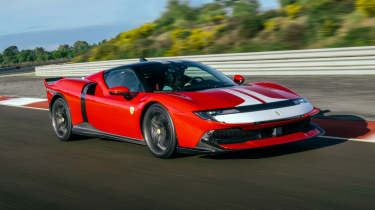
Ferrari’s hybrid-engined Testarossa features an evolution of the SF90’s twin-turbocharged V8 powertrain and with 1036bhp and a £407,617 price you’d be forgiven for thinking this was the top of the Ferrari hypercar tree. But that role is left to the £3.6million, 3-litre V6 1183bhp F80. And despite their four-figure power outputs both would benefit from having the 12Cilindri’s naturally aspirated V12. Progress, eh?
Anyway, hybrid it is and for the 849 that means a slick transition from electric drive to petrol power and with each turn of its manettino a bigger slug of performance crashes over you. It feels big from behind the wheel but the light steering delivers the feel required to position with 296 precision.
A heavily revised SF90 FF chassis set-up provides the 849 with the control, balance and a distinct character that was missing in the SF90 it replaces and injects the Testarossa with a personality that you grow to understand and appreciate. There are times that more often than not you ask yourself if you need anything else from a 1000+bhp Ferrari…
Alternatives to the 849 Testarossa
Rivals to the 849 Testarossa are easy, for it is one third of what is surely a new holy trinity. The other two-thirds are Aston Martin's Valhalla and Lamborghini's Revuelto. All pair combustion power with motorised front wheels that have no mechanical connection to the rears. All are close to 1000bhp. All sit somewhere along the grey area spectrum between supercar and full-on hypercar. Then again, you could also look slightly downward from the Testarossa, to the 296 Speciale and McLaren 750S.
BMW M5
- Prices from £114,095
- Pros – Still does everything you’d expect of an M5
- Cons – Plus some stuff you don’t
- 4 stars
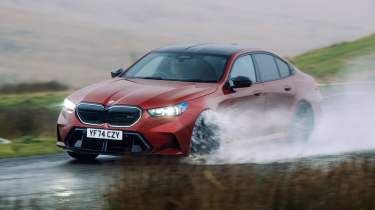
The big hybrid of the moment, so to speak, is the BMW M5. It weighs a substantial 500kg more than its pure-V8 predecessor, and you have to wonder whether that’s a worthy trade-off for an extra 100bhp or so and around 50 miles of electric driving. However, in our first drives of both the saloon and the new M5 Touring, and a subsequent twin-test with the Porsche Panamera Turbo E-Hybrid, we found that BMW has engineered the G90 to drive with remarkable precision and agility for its size. It really doesn’t feel as heavy as it is.
> BMW M5 (G90) v Porsche Panamera Turbo E‑Hybrid – 700bhp hybrid super saloons go head-to-head
It's big and bulky, the interior is a bit garish and the seating position is quite high but to drive the M5 is a revelation. The steering’s quick and precise, and the front-end grip is phenomenal. It’s nimble too, feeling like a smaller and lighter car, and that, in part, is thanks to the rear-wheel steering which endows it with a real feeling of agility. It’s quick too, but perhaps not quite as fast as 717bhp would suggest as its power-to-weight ratio is actually slightly down on the previous generation M5. Ultimately though it’s still a brilliant performance car, despite its weight, and it just pipped the Panamera to a twin-test win.
‘The good thing is that in its base settings, with everything in ‘Comfort’, the car’s dynamic composure feels unshakeable. There are many modes, of course, many tuneable features so you can adjust the car to your taste, ramp things up, though on the road there isn’t much need for tighter damping.’ – John Barker, editor-at-large, who drove the M5 on the launch in Germany
Alternatives to the BMW M5
The M5 took a narrow victory over the Porsche Panamera Turbo E-Hybrid when we put the pair together, but the Porsche’s more natural feel, tidier cabin and more unassuming styling may give it the edge for some buyers. Otherwise, the M5’s closest competition arguably comes from within: the more traditional non-hybrid BMW M8 Gran Coupe costs only a little more, the M3 starts around £20k less, and nearly-new previous-generation F90 generation M5s are still great cars in their own right (and half a tonne lighter).
Bentley Continental GT Speed
- Prices from £236,600
- Pros – New hybrid powertrain suits the GT’s character nicely…
- Cons – … but makes an already heavy car heavier still
- 4.5 stars
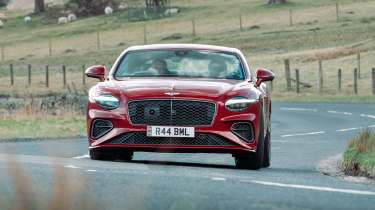
You have to wonder why the BMW M5 gets such a hard time for weighing what it does, when the new hybridised Bentley Continental GT Speed is just as heavy. Perhaps it’s because Bentleys have always been more concerned about luxury than pure athleticism, making the leap to a heavier PHEV less controversial. But again, while the Bentley’s c2.5 ton kerb weight might jump off the screen at you, it would be totally unfair to dismiss it on that basis.
Because like the M5, the GT Speed is a mighty impressive achievement, in the way it manages its weight and in terms of its pace – not surprising when it has 771bhp and 738lb ft of torque. In fact, thanks to its new electronically-controlled two-chamber air suspension, torque vectoring capability and limited-slip differential, the heaviest Continental GT yet is also one of the most dynamic. It’s still a proper Bentley too, with the presence, refinement, quality and appointment you’d expect, only now with the ability to drive electrically, in actual silence, for up to 50 miles.
‘When there’s the space and vision to do so, it goes well: peak torque – all 738lb ft of it – comes in at relatively low revs, circa 200rpm, due to the engine and e-motor working together, and even up at high revs, there’s more torque than the W12 engine in the previous Conti GT Speed.’ – James Taylor, deputy editor, drove the Continental GT Speed on the launch event.
Alternatives to the Bentley Continental GT Speed
The Continental GT is out on its own as far as direct rivals go. The Aston Martin Vanquish and Ferrari 12 Cilindri are more powerful but also more expensive (both in the £300k and up range) and less luxurious (odd as that may sound for that pair), and the Mercedes S-Class Coupe is no more, and lacks the Conti’s prestige anyway. The all-electric Rolls-Royce Spectre is an option, but again starts in the mid-£300k range, doesn’t have the Speed’s performance, and is ultimately limited by range and charging as a GT, in a way the Bentley isn’t.
> Bentley Continental GT Speed review
Ferrari F80
- Prices from: £3.6million
- Pros – Astonishing capability, well rounded and intuitive
- Cons – Agitated low-speed ride
- 5 stars
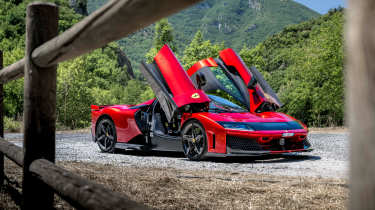
Ignore the marginal horsepower gain over the 849 Testarossa, the F80 is Ferrari’s apex hypercar. It’s insanely quick when you allow yourself to let everything its V6-hybrid powertrain has to offer, so much so the full-throttle moments become all too fleeting as self-preservation instincts kick in. But even at 75 percent and less the F80 enthrals like few others.
The engine and gearbox combine to deliver a seamless delivery of all encompassing power and torque. The braking response is like no other, the steering and chassis manage every movement, angle of pitch and roll with such precision and finesse you worry you’ll be spoilt for every car you drive thereafter.
There’s a purity to the F80 that some might find at odds with the brain-scrambling technology that brings the car together to create those unforgettable moments. And while it is at the forefront of today’s modern hypercar there’s a beautiful old school manner to the execution.
Alternatives to the Ferrari F80
The obvious comparison to the F80 is McLaren's not-quite-cooked W1 hypercar, the successor to the P1. At this end of the market, though, there's plenty of choice besides, from past and present. Miss the Ferrari V12? A used LaFerrari. Miss manual? See if GMA have any T.33 allocations. Averse to internal combustion at all for some reason? Of course you're not, but the Rimac Nevera exists just in case.
Lamborghini Temerario
- Prices from: £259,567
- Pros – Agility, blistering performance and redline
- Cons – Lacks some of the grit and soul of the Huracán
- 4 stars
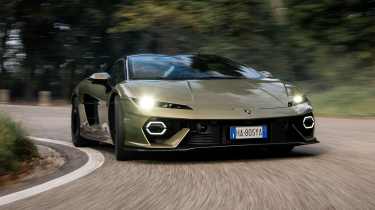
After the all-conquering Revuelto came the Temerario, which you could argue has the tougher job, yes, it needs to follow in its big brother's tyre tracks and all that it has achieved to date in terms of Car of the Year victories and beating every rival you could drive at it. But also the latest ‘baby’ Lambo also has to follow the final-fling Huracán models, the simply sensational STO and Tecnica.
Having its naturally aspirated V10 switched for a twin-turbocharged hybrid V8 hasn’t dampened its performance with its 907bhp and sub 2.5-second 0-62mph, but in chasing power it’s lost some of its soul. Something the V12 hybrid Revuelto certainly doesn’t suffer from.
And for a Lamborghini it feels almost too sensible; more Audi R8 than raging bull. It steers, rides and handles with a superior clarity to many of its rivals, its competence levels far higher than what went before and what’s available from most of its competitors. But in being so complete, so competent it’s lost some of its Lamborghini-ness. It’s still furiously quick, and able to thrill but a little bit of the Huracán’s spirit has been polished away.
Alternatives to the Lamborghini Temerario
Spectacular supercars aren’t difficult to come by, with the McLaren Artura below, and the Ferrari 296 Speciale. While not as blue-blooded, the C8 Chevrolet Corvette in all its forms is a proper supercar these days, and we’re fans of the Maserati MCPura too, as a previous evo Car of the Year winner.
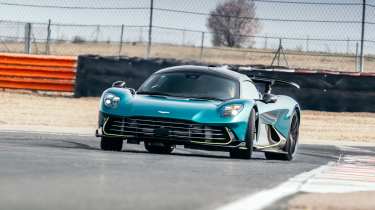
Aston Martin Valhalla
- Prices from
- Pros – Agile and exiting handling on road and track; fascinating engineering; looks a million dollars’ unique character
- Cons – Flat engine note; sparse interior; no luggage space
- 5 stars
It took a while, seven long years in fact, but when Aston Martin’s Valhalla finally arrived in 2026 the long wait was worth every passing day, week, month and year since its initial 2019 reveal. The current crop of front-engined Aston Martins - Vantage, DB12 and Vanquish - are the best the company has ever produced, but the mid-engined plug-in hybrid (Aston’s first) is on another level. It’s to a standard Aston Martin has always promised but rarely been able to deliver.
Its mini-Valkyrie looks are more resolved, its technology no-less spectacular from its inboard suspension to its active aero, the sensations it delivers once you have got your hands on its near square steering wheels on a par with the Adrian Newey-created hypercar. But the Valhalla is more usable, more exploitative and more fun on road and track more of the time. That you can hear yourself think when driving it helps too.
Others might be sharper, some faster (hard to believe, but they are), others with more character but the Valhalla blends all of these elements and more to be one of the most rounded and thrilling hypercars of the decade.
Alternatives to the Aston Martin Valhalla
Time behind the wheel of the Valhalla has revealed to us just how much further down the hypercar spectrum it is than its most obvious alternatives, the Ferrari 849 Testarossa and Lamborghini Revuelto. The price premium it commands is admittedly tall – you could almost buy one of each for the price of a Valhalla – but it is justified. Its billing also means a Ferrari F80 or McLaren W1 could be considered valid rivals.
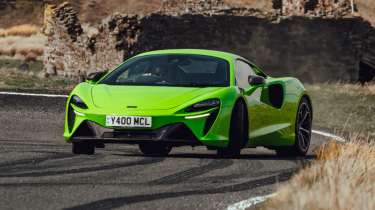
McLaren Artura
- Prices from £201,400
- Pros – As feelsome and rewarding as junior supercars come
- Cons – Not exactly a junior pricetag
- 5 stars
The Artura is McLaren’s first series-production hybrid. It echoes the Ferrari’s basic hybrid system, pairing a new wide-angle V6 engine to an electric motor that powers the rear wheels via a dual-clutch transmission. Over the years the Artura has been updated to refine the package and boost its initial 671bhp power figure to 690bhp. It’s still below that of the 296 GTB, which produces as much as 819bhp in its most potent driver mode, but that variation is drawn almost entirely from the engine, rather than the electric motor.
Apart from being hybrids, there are key differences between the two, starting with the McLaren’s brakes. The Ferrari, like most hybrids, uses regenerative braking to help refill the battery pack and recycle some of the otherwise wasted energy. McLaren on the other hand has kept the braking purely by means of pad and disc, making the brake pedal feel even more impressive than the Ferrari’s. In fact, this emphasis on ‘feel’ rather than outright performance is seen in various parts of the Artura, as not only are the brakes non-regenerative, they’re also still fully hydraulically operated rather than by-wire as almost all new cars are. The same can be said of its hydraulic steering, with the whole package being one of the most organic-feeling hybrid cars we’ve yet driven. It’s also the most impressive hybrid of its type for electric range, offering 19 miles of silent running capability. It’s such an involving machine that it almost took top honours in its Spider form in eCoty 2024, eventually coming home in joint second place.
‘The V6 is vocal enough but it’s extremely smooth and has a precise, highly tuned feel to the way it revs. With the assistance of the electric motor, there’s superb throttle response. In fact, the torque-fill is extremely effective and works much better than it did in the P1, for example.’ – Jethro Bovingdon, contributor, who drove the Artura on the launch event in Spain.
Alternatives to the McLaren Artura
The Artura competes almost directly with the Ferrari 296 GTB above so that’d be our first port of call – it doesn’t quite have the McLaren’s feedback, but its V6 is more emotive. The Lamborghini Temerario has recently arrived while the Maserati MC20 was already here, recently replaced by the MCPura. It's a very different character to the McLaren but not short on pace or involvement.
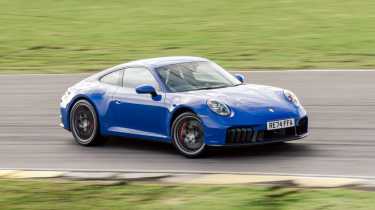
Porsche 911 GTS T-Hybrid
- Prices from £137,900
- Pros – A complete, charismatic and hugely capable 911
- Cons – Hybrid tech means no manual gearbox option
- 5 stars
The Porsche 911 GTS T-Hybrid probably has the least claim to a place on this list, given it has no electric-only driving capability. The electrified element is instead fully integrated into the powertrain as a performance enhancer that happens to help reduce emissions. Incorporating a small electric motor into its eight-speed PDK transmission, the 992.2 GTS has a relatively measly 1.9kWh battery – just over one fiftieth the size of the largest Taycan battery. The battery also feeds an electric motor that’s connected to the 3.6-litre engine’s single turbo, allowing it to be pre-spooled for quicker response. Both motors work together to effectively eliminate turbo lag and together with the internal combustion engine, generate 534bhp and 450lb ft of torque.
It’s not the outright power that’s impressive, though, it’s how deeply well-resolved this car feels. In spite of it being the most experimental 992 yet, it also feels the most complete. An unconventional hybrid it may be, but it’s symbolic of how electric power can be integrated with the combustion engines we know and love, enhancing performance with few – if any – downsides.
> Porsche 911 GTS T-Hybrid review
‘Select manual for the shifts and the new GTS comes to you even more, the immediacy upped further still, the engagement levels further heightened. That rapid boost-pressure build provides such an improvement in throttle adjustability that the 992.2 starts to feel more than a facelifted model.’ – Stuart Gallagher, editor-in-chief, who drove the 911 GTS T-Hybrid on the launch event.
Alternatives to the Porsche 911 GTS T-Hybrid
Take your pick from anything similarly-priced in the 911 range and it’d be a viable alternative to the T-Hybrid; a regular Carrera S is a fantastic car and around £17,000 less, or you might be compelled to stretch to the £158k asked for a GT3 Touring. Outside of the T-Hybrid’s siblings, you’re looking at the current Mercedes-AMG GT, from £143k in V8 ‘55’ form and £164k for a GT 63 (though the hybrid version of that is upwards of £186k).
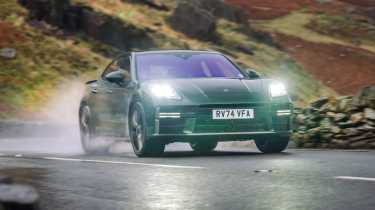
Porsche Panamera Turbo E-Hybrid
- Prices from £151,500
- Pros – Brutal performance, clever Active Ride technology
- Cons – Not as fun as the BMW M5
- 4 stars
Porsche’s hybrid Panamera has evolved into a force of nature in its latest Turbo S E-Hybrid form. With M5-beating levels of power and ultra-sophisticated active suspension tech, it’s one of the most advanced supersaloons on sale today. But it's probably not worth the extra £24,600 over the 671bhp Turbo E-Hybrid.
For the latest Turbo E-Hybrid (and Turbo S), Porsche has tweaked elements such as the blending of the powertrain’s petrol and electric motors, and better integrated the PDK transmission. It’s also made big improvements to brake pedal feel and the switch between regenerative and friction braking. This comfortable, cossetting, luxurious and well-equipped supersaloon will hit 62mph in 3.2sec before reaching 196mph (which it does so with remarkable ease on the autobahn). When not flat out, it’ll go an impressive 52 miles on a charge thanks to its 25.9kWh battery.
The new car can also be had with Porsche’s Active Ride suspension system, which employs active dampers controlled by electro-hydraulic pumps to keep the body as level as possible. It can effectively stamp out body roll. It’s mightily impressive, but is it better than the new BMW M5?
‘The Panamera is so smooth and relaxing generally that it’s not until I accelerate smartly out of a junction and my head hits the headrest that it makes its full 671bhp/686lb ft muscle known. It’s the full proverbial scalded cat, and the V8, previously whisper-quiet, emits a disgruntled growl like a scalded tiger.’ – James Taylor, deputy editor, tested the Panamera against the BMW M5 in Wales.
Alternatives to the Porsche Panamera
The Panamera E-Hybrid has already had to play second-fiddle to the BMW M5 in a recent twin-test, but it was a close-run thing – if you chose either solely on styling or badge appeal, you’d be justified in your decision. Another option if you’re already happy with the idea of an electrified Porsche is the Taycan. Recent updates have significantly improved its range and efficiency, it was already great to drive, and unlike the Panamera, it’s still available in Sport Turismo estate form too. E-Hybrid money gets a 394-mile, 872bhp, 2.7-to-62mph Taycan Turbo.
Chevrolet Corvette E-Ray
- Prices from £159,230
- Pros – Hugely potent powertrain, excellent balance, luxurious cabin
- Cons – Heavy, confusing drive modes, steering feel lacking
- 4.5 stars
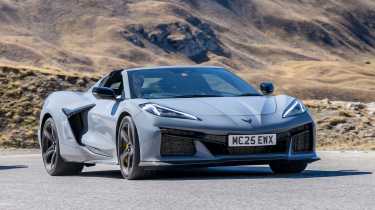
Beating Porsche to the punch, Chevrolet has also integrated electrified powertrain tech into its Corvette sports car. The E-Ray is the result, with a 1.9kWh battery feeding a motor on the front axle and allowing for a low single-figure electric driving range. Pointless? Not entirely, if you’re bimbling in traffic or wanting to make a whisper-quiet getaway in the morning. But at the same time, that electric motor also adds to the LT2 small block’s 495bhp, for a 655bhp total output, allowing it to reach 62mph in under three seconds.
It also isn’t too heavy, weighing just over 100kg more than the Z06. In theory, it’s the ultimate all-rounder Corvette. In practice, well, we’d need to spend a little more time with it but the concept and initial impressions are very promising indeed.
> Chevrolet Corvette E-Ray review
‘Whereas the Z06 can feel genuinely gutless when you request a little more speed while cruising in one of its higher gears, the E‑Ray responds with real intent. On most roads and for most people, I expect Corvette’s hybrid would beat its hardcore would-be racer.’ – Jethro Bovingdon, contributor, who drove the Corvette E-Ray on the launch event in the US.
Alternatives to the Chevrolet Corvette E-Ray
The E-Ray is shortly to be available in the UK, in RHD which is exciting news indeed. Less exciting is it's almost double the Cayman-troubling £85k price it costs in the US, at £159k. As such, it has to mix it with the 911 Carrera GTS and proper supercars like the McLaren Artura. It's a compelling alternative to the former but comes up short compared to the latter, albeit for £50k cheaper.
Lamborghini Urus SE
- Prices from £208,000
- Pros – Looks and feels more sophisticated, notable sense of humour to its drivetrain
- Cons – Weight, of course. Environmental kudos vastly depends on usage
- 4 stars
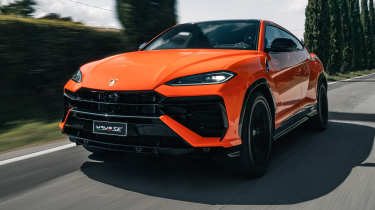
Revuelto, Temerario, Urus SE – yes, the full Lamborghini lineup is electrified. We found the original Urus to be a bit rough around the edges, and not in the endearing, charming, ‘Lamborghini’ way. The Urus SE, which on top of being easier on the eye, brings hybridisation for 789bhp, electric-only driving capability and a handy helping of sophistication.
Thanks to its 25.9kWh battery and 37 miles of claimed electric range, it boasts impressive versatility that even Ferrari Purosangue buyers will be envious of when sitting with that V12 chuntering away in traffic. Is it the most charming or engaging of its ilk? That’s where the Purosangue and the Aston Martin DBX707 claw back some ground but there’s no doubting the real world appeal of the Lambo. Is that a sentence that’s ever been written before?
‘Whereas track-focused Corsa goes for neutrality, Sport is designed for fun. A spring immediately enters the car’s step and it doesn’t take much provocation for its rear axle to play a lead role out of roundabouts and tighter corners. Nothing too antisocial, just a giddy, up on its toes sensation that – given the space to play – will goad you on to drive yet harder to unlock more of its dynamism.’ – Stephen Dobie, contributing writer, who drove the Urus SE on the launch event.
Alternatives to the Lamborghini Urus SE
The £208k you’ll pay for a Urus SE won’t get you in the same ballpark as that other Italian super-SUV, the Ferrari Purosangue (which starts in the £300k range), but platform-mates like the Bentley Bentayga are an option – though hybrid versions of the Bentayga are V6 rather than V8-based, so there’s no direct equivalent there. The Cayenne Turbo E-Hybrid gets closer (making 729bhp and costing £140,600), but as a wildcard, how about the £130k, 893bhp Lotus Eletre 900 Sport?
Mercedes-AMG GT 63 E-Performance
- Prices from £187,590
- Pros – Staggering performance, impressive tech
- Cons – Hefty kerb weight, hefty price tag
- 4 stars
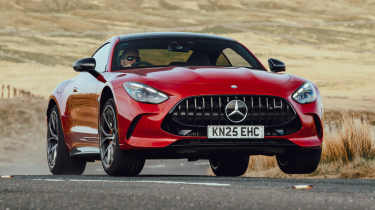
The Mercedes-AMG GT 63 S E Performance puts out some huge numbers, almost as extensive as its name. How about 0-62mph in a scant 2.8sec – that’s faster than the AMG One hypercar. Or a top speed of 199mph? Perhaps less impressive is a kerb weight of 2120kg, and this is a two-door coupe remember. We can’t really single out the AMG though as the vast majority of machines in this list are equally porky, thanks to their hybrid powertrains. If you’re going to have a battery pack large enough to add significant performance it’s going to add to the car’s waistline.
The AMG’s V8 already produces significant numbers – around 600bhp – but add a 200bhp electric motor and there’s a combined output of 805bhp and 1047lb ft of torque. Less impressive is an electric range of just eight miles. It’s a handsome and purposeful machine though with more than a hint of another Stuttgart-based manufacturer’s sports car around its rear haunches. It sits on 21-inch alloys hiding some monster carbon-ceramic brakes and while it is heavy and wide it is a surprisingly willing car, but one with more GT credentials than sports car.
‘The way the GT piles on speed well into three figures is unreal. I imagine it hits its top speed of 199mph (320kph) like most cars hit the rev-limiter in second gear. At monster speeds it feels rock-solid, relaxed almost, and the sight of its aggressive front end in the mirror clears the outside lane effectively too. This feels very much like the hybrid GT’s natural habitat.’ – John Barker, Editor-at-Large, who drove the AMG GT 63 E-Performance on the launch in Germany
Alternatives to the Mercedes-AMG GT 63 S E Performance
If you’ve no great desire for the E Performance’s full 805bhp then you can save around £17k and get the regular 577bhp AMG GT 63 instead, or pocket a further six grand by going for Premium rather than Premium Plus trim. Only you can say whether you’ll regret not getting to 62mph 0.4 seconds quicker. Otherwise, our temptation would be to knock on Porsche’s door: The AMG’s £186k price tag gets you a GT3 Touring and some choice options, and with that as the alternative it's easy to lose interest in the hybrid guff...
Lamborghini Revuelto
- Prices from £454k
- Pros – Design, performance, V12, balance and dynamics
- Cons – Noisy at a cruise
- 5 stars
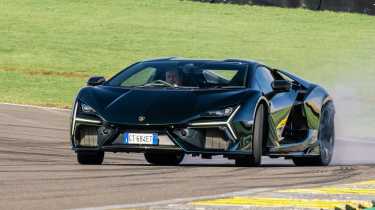
We were tempted to leave the Revuelto out here, not because it isn’t an excellent car. Because it is an excellent car. But because it’s not dominated or defined by its hybridisation. The electric stuff just happens to be there, as a better solution to powering the front wheels than what came before. In a way that makes it one of the very best hybrids – an exercise in seamless integration.
The thing is though, when you’re actually using it, the hybrid stuff comes into it a lot. It’s just so usable, from being able to trundle off your driveway in EV mode without using the V12 to start a neighbourhood coup, to saving the V12 a long hot idle when trundling in traffic. Absurdly, the practicalities of hybrid power are never more evident or appreciable, than when in this mid-engined V12 supercar. It’s a model for how the sorts of cars we love can and should live on, with personality-laden naturally-aspirated engines and electrical augmentation to make them emissions compliant and fill out the power band.
‘Unsurprisingly, when judged objectively the Revuelto is a far better car than its predecessors. Faster yes, but also blessed with far greater bandwidth, more deployable performance and a chassis that is no longer overshadowed by its powertrain. That it also shoulders its social and environmental responsibilities is no less commendable, especially as the new V12 means there’s minimal dilution of the time-honoured drama we expect from Lamborghini.’ – Richard Meaden, evo editor-at-large, who tested the Revuelto on the road and on track.
Alternatives to the Lamborghini Revuelto
Conventional wisdom says fellow V12s, the Aston Martin Vanquish and Ferrari 12 Cilindri, are its closest competitors. But they don’t share the Revuelto’s hybrid versatility. The Aston Martin Valhalla hypercar will when it arrives, while the McLaren Artura and Ferrari 296 GTB and Speciale do now.